

Shady Forest Park deal
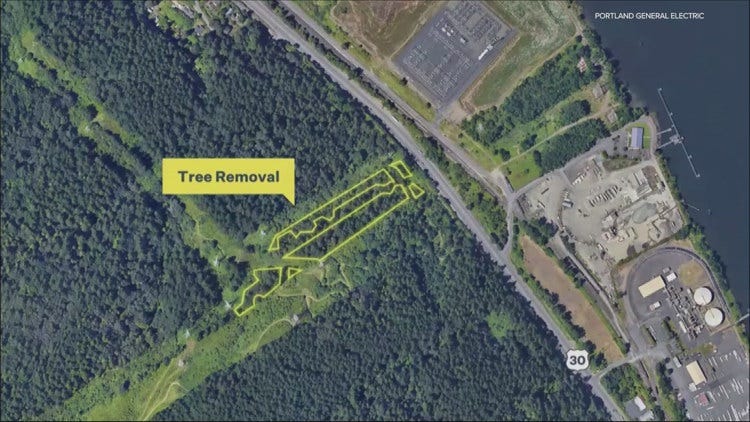
After Portlanders registered their strong opposition to a PGE plan to destroy a major section of Forest Park, here come the axes. And the cuts won’t just be felt in Forest Park and the killing of some of the last remaining old growth trees in the city, but in Portlanders’ trust in their leadership to live up to their word and stand up for what’s in the best interest of the public.
In a disgusting display of political gamesmanship, a backroom deal was cut by the city that gives PGE the right to raze 5 acres of the park — even after the City Council voted the proposal down last year.
With this action, Portland officials have proven where their loyalties lie, and it’s not with their citizens. Knowing the strong opposition from the public, City Council and leading environmental groups, Portland City Administrator Raymond Lee signed the mediated settlement in secret with PGE anyway. City councilors Mitch Green and Steve Novick participated in the confidential mediation process.
What a blatant disregard of public process and trust. And it won’t stop here. Now that the city has signed over 5 acres of sensitive Forest Park habitat for development, PGE plans to confiscate and destroy another 15 acres in Forest Park.
Portland residents are frustrated by city officials who are actively working against their interests. Portland once attracted outdoor recreation and athletic companies based on its environmental leadership. Now, with the city’s willingness to sacrifice places like Forest Park, it’s clear the green edge Portland once had can be bought and sold off for short-term gain.
This deal puts Forest Park and surrounding neighborhoods at risk for increased wildfires.
By disregarding things that make Portland desirable and set it apart, city officials have signaled that public priorities be damned in favor of private interests.
Darcie Meihoff
Past president, Forest Park Conservancy
Despicable vitriol
How I wish I did not have to encounter the reactionary, solipsistic NW Examiner in my mailbox every month. While I found Mr. Classen’s obsession with the Food Front Coop tedious, it was preferable to the despicable vitriol consistently directed at the unhoused.
This time, Mr. Classen (the Examiner is less a newspaper than it is a personal blog on newsprint, with Classen writing almost all the “articles” himself) has taken to spurious attacks, including a borderline doxxing against Michael Gilbert, whom he describes in comically ominous language, all in the service of his larger, ceaseless campaign to demonize the least-fortunate members of our society.
Couching his allegations in conjecture and the interrogative form (kudos to his attorney), Classen all but avers that Gilbert is “financ[ing]” and “orchestrating” attacks on Portland residents by “street hooligans,” and then pouts that Gilbert has not responded to his phone calls.
Also, there is no acknowledgement that the Examiner has previously given an award to the Stadiumhood group championed in the article, but who cares about journalistic standards? The “Portland’s Paradox” op-ed gives away Classen’s game, which was never in doubt anyway, as he advocates for the elimination of social services with the hope that it will make homeless people disappear from his line of sight.
Of course, this seems to be the baseline position of many: “I don’t do anything productive to alleviate the condition of the homeless; my proposed solution is for ‘those people’ to go somewhere else.”
This heartless crowd has now gotten the shelter closures it wanted, and it’s gotten the county ordinance it wanted. So, what is this group going to do now to actually address issues of affordable housing, access to healthcare and employment that provides livable wages?
Allen Duarte
NW Lovejoy Street
Transit loops are key
The term paradox—a seemingly absurd statement that proves to be well-founded—does not make a fair comparison between “induced demand” where road building worsens traffic and efforts to address our homeless crisis [“Portland’s paradox,” July 2026]. The two issues are almost entirely unrelated.
What they do have in common is housing. Freeway expansion began in earnest in the 1950s while building single-family homes in sprawling suburbs. More than freeway expansion, suburban housing development induced cross-country commuting and other travel demand that can only be met by driving.
As for public transit, both rail and bus “commute” systems likewise create an overwhelming demand for rush hour commuting that they cannot handle, the overflow always falling to automobiles. Light rail, however, can be considered an “anti-commute” system because MAX train sets run 18 hours a day in both directions, inducing demand to fill their seats in the reverse commute direction, whereby local travel serves infill, mixed-use transit-oriented development that suburban housing sorely lacks.
Since the 1980s, I have promoted a transit system design dubbed “loop oriented transit intermodal.” A single LOTI loop can usually direct transit-oriented development to integrate bus routes to MAX lines for reliably convenient transfers. In sum, two convenient transfers make a more effective transit system than those with one inconvenient transfer.
Art Lewellan
NW Ninth Ave.
I may be the victim of mistaken identity. I believe JW is referring to letter-writer Allen Duarte.
We print all letters submitted for publication if they pertain to our area of the city or something covered in the paper. We do not screen them for alignment with our editorial positions.
Wow, Allen - you have really got your panties in a bunch over Allen Clausen's journalism. Luckily, I have a simple solution for you. Don't read the Northwest Examiner! See, its really simple! I assume that most readers, like me, really enjoy reading Allen's journalism and benefit from his perspective on things. I even donate to his foundation, to support his work. Noone has a gun to your head, so just stop doing something that brings you so much anguish! The paper will di just fine without you.