



The cluster of masked hoodlums seen on video taunting Michelle Milla at her front gate the night of Sept. 13, 2024, did not happen along randomly. A masked stranger had earlier looked up at the security camera mounted on her house on Northwest 19th Avenue and said, “Hi Michelle.”
They knew who she was and where she lived. Perhaps more disturbingly, she knew what they had against her.
Before reaching her gate and safety, Milla and her friend Pete Colt were walking near her home when about 12-15 masked people boxed them in, front and back. They moved faster to no avail.
“They chased us block to block to Everett, calling out, ‘You gotta run … Where are the rest of your friends?’”
She and Colt finally found refuge in the King’s Hookah Lounge just a half block from her house. They called the Portland Police, which sent two officers to escort them.
Colt, a street savvy protector of this area for decades, told her he had never encountered anything like it before. Nor had she.
As police officers let her off at her gate, her tormenters had the final chilling words: “Goodnight, Michelle.” “Sleep well.”
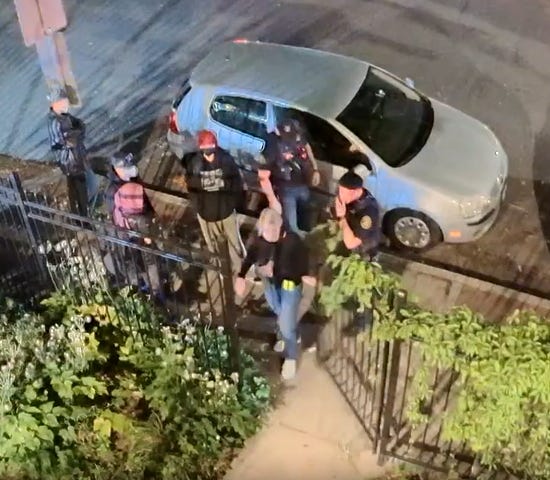
After their intimidating performance, the band regrouped nearby, where another camera caught their debriefing. The now-unmasked young marauders were greeted by a middle-aged man, who gave high-fives and hugs.
That gray-haired man supporting and perhaps orchestrating the action was Michael Gilbert, who, according to a since-deleted LinkedIn page, is a senior lead scientist at Booz Allen Hamilton, a major provider of cybersecurity services to the U.S. Security and Exchange Commission. The page also described Gilbert as a “public health technologist.”
What business did Gilbert have with street hooligans? The cheerleader may also be their financier. The Friday night drug paraphernalia handouts at Northwest 19th and Couch streets were started in 2015 by Portland People’s Outreach Project, an unregistered entity whose website touts the radical philosophy that everyone has the right to choose what they put into their bodies without social judgment or sanction. The project was launched by nurses bringing supplies on their bicycles, but things ramped up in 2023 when the group got a van, a clean new stretch model registered to Michael Gilbert.
PPOP’s 19th and Couch location put it on a collision course with Milla, who moved there with her husband in 2023 and began documenting the patterns eating away at their safety and “quiet enjoyment” of their home. She and neighbors formed Stadiumhood Neighbors the next year. They took photos and videos, held counter demonstrations in which they stood together in vigils by the tables where supplies and snacks were handed out. Eventually the news media took interest, especially KPTV, which broadcast its own investigations and even-more revealing videos.
Stadiumhood invited elected officials to walk with them through their neighborhood and see for themselves. That led to proposed state legislation to regulate mobile “harm reduction” supplies near schools. Multnomah County just adopted its own ordinance as a stopgap measure awaiting possible state action in 2027.
None of this could be pleasing to Gilbert, who is not a recent convert to the libertarian approach to illicit drug use. He was involved with a harm reduction campus organization as a student at Harvard University, according to his LinkedIn page.
While PPOP describes itself as “a volunteer peer-run organization,” Gilbert, who lives in a large single-family home in Pleasant Valley in outer southeast Portland, stands apart from the people availing themselves of survival supplies.
In May, Gilbert testified at two Multnomah County hearings on a Safe School Zones ordinance that passed unanimously last month.
“My name is Michael Gilbert,” he told the commission. “I’m an epidemiologist and sometimes advisor and volunteer with Portland People’s Outreach Project, among other local public health outreach programs.
“Portland People’s Outreach Project offered a Friday night mobile syringe services site at Northwest 19th and Couch starting in 2015 … based on the prior and consistent presence of people who used drugs and the longstanding unmet need for harm reduction resources outside of brick-and-mortar business-hour services.”
At his second appearance a week later, he was pressed to refute complaints of used needles, garbage and impacts on neighbors around PPOP sites, of which there are now seven in the city.
“I think the association between the operation of that program and the presence of drug litter is spurious,” he testified, “and if the presence of drug litter persists, despite our absence for more than a year [from 19th and Couch streets], this further strains the assertion.”
County Commissioner Julie Brim-Edwards asked why banning needle handouts within 1,000 feet of schools would be unreasonable.
“I think it’s an arbitrary distance, based on a tenuous, if not completely spurious assertion that the presence of a mobile syringe program increases the presence of drug litter or the prevalence of public drug use,” Gilbert replied.
That assertion set off even County Commissioner Meghan Moyer, a staunch supporter of harm reduction in general.
“I think it is profoundly naive to try to say that by having a needle distribution site we in no way contribute to people openly using drugs in the vicinity,” Moyer said. “Of course they do.
“My child went to MLC [Metropolitan Learning Center],” she continued. “I don’t think anybody who was around Couch Park over the last decade didn’t know what an absolutely serious situation that was.”
Gilbert was left to blame something else for the drug litter.
“I would like there to be fewer discarded syringes in the neighborhood. I would also like the prevalence of HIV and hep C to be lower, so that any needle sticks that do occur from the needles that persist in the neighborhood are less likely to harm any child who should encounter them. So, if you want to reduce the risk of harm related to drug litter, we should reduce the prevalence of hep C and HIV,” he said.

Talia Giardini also testified at that meeting. Giardini is a nurse and a recovering substance abuser.
“PPOP does paraphernalia distribution,” and does not provide health care, she said. “PPOP isn’t known for following rules or respecting community. They are known for intimidating the public, including myself and people in this room. Last week, I was harassed by PPOP right outside this boardroom for using my free speech.”
Giardini was referring to an incident recorded on a Multnomah County security camera. After leaving the May 21 board meeting, she said Gilbert stepped in front of her and called her a liar. She responded in kind, and soon the head of building security hurried to intervene.
“He [Gilbert] was in her face,” said a Stadiumhood member. “He was very aggressive.”
We left messages with Gilbert to explain his side of things, including the suspicion that he orchestrated harassment of Milla, but got no reply. We are particularly interested in how he connects his role as an epidemiologist to supplying paraphernalia to sufferers of the drug epidemic. Could PPOP be his laboratory for testing his theories?
Gilbert did not return our phone messages.
As for the harm imparted on communities by the untethered practice of harm reduction, Milla bears the scars. She told the Examiner that she had largely shut down her reaction to the 2024 incident when she was chased by a PPOP throng in her neighborhood.
“I’ve sort of not tried to process that, but I felt it all coming back when I saw Mike Gilbert. I really had to work up the courage to testify knowing he would be in the room,” she said.
After going through the proper steps, seeking to meet with PPOP representatives and find compromise through proper channels, she ran into “violent intent. … It feels terrible. It still feels terrible.”
“It’s not something a resident should be knocked up against.”
Quiet Enjoyment
The phrase Michelle Milla reached for was "quiet enjoyment." It's a term of art, the covenant every homeowner and tenant is supposed to be able to count on, the baseline promise that your home is a place you actually get to live in. She used it to describe the thing that has been taken from her on Northwest 19th Avenue. Sit with that for a second: a Portland woman now has to invoke property law to describe the modest ambition of walking home without a masked crowd chasing her block to block.
Here is what a decade of harm-reduction absolutism has produced on that stretch of Northwest. A resident bought a house. She organized her neighbors, filmed what she saw, invited elected officials to come look with their own eyes, and asked, through every proper channel, in the way civics is supposed to work, that the Friday paraphernalia handouts move away from the grade school and the park. What she got back was fifteen masked people boxing her in on the sidewalk, taunting her by name, and waiting at her gate to wish her a good night's sleep. And when the police escort finally peeled off, the man who greeted the unmasked crew afterward with hugs and high-fives was not some street kid. He was a senior scientist with a big federal contractor and a Harvard line on his résumé, the registered owner of the van, the epidemiologist who would show up weeks later to lecture the County Commission that any link between the syringe operation and the syringes in the gutter was "spurious."
Somewhere in the last ten years, this movement quietly decided that the person with rights on that sidewalk was not Milla. It was the person she was being told to tolerate. That is the inversion at the center of all of this, and it is worth naming plainly, because the movement's own literature names it for us. Portland People's Outreach Project's stated creed is that everyone has the right to put whatever they choose into their body without social judgment or sanction. Read that again. Not without arrest, without judgment. The demand is not merely legal tolerance; it is that the rest of us surrender the right to think that a man dying by degrees on a public sidewalk, in front of children walking to school, is a tragedy rather than a lifestyle. Those of us who have watched what addiction actually does to a person, or done the work of climbing out of it, are told our moral reaction to it is the thing that needs correcting.
Grant the entire public-health case for the sake of argument. Grant that syringe access reduces the transmission of HIV and hepatitis C; the evidence for that is real and I won't pretend otherwise. None of it, not one study, not one saved life, requires siting the tables a few hundred feet from Metropolitan Learning Center. None of it requires opposing a 1,000-foot school buffer as "arbitrary." None of it requires that when a neighbor documents used needles at the entrance to a rec center, the credentialed answer is that the litter would be less dangerous if only we drove the disease rates down first. That is not public health. That is a pirate operation that has accepted that children will encounter the needles and is offering, as consolation, that the needles will be cleaner. The most damning verdict on that logic didn't come from a NIMBY. It came from Commissioner Meghan Moyer, a harm-reduction supporter whose own child went to MLC, who called the pretense that a distribution site does nothing to draw open drug use exactly what it is: naive to the point of insult.
That is the tell. When even your allies on the commission have to publicly correct you, you are no longer running a health program. You are running an ideology, and the neighborhood is the lab.
The residents of Stadiumhood are not anti-poor, and they are not anti-recovery. They are the opposite. Milla did the patient, unglamorous, deeply civic thing, the meetings, the vigils, the requests for compromise, and was met with what she accurately calls violent intent. The nurse who testified against the group, herself in recovery, was cornered outside the boardroom and called a liar to her face on a county security camera. These are not the tactics of people trying to keep the vulnerable alive. They are the tactics of people who have decided their neighbors are the enemy, and who have found, in the language of compassion, a permission structure for cruelty.
Portland spent a decade being told that asking for a livable block made you the villain of the story. A lot of us are done accepting the casting. You can care about the man on the sidewalk and still believe the woman who lives there is entitled to the quiet enjoyment of her own front gate. The movement that can no longer tell those two things apart has lost the plot, and it should stop being surprised that the neighborhood noticed.
Thank you for your reporting. This is multiple levels of disturbing.