


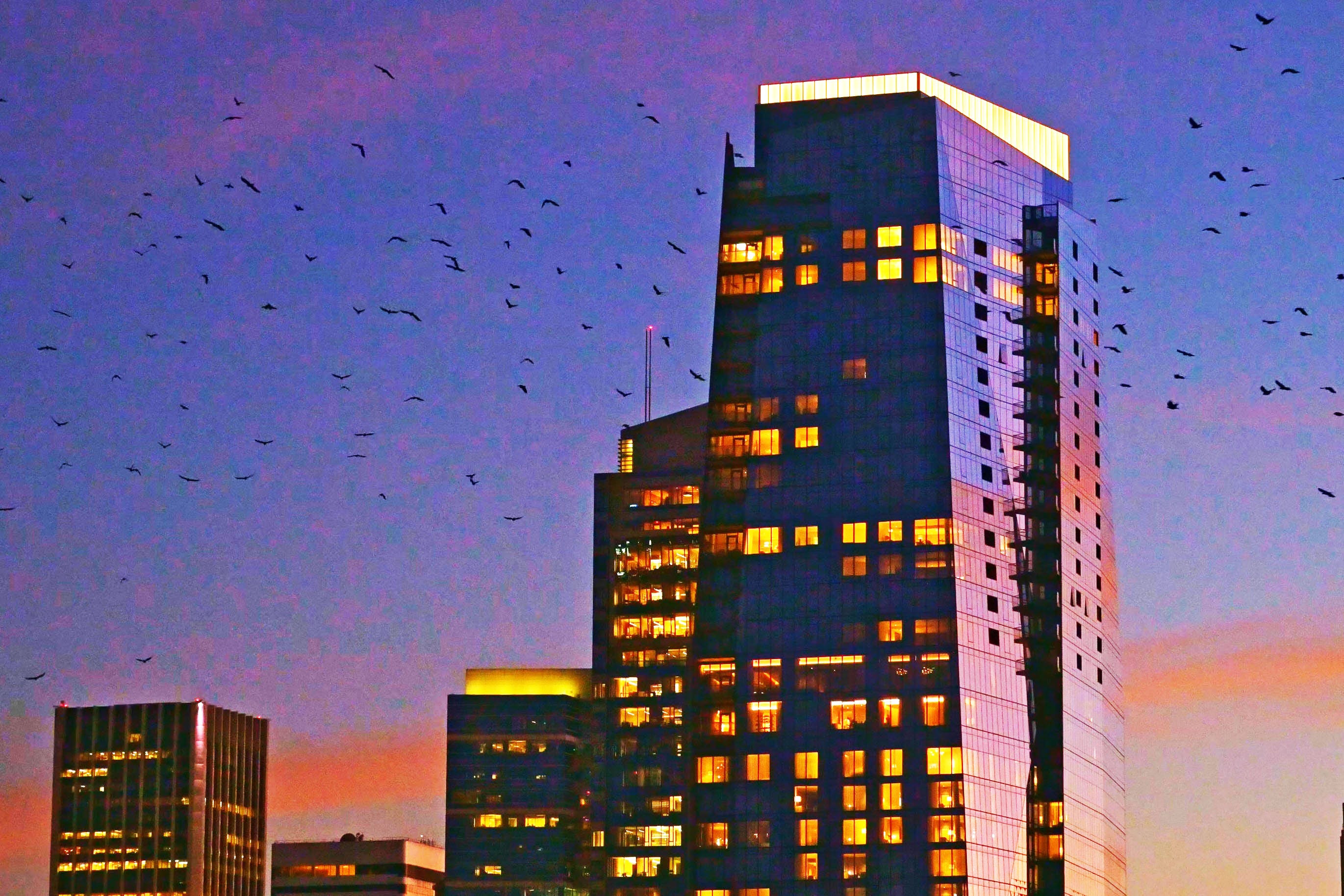
Pearl District neighbors raised funds this year to encourage crows to roost elsewhere. The nonprofit Northwest Community Conservancy paid a private company $24,000 to carry out an abatement program.
Downtown Portland Clean & Safe has employed the same company, Integrated Avian Solutions, to provide the same service since 2017.
It’s a continuous battle each roosting season. Falconers walk around with hawks at dusk to influence the crows to move on. Without a steady influence, the crows return.
Is it worth the cost and effort?
NWCC’s Executive Director Chase McPherson told the NW Examiner that the program has helped. Crows were pecking at HVACs, damaging roof insulation and leaving a significant amount of droppings, he said.
Crows are a protected species, and they have a right to be here, said Kort Clayton, the owner of IAS who is a master falconer.
“We can’t just kill them off because we don’t like them messing up the streets and in the city, so they’re here,” he said. “They’re here to stay, and they need a place to sleep.”
It’s an expensive endeavor. But the alternative is letting the crows roost wherever they choose, which inconveniences humans. There aren’t many safe ways to remove the birds from an area. Besides hazing, the options for dealing with large crow roosts are to tolerate them or try reducing human food subsidies and outdoor lighting, according to the Bird Alliance of Oregon.
Crows are attracted to the messiness of cities, allowing them to easily find food and take advantage of unnatural light, said Brodie Cass Talbott, the adult engagement manager at the Bird Alliance of Oregon. When finding a new place to roost, the crows also need a place with enough trees to fit 20,000 birds.
Most of the Portland crows are hatched in the city and will spend their whole lives in it, Cass Talbott said. When they are displaced from one neighborhood, they will find another area of the city. The best way to coexist is finding a place for the crows that is least impactful to humans, Talbott said.
Hawk-based abatement, which the Bird Alliance of Oregon finds acceptable, involves a hawk following a falconer up and down the street, landing on awnings, light posts and other structures. When crows see these hawks at night, the majority get uncomfortable enough to leave the area, said Clayton.
Ushering the crows away works in the moment. Crows don’t question the predator in front of them, so they will move several blocks away. The goal of IAS is to follow up and push them fully out of the area, Clayton said. These programs are need-based. Depending on how much pressure the crows in an area need to leave, falconers can be out in an area between three and five nights a week.
“It’s an ongoing dynamic,” Clayton said. “They don’t ever really abandon the idea of coming back into the district. But they’re very cautious about it, and their numbers are diminished.”
The hawk program isn’t expected to eliminate the problem, it’s designed to manage it when it happens, Clayton said.
Crows roost to stay warm during the cold months, to stay safe from predators and to communicate, Cass Talbott said. They congregate to learn about one another — such as where others are going to get food — and to find a mate.
Since 2017, when IAS began working on crow abatement downtown, the problem has only grown, said Clayton. Some have concentrated on the waterfront.
“There’s some connectivity there with crows that are building up in other places and kind of filtering into the Pearl District,” Clayton said.
It’s unlikely the birds will abandon urban areas.
Crows are intelligent. They learn what it feels like to be pressured by a raptor, they learn that they keep getting hazed in certain areas, and they learn, more or less, to stay away from those places, Clayton said. If they don’t stay away, reminding them is somewhat simple. It’s like reinforcing a boundary that keeps being tested, he said.
“I’ve had instances where, when my vehicle pulls up, and I open the door, they recognize it’s either me, or it’s just the way the whole situation looks,” Clayton said. “And they start to leave because they just know.”
Before using the hawk-based abatement program, Downtown Portland Clean & Safe used a street sweeper, the Poop Master 6000, to clean the streets of crow feces, but the amount of feces left by the birds became unmanageable, said Sydney Mead, Downtown Portland Clean & Safe’s senior director of downtown programs.
Clean & Safe’s goal is to move them into the South Park Blocks and Tom McCall Waterfront Park.
The crow populations have increased at a rate of 1.25% nationally, close to 2% in Oregon and nearly 3% in Portland over the past several decades, according to the Bird Alliance of Oregon and Christmas Bird Counts, an annual winter bird count.
Despite the abatement program, in 2025 and this year, Downtown Portland Clean & Safe has had to do more power washing than any prior years.
“We feel like we’re barely staying ahead of it,” Mead said. “If anything, we’re like, looking at it going, ‘Wow, this is crazy.’”
“It’s a constant struggle trying to figure out how to ‘live in balance’ with urban wildlife,” Mead said.
But the presence of this native species that has been around for thousands of years is an opportunity for humans to remember they are sharing a habitat with creatures, especially native ones, Cass Talbott said.
“I think sometimes we think of … the human-made world as being this very sanitized thing,” he said. “But we are also living in wildlife habitat, and crows are a good reminder of that.”
Noting the people watching thousands of crows along the waterfront at dusk, Cass Talbott said, “It’s just kind of a spectacle, and it’s fun to remember that we do have wildlife spectacles in our backyard.”

I moved here a few years ago and live in Old Town. I love the crows. I don't notice anything particularly problematic about them. How about the homeless people whose poop I have to step over and deal with just walking around. How about the damage they are doing? Can we work out some sort of "falcon" based system for dealing with them? Perhaps wolves? Or angry badgers?
Leave them alone! They roost here because the ambient light keeps them safe from owls. They are intelligent, funny and personable….like many Portland folks!