

By Robert Miller
Last November, under a voting system Portland had never used before, a coordinated slate won seven of the 12 seats on the city's new council. The first article in this series documented the agreement behind that slate. The second followed its money. This one answers the question underneath both: how does seven of 12 actually happen?
Fair warning: the answer is dense, because it has to be. It is arithmetic, and arithmetic does not summarize. So let me do what a prosecutor does on the first morning of a long trial and tell you exactly what the evidence will show, so you can follow every exhibit knowing where it goes.
We will show you the game: a seat costs 25% of the vote plus one ballot, and every vote that a winner doesn't need moves to that voter's next choice. First choices start the count. Second choices decide it.
We will show that first place does not win: a candidate who trailed two rivals took his district's first seat, and a candidate sitting in a winning position lost his, felled not by his opponents but by his own lane's discipline concentrating on the other guy.
We will show, from the certified record of every ballot in this city, that coordinated voting was not a socialist invention: every organized lane built ladders, and the strongest single ladder in Portland belonged to the Chamber of Commerce's own coalition.
We will show that the candidates’ money was nearly even, so nobody bought these seats.
And then we will show you the one thing the evidence attributes to a single organization: ranking instructions, published on paper, working in all four districts at once, delivered by an organization that did something no other political formation in this city does. It did not go home after the election.
Do not lose hope as you read. There is a plan, and it is next week’s article.
What happened
In November 2024, Portland played a brand-new game for the first time. Ninety-eight candidates ran for 12 council seats—three seats per district—and in two districts, the ballot listed 30 names. [1] Voters ranked their choices. When the counting stopped, a slate carried by the Working Families Party's machinery held seven of the 12 seats, and six of the seven went on to form a caucus of their own naming on the council.
Six of the seven went on to form a caucus of their own naming on the council; Pirtle-Guiney never joined it, Dunphy has since formally left it, and Green says he no longer attends.
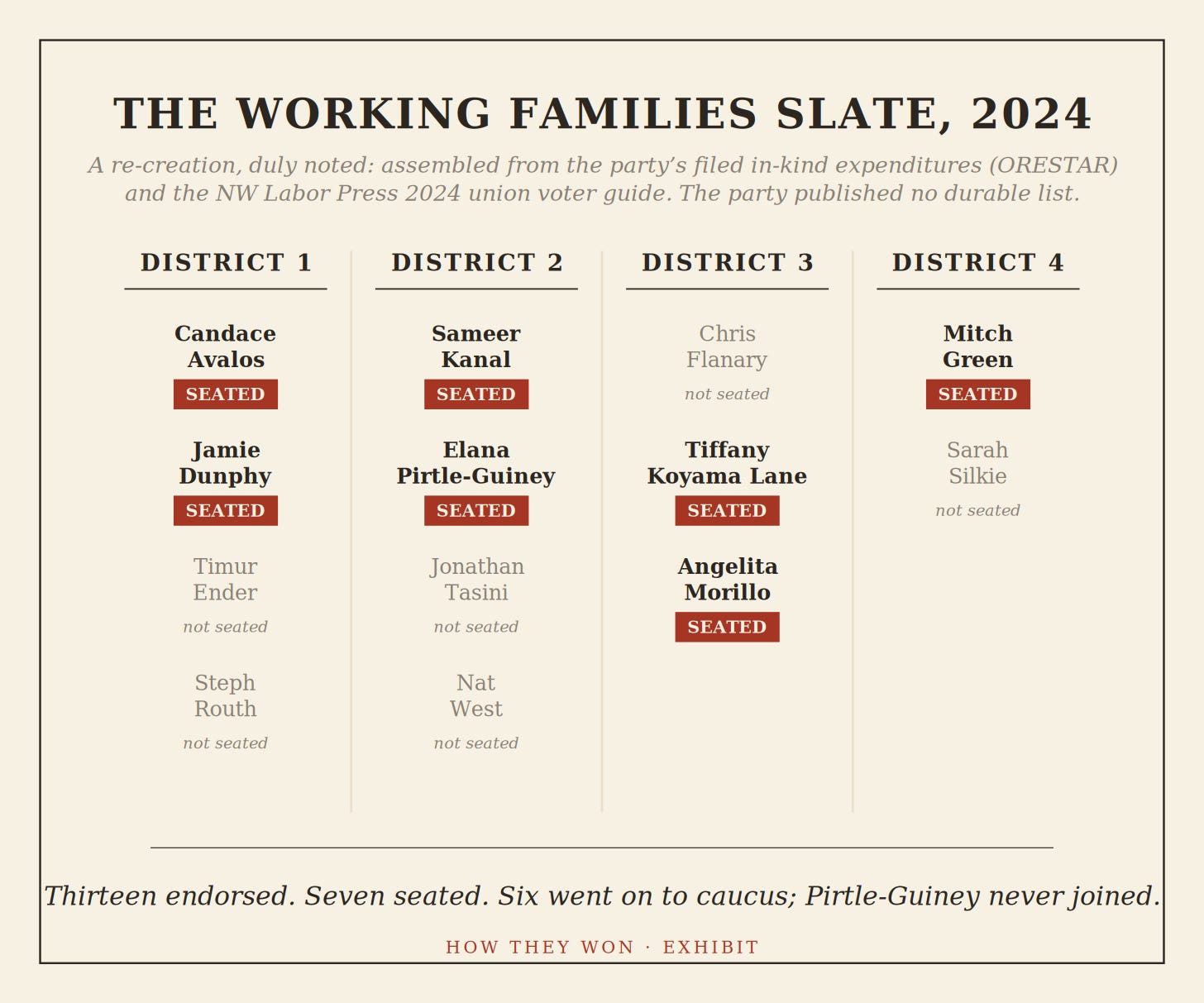
The agreement at the center of the coordination, documented in the first article of this series, was the Democratic Socialists of America's. The two organizations' lists were not identical, and the difference is instructive. Working Families endorsed all seven. The DSA's published voter guide fully endorsed only Green and Koyama Lane, green-lighted Avalos, Dunphy, Kanal and Morillo among its 23 partial endorsements, and left Pirtle-Guiney out entirely; she is also the one of the seven who never joined the caucus. [5]
Whether the two organizations coordinate with each other is a question no filed document answers; what the filings and the published guides show is that they converged on six of the same winners, share people at the top and won. The second article followed the Working Families money. This one explains the game, and, because fairness demanded it, reads every ballot in the city to find out who else was playing.
The new game
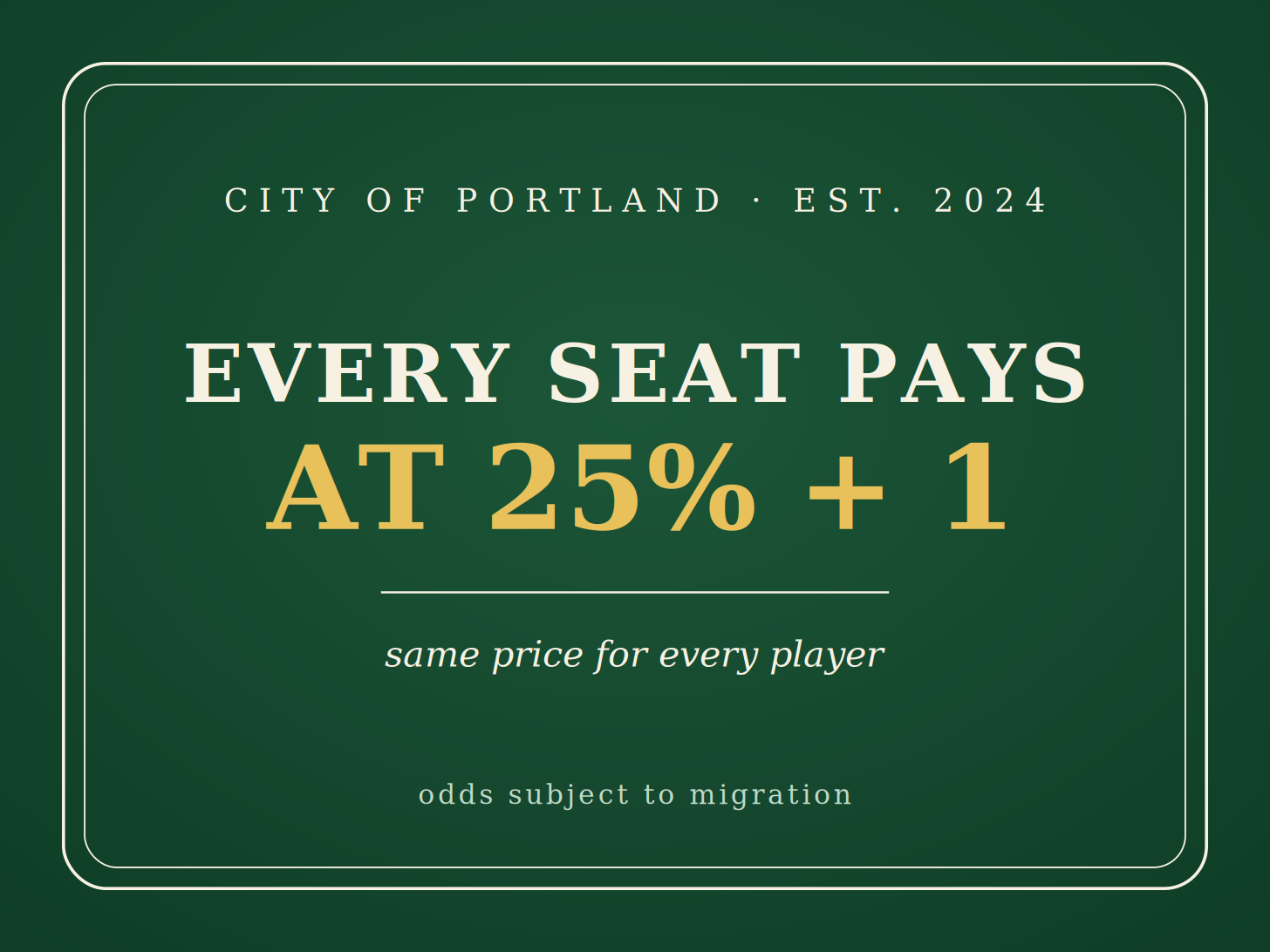
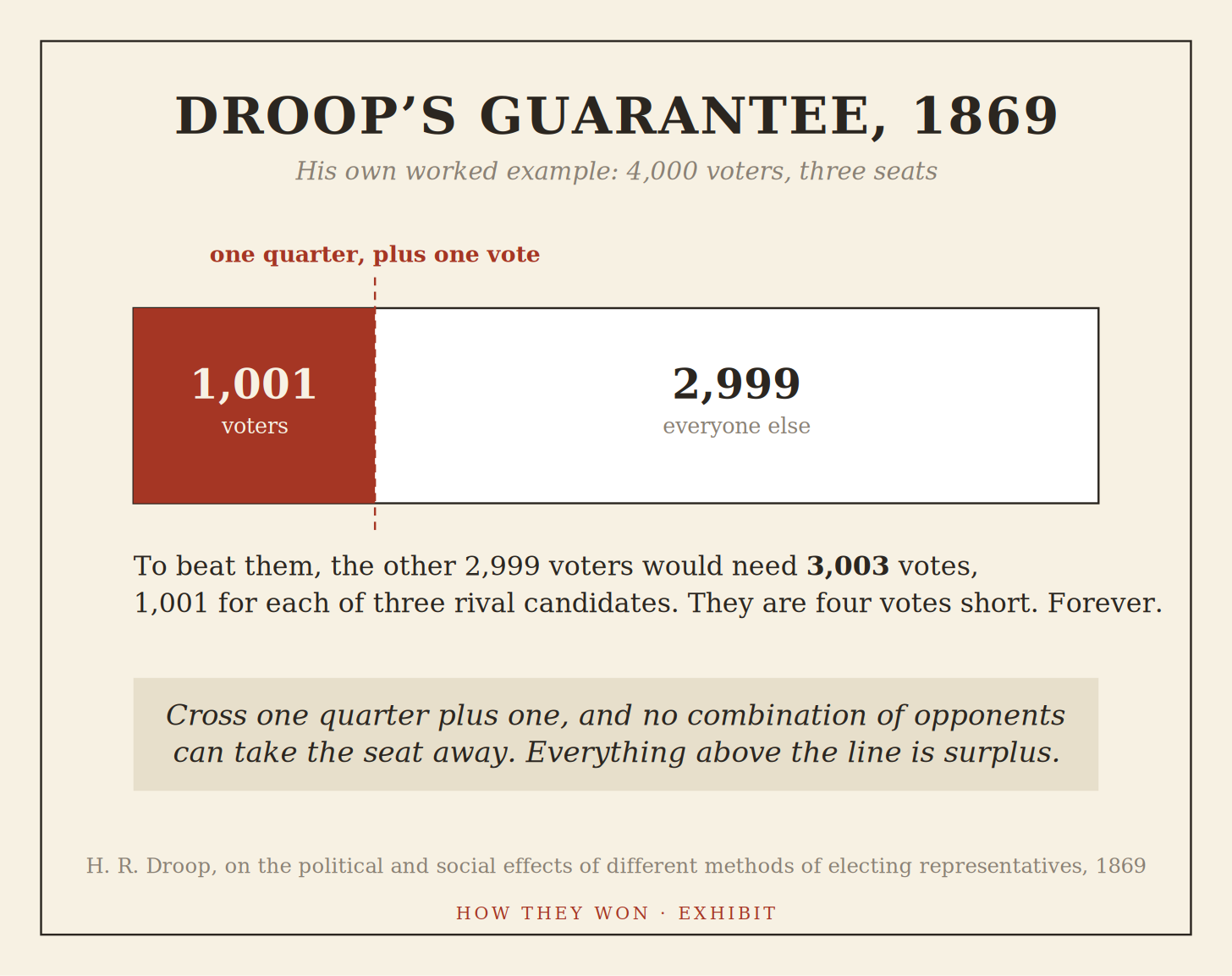
In 1868, an English barrister named Henry Droop worked out the smallest number of votes that makes a seat mathematically safe. His example: In a district of 4,000 voters electing three members, any group of 1,001 voters is guaranteed a seat; no combination of the other 2,999 can take it away. [2] One quarter plus one vote. That is the number Portland now uses: cross 25% and you are in, and everything beyond that line is surplus. The system doesn't waste surplus. It transfers it to those voters' next choices.
Strip away the politics and Droop's system is a rule from the mathematics of allocation: How to move scarce things so nothing sits stranded where it produces no return. Establish the minimum needed to complete one transaction. Stop allocating once the transaction is assured. Release the excess to the remaining demand. Repeat until the seats are filled. Droop did for votes what a competent bookmaker does for capital: once money can no longer improve one position, he stops stranding it there and puts it back to work. Honest math. But notice what it means: The count no longer ends when the first-choice votes are tallied. It ends when the transfers do.
First place doesn't mean you win
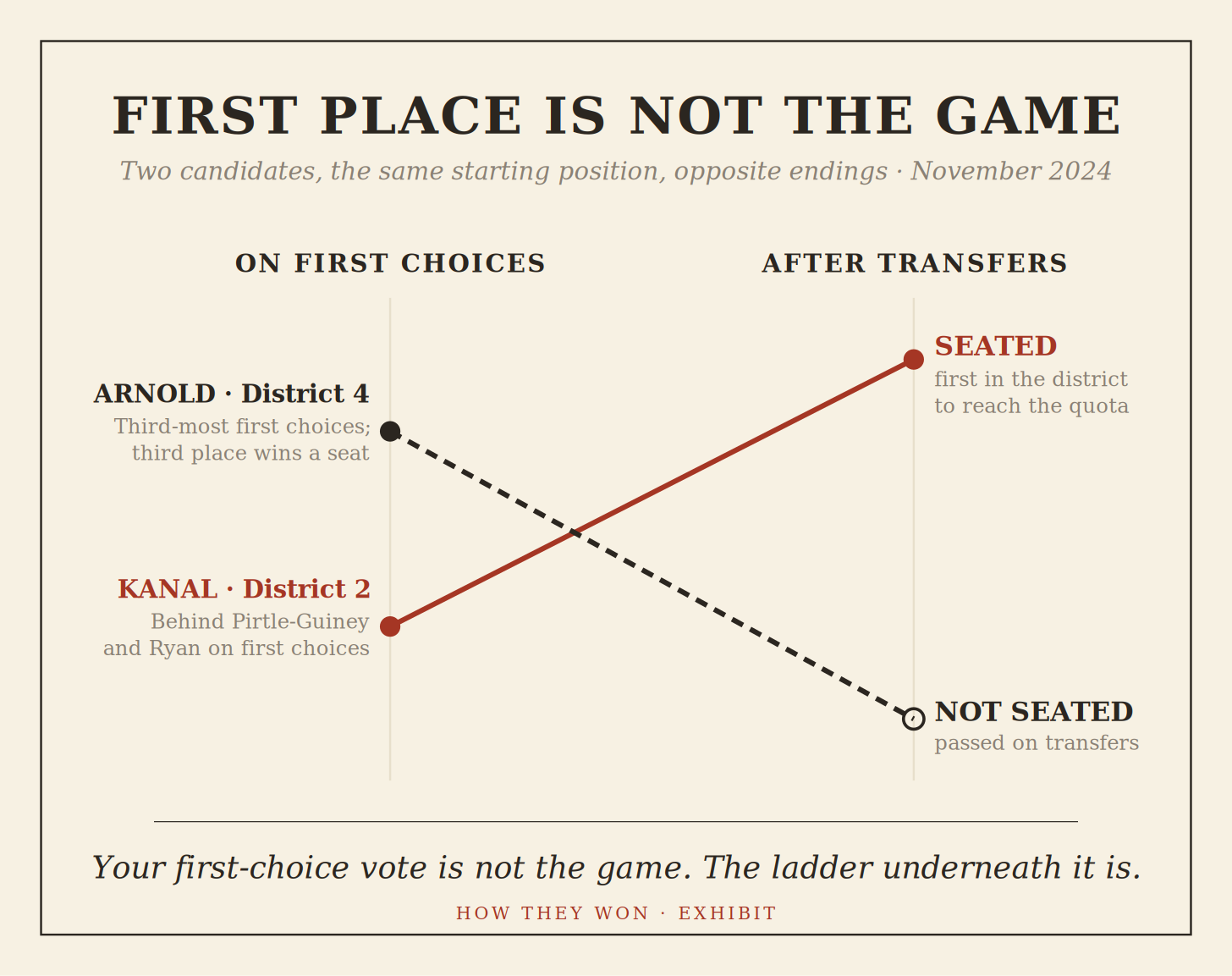
Here is the part of the 2024 results almost nobody absorbed. In District 2, fewer voters ranked Sameer Kanal first than ranked Elana Pirtle-Guiney or Dan Ryan first. Kanal took the district's first seat anyway; when other candidates were eliminated, their voters' next choices flowed to him and carried him past both. [3] In District 4, Officer Eli Arnold finished with the third-most first-choice votes, ahead of Eric Zimmerman. Third place wins a seat in this game. Arnold doesn't hold one. And the certified ballots reveal the detail that should end every lazy telling of that story: The transfers that lifted Zimmerman past him came principally from Olivia Clark's surplus, which broke 50% to Zimmerman and 10% to Arnold. [4] Arnold was not beaten by the socialists. He was beaten by his own lane's discipline, concentrated on the other guy.
Started behind two, seated first. Started in a winning position, never seated. Your first-choice vote is not the game. The ladder underneath it is.
Everybody built ladders
Before this series accuses anyone of playing the game too well, fairness requires the whole table. So, I ran one measurement, the same instrument for everyone, across the certified record of every council ballot in the city: When a voter's first choice belonged to an endorsement bloc, how often did their next choice stay inside it? [5]
Here is what the ballots say. Candidates formed pairs everywhere, and the strongest reciprocal pair in Portland was not the slate's. It was Olivia Clark and Eric Zimmerman, endorsed together by the business coalition United for Portland: half of Clark’s voters ranked Zimmerman next, and 46% of Zimmerman’s ranked Clark.
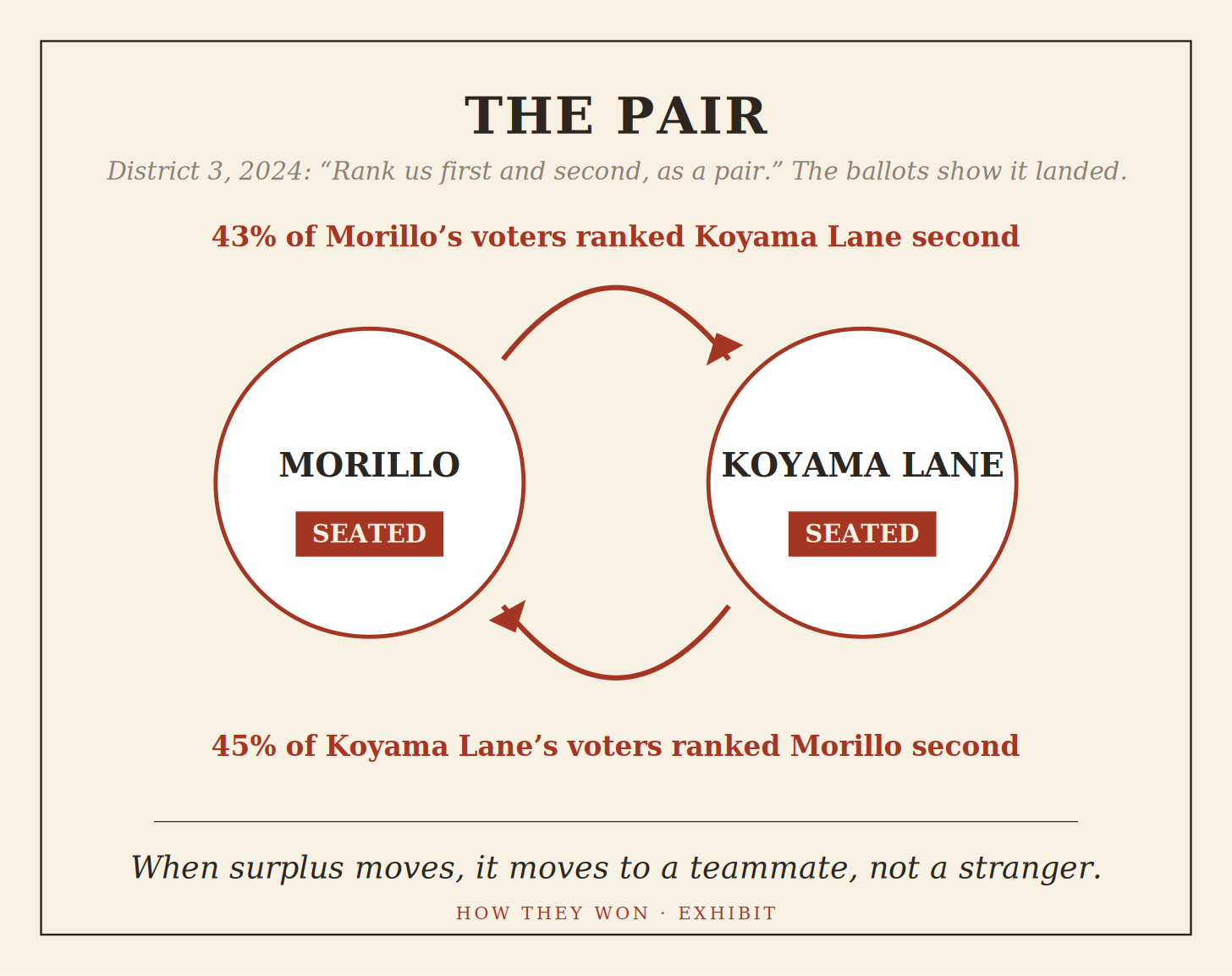
The slate's showcase pair—Tiffany Koyama Lane and Angelita Morillo, who campaigned as a pair and asked to be ranked as one—ran at 46% each way. In District 2, Sameer Kanal and Michelle DePass formed a pair across lanes at roughly 40% each way, which is the machinery of Kanal's transfer-powered seat. Measured as whole blocs, the strongest single ladder in the city belonged to United for Portland's District 4 slate, whose voters stayed inside it at more than twice the rate outsiders entered it, the strongest bloc ladder measured anywhere in the city, in any lane. [5] So no, coordinated voting was not a socialist invention, and anyone who tells you the chamber's side doesn't play has not read the ballots. I have.
Then what, exactly, was different about the slate? Reach and system. The DSA's published guide is the only instruction set in Portland whose voters laddered in all four districts at once. United for Portland's ladder was mighty in District 4, real in District 2 and absent in District 3. The labor council's worked in three districts and ran backward in the fourth. The ballots teach why: Ladders require short lists. Working Families endorsed 13 council candidates and seven won; the labor council endorsed 12 and eight won; United for Portland endorsed 27 and six won, and in the district where it endorsed 11 at once, its ladder dissolved into the crowd. [5] A guide that says rank these few, in this order, concentrates. And one correction the ballots insist on: this was not an army. Barely 1-4% of voters copied the DSA's complete guide.
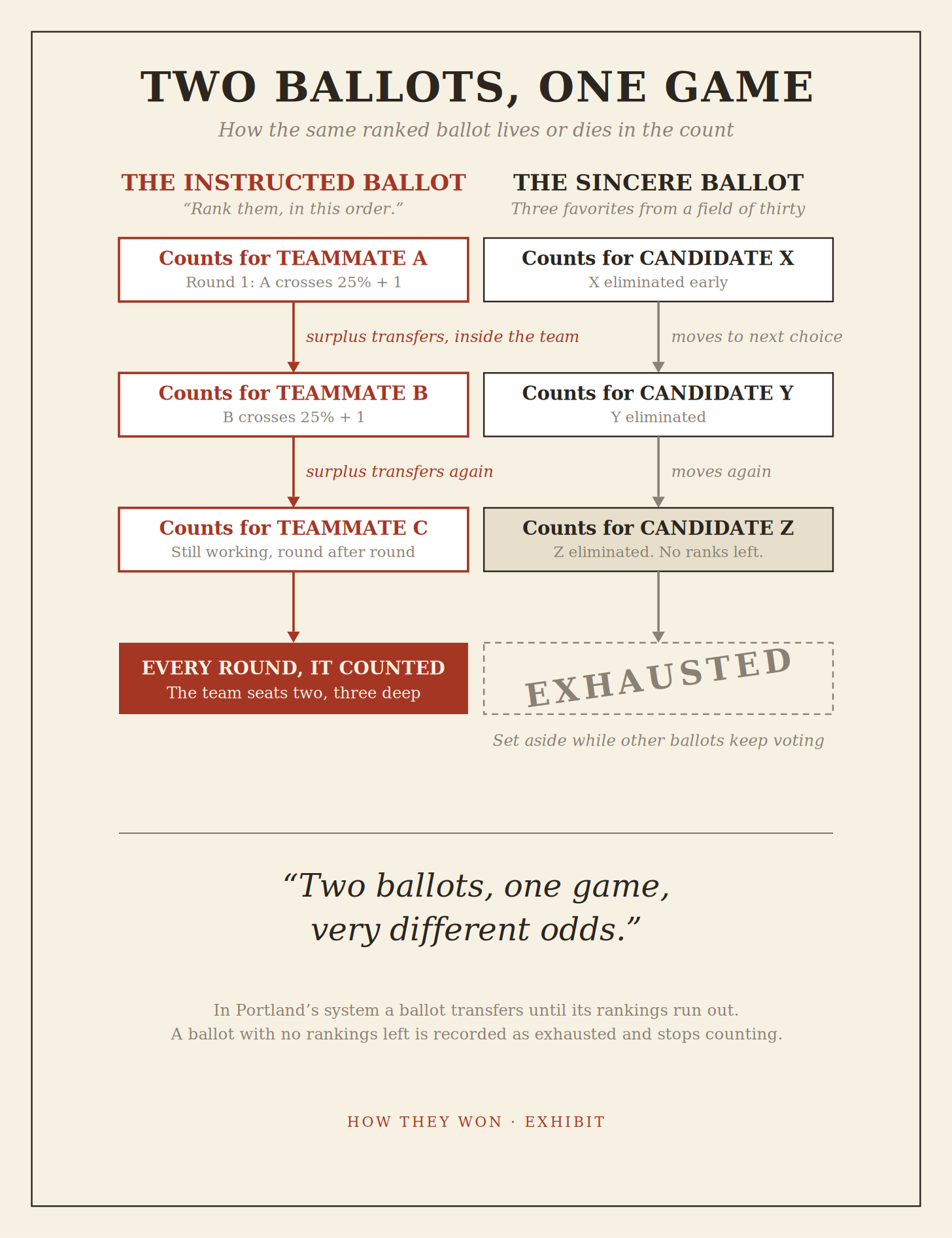
What the guide supplied was humbler and more effective, a usable ladder laid onto voters' real preferences. One organization published that instruction citywide, on paper, before the election. That is the difference, and it is a difference of system, not of kind. Underneath all of it is one mechanism. An instructed ballot climbs, round after round, landing inside its team. The ballot of a voter who walked in alone and ranked three favorites from a field of 30 can die early—set aside, exhausted—while the instructed ballots keep working. Two ballots, one game, very different odds.
The bankroll
Instructions are free to write and expensive to deliver. Getting “rank them, in this order” into tens of thousands of hands takes canvassers, phone banks and texts; the machinery behind the slate spent $96,000 on phone and text contact in the nine weeks before the election alone. The second article in this series followed all of it to the dollar. [6] To get this done, the movement behind the slate mobilized more than $1.6 million: roughly half a million through the Working Families machinery, 83 cents of every dollar arriving from Brooklyn, and $1.1 million from Portland's own public matching fund.
Mobilized, not spent. And the distinction matters: almost none of it ever touched the organization's books. And in fairness, money sat on every side of the table. The business coalition's fund raised $1.2 million the same cycle, and the candidates' own war chests were nearly even: the slate's seven committees spent about $970,000 in 2024, an average of $138,000, with the other winners close behind and a public-match gap of about 8%. [6] Nobody bought these seats. Money was everywhere. The citywide instruction was in one place. Every dollar of all of it is on file. What no filing shows is the instruction the dollars carried.
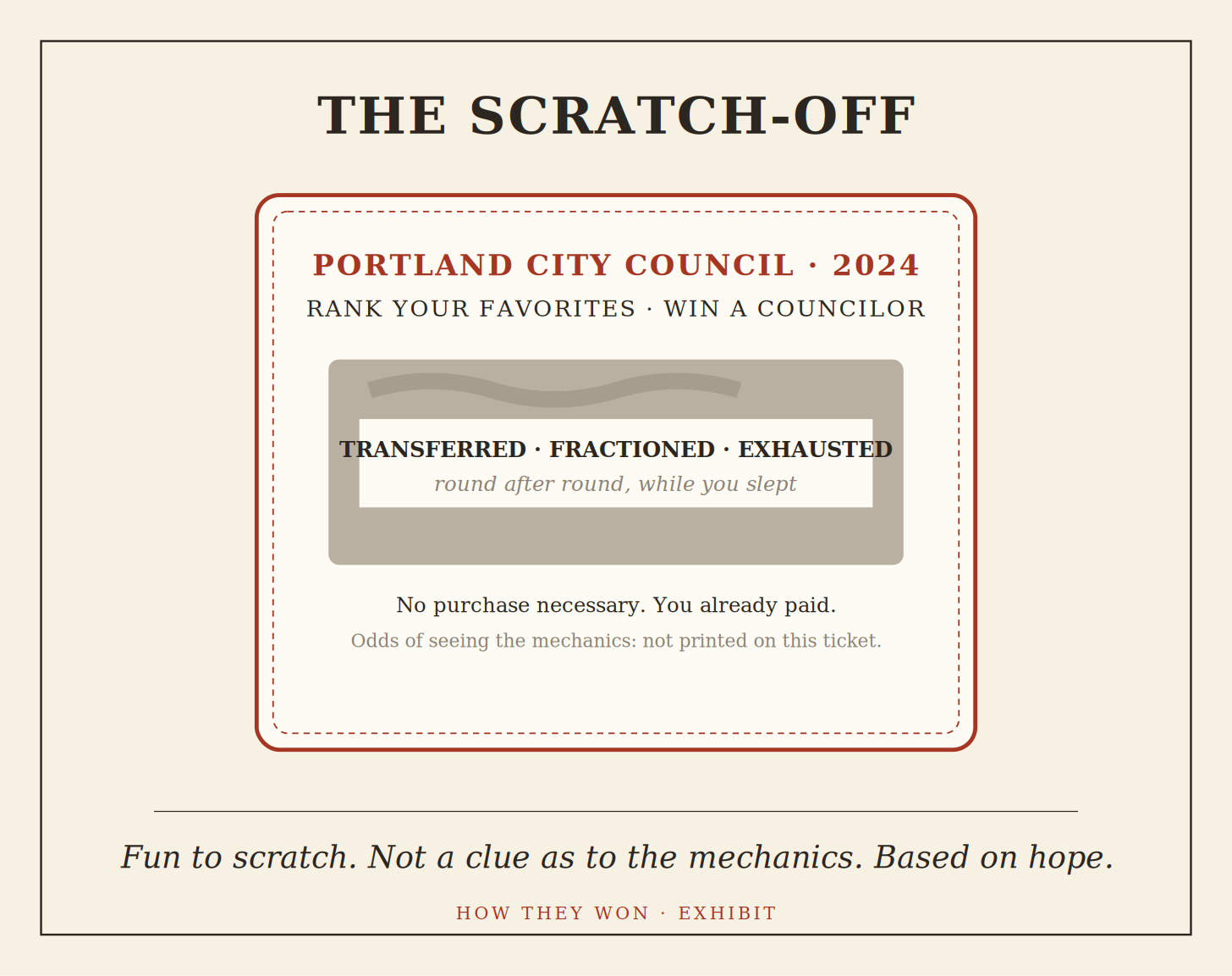
The voter cannot see any of this happen. The old system was crude but face up: one vote, count the piles, biggest piles win. Voting in Portland now is like buying a scratch-off lottery ticket. It is fun to scratch. It offers not a clue as to the mechanics. And it is based on hope.
The casino
I spent five decades in the gaming industry, so permit me a short translation. You can beat the house. Coordination is required. It is not allowed in casinos. That is why they have cameras. And in gambling, bettors don't trust the house. They trust the game, because the game is regulated, and the entire purpose of regulation is that the odds printed on the felt do not migrate. Portland's felt says 25% plus one, same price for every player. But teams that transfer surplus internally while solo ballots exhaust are not paying the printed price. In 2024 several tables had teams. The count was honest. The odds migrated anyway, at every table, in whichever direction the local team leaned. And Portland employs no one whose job is to notice.
Droop's ghost
One last thing about the barrister. Droop knew that parties could win transfer games through vote management; he wrote down what it cost them: “an expensive organization and strict party discipline.” [7] His system was designed to make that machinery unnecessary, so ordinary voters wouldn't need a party to avoid wasting their votes. The 2024 ballots now show, clearly, that money can buy the first half of Droop's price and cannot buy the second. The business coalition's $1.2 million bought the most effective ladder in the city, in one district, for one night. Discipline is supplied by members, not vendors.
The machine
Here is the defining lesson of 2024, and it explains everything the exhibits showed. When the chamber, the good-government groups and the business class come together, it is a debutante ball. Committees, catering, flowers, a band, a triumphant night of it. And then it is over, and everyone goes back to their world, because their world is somewhere else: a company, a practice, a payroll. Politics, for them, is an evening they attend. This is not a failure of principle. The chamber has principles, and so do the churches and the good government leagues. What they lack is experience. Nothing in their world prepared them for an opponent whose politics is not an evening or a season but an identity: a congregation that votes. The ballots prove they can dance; their District 4 ladder was the strongest in the city. Then the band went home.
The DSA has no other world to go back to. Its stated mission, in its own words, is to end capitalism, and that is a full-time job with no completion date. [8] And progressive Portland's populism supplies the fuel such a mission runs on: It pitches the oppressed against the oppressors, and a war between the oppressed and their oppressors has no off-season, no closing ceremony, no last dance. So, there is no season for these politics. The winter home of the business coalition's $1.2 million is a bank account. The winter home of the DSA is a meeting. Full-time organization, member discipline, one operational goal, build power and keep it, legitimized by lofty goals: Americans have a name for that structure, and it is not an insult, it is a genus. Tammany fed the poor and naturalized the immigrant. Daley's Chicago called itself the city that works, and the trains ran, because patronage discipline pointed every job at a single purpose: stay in power. [9]
The machines were never legitimized by their machinery. They were legitimized by their ideals, and they delivered just enough of them to keep the franchise. Droop's system was invented to kill exactly this animal; New York adopted it in 1936 for the stated purpose of breaking Tammany. [10] Portland has now run the experiment nobody thought to run: What happens when the machine is born inside the anti-machine system, already fluent in its arithmetic. The answer is seated on your council. The math is doing exactly what Droop built it to do: rewarding whoever wastes the fewest votes. He assumed that would be the voters. It is the only full-time organization in town.
The way out
So, what levels the playing field? Not repeal; the math is honest and it protected voters in ways the old system never did. Not outrage; you do not out-argue a playbook. You update yours. Everything measured in this article, the pairing, the instructions, the ladder, is legal, public and available to any group of Portlanders willing to organize, and the ballots prove it works in every direction: the chamber's coalition built the stoutest ladder in the city, and voters in every lane built pairs. The game pays whoever organizes. Yet in 2024, roughly three of every four voters still played it alone. And a game that rewards organization stops being a scandal the moment everyone organizes.
There is a country that proves it. Ireland has run its national elections on Droop's arithmetic for a century, in districts of three to five seats, and every Irish party plays the game the slate played here: paired candidates, ranking instructions, managed transfers. [11] Nobody calls it a machine. They call it Tuesday. Portland is already learning: the mayor announced last month that he is assembling a slate of his own. When everyone plays, the discipline of one bloc stops being an edge and becomes the new normal, and the voters get the proportional council Droop promised them.
One more time, then: the dealing was honest and the count was perfect, and the old poker saying still holds, but read it carefully now. The mark was never the team across the table. Every organized lane had its ladder. The mark was everyone who walked in alone, ranked three names on conviction and hoped. Last November, that was most of this city. And the answer to a full-time organization has never, anywhere, been a seasonal one.
Next week: How Portland's other 75% starts playing, and the plan already built to do it. Do not lose hope. There is a plan.
Notes
[1] AEI, An Initial Assessment of Proportional Ranked-Choice Voting in Portland, Oregon (2025); Multnomah County certified November 2024 results.
[2] H. R. Droop, On the Political and Social Effects of Different Methods of Electing Representatives, read March 10, 1869 (Library of Congress copy); quota also in Droop, On Methods of Electing Representatives, Macmillan, 1868.
[3] Multnomah County certified tabulation, District 2; author's computation from the certified cast-vote record (Nov. 29, 2024 files).
[4] Author's computation from the certified District 4 cast-vote record: P (second = Zimmerman | first = Clark) = 0.50; P(= Arnold) = 0.10.
[5] Author's cluster analysis of all four certified cast-vote records, one instrument for every bloc. Endorsement sets: Portland DSA voter guide (Oct. 16, 2024); unitedforportland.org 2024 endorsements (both tiers); NW Labor Press union voter guide (Oct. 2024). Full table, method, and limits available; measures association, not motive.
[6] Verified record from part two (ORESTAR; City Small Donor Elections disclosures). Candidate committee totals: calendar-2024 ORESTAR account summaries; public-match figures are amounts approved. United for Portland Action Fund receipts: Portland Elections Commission 2024 report.
[7] Droop, 1869, verbatim.
[8] Democratic Socialists of America, About Us (dsausa.org): “As we are unlikely to see an immediate end to capitalism tomorrow, DSA fights for reforms today that will weaken the power of corporations and increase the power of working people.” Page capture on file.
[9] “The city that works,” the Daley-era epithet for Chicago; see Mike Royko, Boss: Richard J. Daley of Chicago (1971), and Cohen and Taylor, American Pharaoh (2000).
[10] PR-STV adopted by New York City in 1936 as a reform aimed at Tammany Hall; used 1937- 1945.
[11] PR-STV in Ireland since 1922; on party vote management, Michael Gallagher, in The Politics of Electoral Systems (Oxford, 2005).
Robert Miller is a Pearl District resident who has spent five decades in the gaming industry. He holds a Ph.D. in operations research from Louisiana State University, writes The Center Held on Substack.
For those who have trouble parsing this unnecessarily complex jumble, here’s what I think the author is trying to say.
1. A candidate wins a seat by getting a bit more than 25% of the vote. If a candidate gets more than they need, the extra votes don't get thrown away; they pass along to whoever those voters ranked next. When a candidate is eliminated for having too few votes, their voters' ballots also pass to the next choice. So the election isn't decided by who gets the most first-choice votes. It's decided by where votes go after the first round.
2. If a group of like-minded voters ranks a short, agreed-upon list of candidates in the same order, their votes keep flowing to each other and rarely get wasted. If you walk in alone, rank three people you happen to like, and all three get eliminated, your ballot just dies. Organized voters get more out of the same ballot than unorganized voters do.
3. What made the DSA/Working Families slate different was two things. First, they published a short ranking guide that worked in all four districts, while the other groups' lists were too long (27 endorsements in one case) to concentrate votes. Second, they're a permanent organization rather than a seasonal one. The business coalition organizes for an election and then goes home; the DSA meets year-round. Under this voting system, the group that wastes the fewest votes wins, and the full-time group is best at that.
Thank you Robert, this was really insightful. As you point out, the difference between tightly bound candidates who are DSA members (Morillo and Koyama-Lane in D3) and those in D4 (Zimmerman and Clark) is that Zimmerman and Clark think for themselves, independently. Contrast that with the DSA candidates, who have taken a pledge to vote as a caucus, and attend monthly meetings where it is decided how they will vote, in lock step.
It's those lock step votes and disinclination to treat colleagues outside of the DSA bubble respectfully that has created the friction on council. Eli Arnold, running in D4, fits in the Zimmerman/Clark mold (independent, works well with others) and nearly everyone I have spoken with hopes he can unseat DSA candidate Mitch Green.