


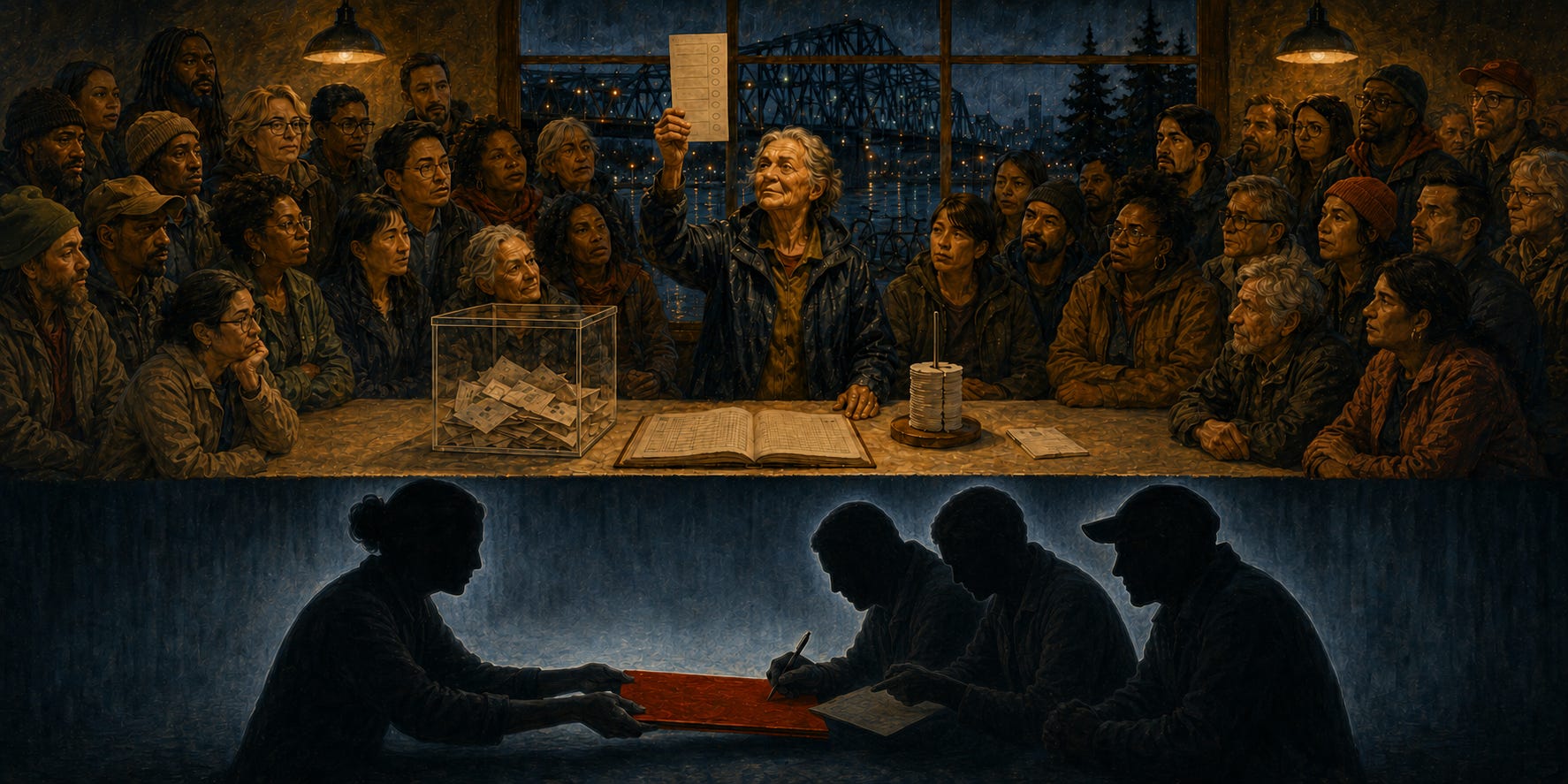
Part two of a series: the people, the money, and the machinery that carried a slate onto a ballot that promised voters no parties at all.
The perfect crime is not the one that goes unsolved. It is the one the law cannot name.
I was a working pollster in Edwin Edwards’s first race for governor of Louisiana. Years later, another man went to prison for money he had given that campaign, the campaign I was working inside, and I never saw a trace of it. I watched Edwards explain the outcome without blinking: it had been illegal for the man to give the money, but it was not illegal for Edwards to take it.[1] The man went to jail. Edwards went back to work.
That is the doctrine this article is about. Louisiana needed another 24 years to reach Edwards, and when it finally did, the case was about casino licenses, in my industry, the one business in America that wrote down what it had learned: stop relying on trust and require the disclosure of every interest in a licensed enterprise. Portland issues licenses too. We call them terms of office.
Every production has a cast. Portland staged one in 2024, it is in rehearsal again for Nov. 3, and the audience, the voters, paid for their tickets without ever being handed a program. What follows is the program the voters never got.
The directors
The first article in this series documented the contract. In March 2023, 20 months before the election, the Portland chapter of the Democratic Socialists of America adopted terms for its top-tier candidates:
meet with the chapter twice monthly,
form a socialist caucus in the elected body, and
serve a program to “disrupt the capitalist municipal order.”
Its recruiting page tells candidates, “DSA is your party.”[2] The four oath-defeating marks from the first article bear repeating once: the commitment comes before the oath; the relationship is a standing structure, not an open door; it has teeth; and it never appears on a campaign mailer. In this program a council seat is not a destination. It is a staging area. The national organization says so itself: organizers first, legislators second.[3]
The company
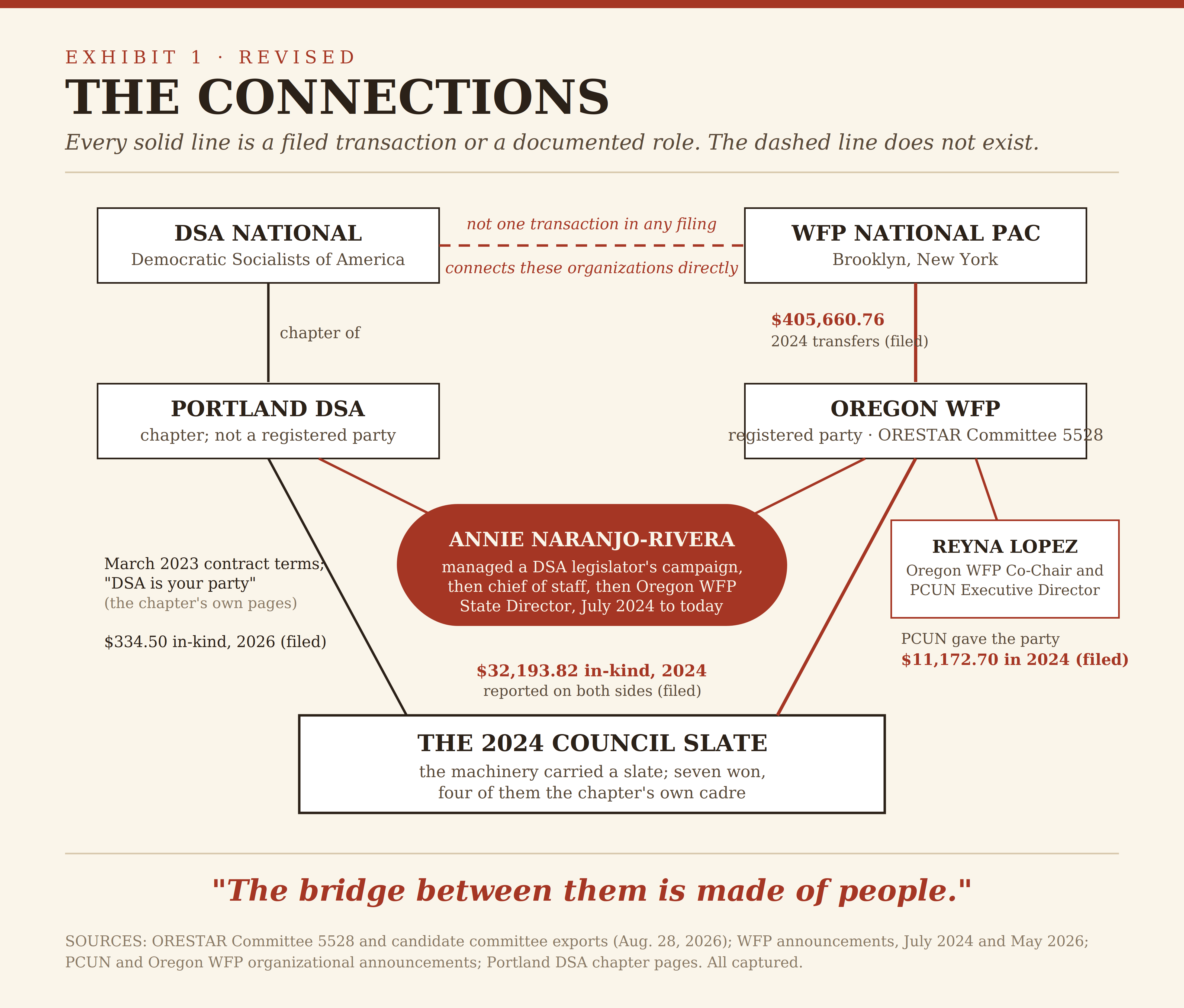
Three structures share one bench: a chapter that declines to be a party, a registered party funded from New York, and the campaigns themselves, and the same people staff all three. In a disciplined formation, people are deployable assets, and resumes become the org chart.
Follow one. Annie Naranjo-Rivera managed the campaign of a DSA member state legislator, then ran that legislator’s office as chief of staff, then moved to direct the Oregon Working Families Party, the registered party whose machinery carried the 2024 council slate. She holds that post today, running the same machinery toward Nov. 3.[4] And one of the party’s own co-chairs directs the farmworker organization that appears in the party’s books as a donor.[5]
Study the map above and notice what is on it and what is not. Every solid line is a documented, cited relationship. The two national organizations never touch in any filing; not one transaction connects them. The bridge between them is made of people. None of these moves is illegal. That is the point of moves like these.
The crew
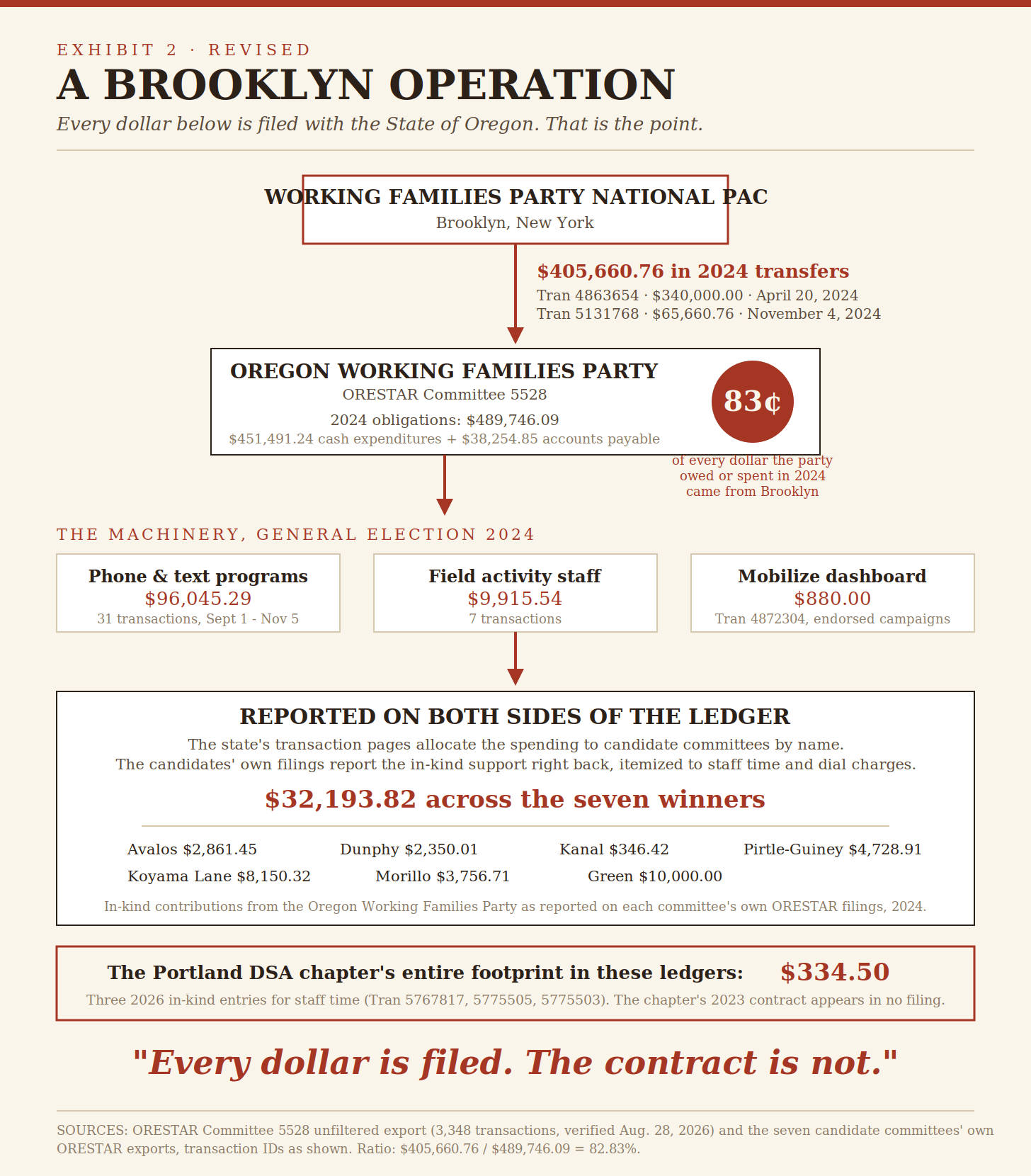
The DSA is not a registered political party, and that is not an oversight. Not being a party keeps the formation outside the ballot rule that names parties, outside the oath’s party-committee clause, and outside the filings that track parties. So the machinery belonged to a cousin: a real registered party, funded 83 cents on the dollar from Brooklyn, its phones, texts and field staff running while Portlanders chose a council.[6]
Here is what the record shows, because we pulled all of it: 3,348 transactions across 20 years of the party’s filings, and the campaign books of every winner. The party’s support for the slate is filed. Its expenditures are allocated to the candidates’ committees by name on the state’s own pages, and the candidates’ committees reported the support right back, $32,193.82 in-kind across the seven, itemized down to staff time and dial charges.[7]
And above all of it sits the largest donor in the race: the public.
The city’s matching program paid these seven campaigns $1,124,067.00, 35 public dollars for every party dollar, clean money by design.[8] Portland’s charter builds a narrow lawful door for organized money, registration, filings, caps, and the party walked through it. The audit my industry would run on this election comes back clean. That is the finding. Follow every dollar and you will end where we did: the money is not where the secret is.
The secret is the contract. The chapter’s terms, the twice-monthly meetings, the caucus, the program, appear in no filing, because an obligation is not a contribution, and disclosure law cannot see what is never paid. Across every ledger we pulled, the chapter’s entire financial footprint is $334.50.[9] Disclosure catches money. It was never built to catch conviction. And that is the injury, and it is not written in any statute. No Portland voter was ever asked whether the city should be governed by the program the chapter put in writing; the ballot’s silence made sure the question never appeared on it. The program itself says what comes next: the contract requires a caucus. Four who took its terms sit on the council today, the chapter has endorsed again for Nov. 3, and on a 12-member council the arithmetic is not a prediction. Six is a tie. Seven is a government.[10]
The leads
The audience sees only the leads, so say their names. The machinery carried a slate in 2024; seven of them won: Candace Avalos, Jamie Dunphy, Sameer Kanal, Elana Pirtle-Guiney, Tiffany Koyama Lane, Angelita Morillo and Mitch Green, each endorsed by the Working Families Party, each on a ballot that by law said nothing about it.[11] Four, Kanal, Koyama Lane, Morillo and Green, were the DSA’s own cadre, carrying all four marks. All seven swore Portland’s oath on Dec. 19, 2024, and the party promptly claimed “a historic majority on Portland City Council.”[12]
The audience: you
Every step of this was legal. That is not the defense; it is the design. So let me say the whole of it in the plainest words I have.
Before the election, candidates who wanted the chapter’s top endorsement agreed to a deal in writing: win, and you will meet with the chapter twice a month, join the others who signed, and serve the program. The chapter is not a party, so the oath about parties never touches the deal. The chapter is too small to run campaigns, so a real party ran the machinery, legally, and filed every dollar. Most of the money was not even private: the public paid over a million dollars to fund these campaigns. We checked all of it, and every dollar has a receipt. Nothing was hidden, because nothing needed to be.
Our rules are built to catch hidden money. Nobody ever built a rule to catch a hidden promise. A promise costs nothing, so it appears on no receipt. The voters financed the entire production, and they were never handed the program. Edwards would have admired the workmanship.
I once heard Huey Long’s son, Sen. Russell Long, say that Louisiana’s corruption could be made illegal but never made unpopular. The line was probably not original to him, but no one was born better placed to repeat it. That was the deepest injury there: not any payment, but the shrug, the day personal and public integrity stopped being an absolute requirement and the doctrine became the normal graft of government.[13] Portland’s method runs the other way. It cannot be made illegal. The only court left is the one that sits on Nov. 3, and the only question before it is whether the method can be made unpopular. We know our leaders by the congruence between their conduct and the oaths they have averred.
The production is in rehearsal now: the same machinery, the same director, and new national money reported this month.[14] The election is Nov. 3. This time, you are holding the program.
SOURCES

I think the way forward politically is to pick candidates who have positions that support public safety, increasing the number of police, prosecuting those who break public law even those with mental health issues, an improved mental health response, and an appropriate societal response to a public emergency in Portland. We should support candidates that openly state that it is the responsibility of mentally ill citizens to get a recovery plan, and not the obligation of the state to recover them. We can help them fix their problems by stopping enabling behaviors and push back against needle distribution, drug paraphernalia distribution, which is one of the worse public health measures in the past 50 years. Mandatory six weeks abstinence for near death overdoses requiring Narcan would be a good place to start. Placing them someplace where they can't get their hands on drugs is a good thing to consider as a first step. Significant reform of civil commitment and hospital care in psych wards in community hospitals for a maximum of six weeks, with a 12-hour hearing after ER admission, and a substituted consent process administered by the judge is a good way forward. The political approach to encourage candidates who are able to adopt clear strategies to improve public safety, civility, and beauty and who aren't afraid to denounce those who wish to sow discord and chaos in the public arena. Taking on one's political rivals means confronting the opposition, but is best argued by those who are candidates, not organizations which can have counterproductive effects.
Thank you for this. It tells an infuriating story that I wish could get much wider distribution.