

By Robert S. Miller
I filed testimony with the Portland City Council on Sept. 2. The full discussion paper behind it, “Before Portland Builds the Blacklist,” is in the sources at the end of this article. My argument was that ethical investing, stripped of upfront universal rules, can become a mechanism that finds its way to one target no matter how neutral the language sounds.
The hearing happened on Sept. 3. No vote was taken. Both agenda items were “placed on file,” meaning heard but not decided. Resolution 37723, adopted last December, still governs. On the surface, nothing happened.
But the city also posted 72 written testimonies and a staff presentation describing how an ethical-investment policy could actually be implemented. I read all of it and went back through the record from the beginning. That record corrected something I had previously misunderstood about the voting math. The six councilors who signed the original pledge did not need a seventh vote to establish the destination. They needed additional votes to create a governmental vehicle capable of reaching it.
The target came first
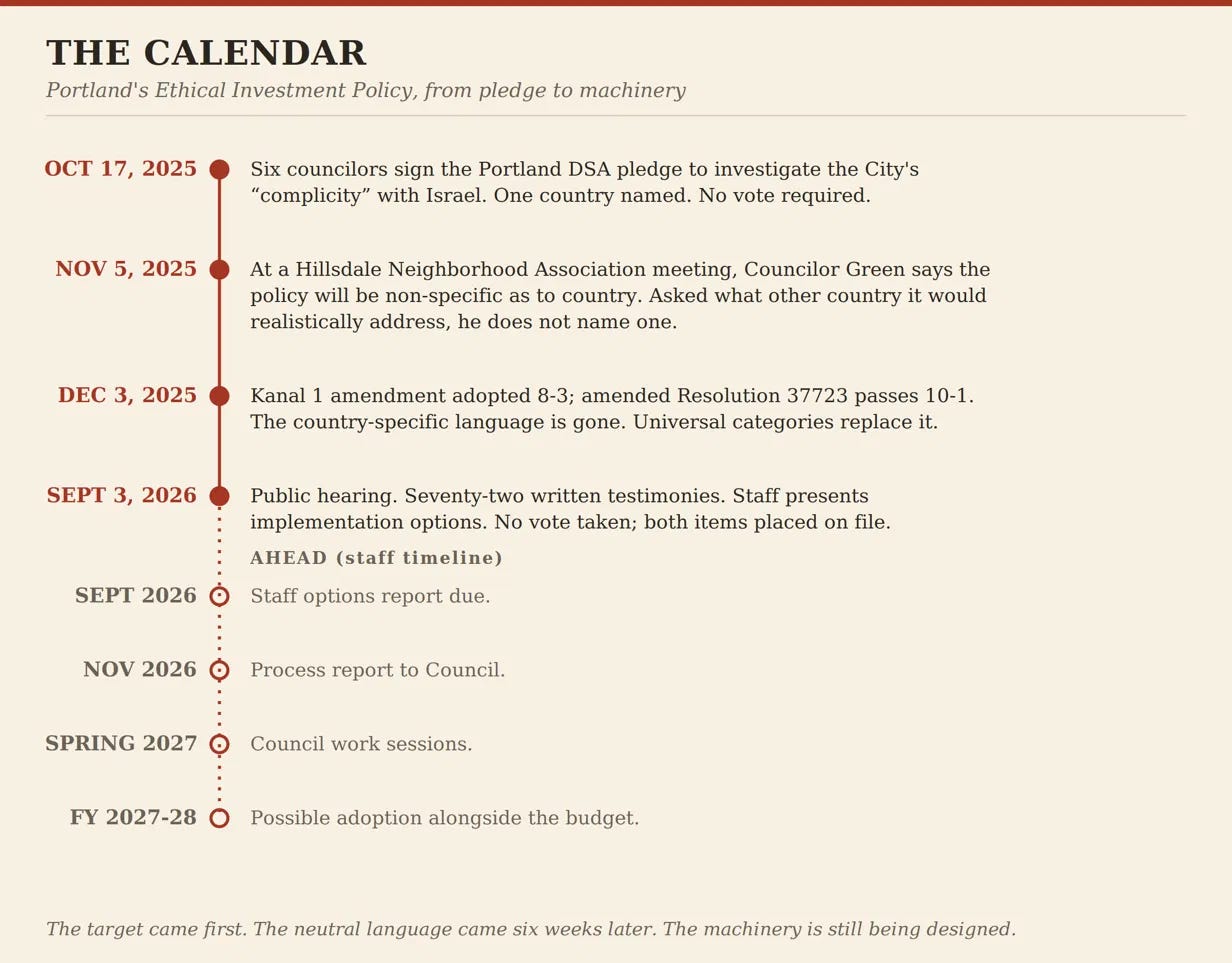
This did not begin as a general review of the human-rights consequences of Portland’s investments. On Oct. 17, 2025, six sitting councilors signed a pledge written by the Portland chapter of the Democratic Socialists of America: Mitch Green, Sameer Kanal, Candace Avalos, Jamie Dunphy, Angelita Morillo and Tiffany Koyama Lane.
The pledge commits its signers to investigate the city’s “complicity with Israel’s illegal occupation, apartheid or genocidal violence against Palestinians.” It specifically identifies weapons manufacturing and transportation for the Israeli military, city investments and contracts with allegedly complicit companies, and other municipal relationships with Israel. This was not a general human-rights pledge. It named one country, one conflict and one political objective.
The DSA’s own frequently asked questions make clear that this was intended as an ongoing political project. Signers are asked to open formal or informal investigations, coordinate with other councilors, support related campaigns and lay the groundwork for further action. There is no fixed definition of what an investigation must entail. Even a small step counts.
The signing therefore did not complete the project. It did something more important for understanding everything that followed: it fixed the destination in public before the “neutral” policy existed.
Then came the neutral vehicle
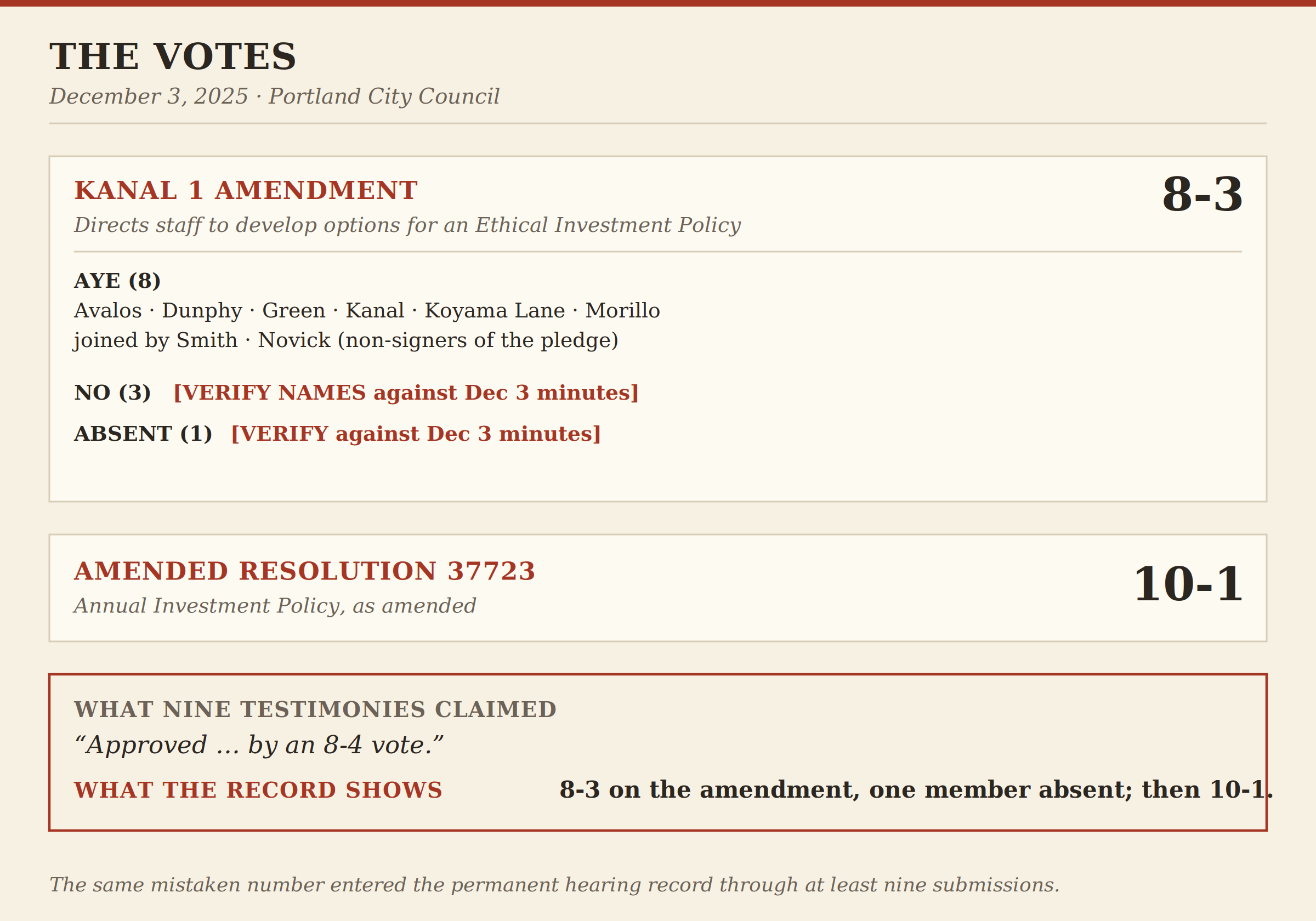
Six weeks later, the same six-member bloc was joined by Councilors Loretta Smith and Steve Novick, neither of whom had signed the DSA pledge. On Dec. 3, the council voted 8-3 to adopt the Kanal 1 amendment to the annual Investment Policy resolution. The amendment directed staff to develop options for an Ethical Investment Policy. The amended resolution then passed 10-1.
The country-specific language had disappeared. In its place were universal categories: human rights, war, armed conflict, genocide, slavery, torture, arbitrary detention, war crimes, crimes against humanity, labor, environmental and consumer impacts.
Those are legitimate subjects for public policy. The problem is not that the language became universal. The problem is that the universal language arrived only after six councilors had committed themselves to a country-specific project, and without the resolution supplying the evidentiary safeguards that would make universal language genuinely universal in operation.
Councilor Green later acknowledged at a Hillsdale Neighborhood Association meeting that he had agreed to make any new investment policy non-specific as to country. When asked what other countries the policy would realistically address, he could not identify one. That does not prove that every supporter of Resolution 37723 shared the original pledge’s purpose. It does establish the sequence: the specific target came first; the generalized policy came afterward.
The political logic is not complicated. A six-person pledge can express a commitment, but it cannot direct treasury, allocate staff time, hire a vendor or prohibit an investment. Those acts require government authority and a council majority. “Investigate and act on Portland’s complicity with Israel” was too narrow to attract the broader coalition. “Develop a human-rights screen” was broad enough for councilors with no particular Israel agenda to support in good conscience.
That does not make Smith, Novick or the other final-resolution supporters participants in a hidden conspiracy. It makes them the necessary votes for a mechanism whose documented political origin they should now be required to confront.
What the 72 testimonies reveal
I coded every written submission for its position, named companies, geopolitical referents and asserted categories of harm. The categories overlap, so the counts below do not sum to 72.
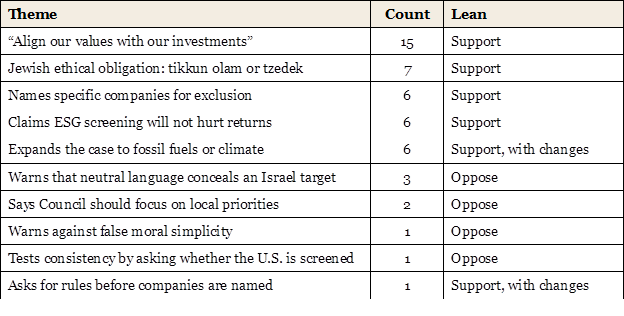
One repeated line says that the council approved the idea of a human-rights screen in December “by an 8-4 vote.” It appears nearly verbatim in at least nine submissions. The official record shows an 8-3 vote on the Kanal amendment, with one member absent, followed by a 10-1 vote on the amended resolution. Call-to-action templates are normal advocacy. They do not make an individual signer insincere. But a mistaken number traveled through at least nine citizens into Portland’s permanent hearing record without anyone checking it.
More important is what happens when the abstraction gives way to names. Several supportive submissions identify the same cluster of intended corporate targets: Amazon, Microsoft, Nvidia and Alphabet/Google, all represented in the city’s large-cap technology holdings. Other submissions refer to cloud computing, artificial intelligence, data processing, ICE, fossil fuels and labor practices. Israel is the dominant geopolitical referent on both sides of the record. The United States appears once, raised by an opponent as a consistency test rather than proposed as an actual target.
One submission calls Israel “the genocidal Israeli state.” That characterization now sits in the city’s official hearing record with no evidentiary standard, no formal finding, no opportunity for a named company to respond and no requirement that the same standard be applied to every government or conflict.
Public testimony is allowed to be passionate, partisan and even wrong. Government designation cannot be. The unanswered question is how allegations in testimony become criteria, and how criteria become a list of prohibited companies.
Who writes the list?
The Sept. 3 staff presentation describes three implementation paths, which may be combined: Use the existing Bloomberg ESG Disclosure Score at no additional cost; have Treasury develop and monitor screening parameters internally, requiring roughly three-quarters of a staff position; or contract for a bespoke ESG rating or monitoring service at an estimated cost of $17,500 to more than $250,000 a year.
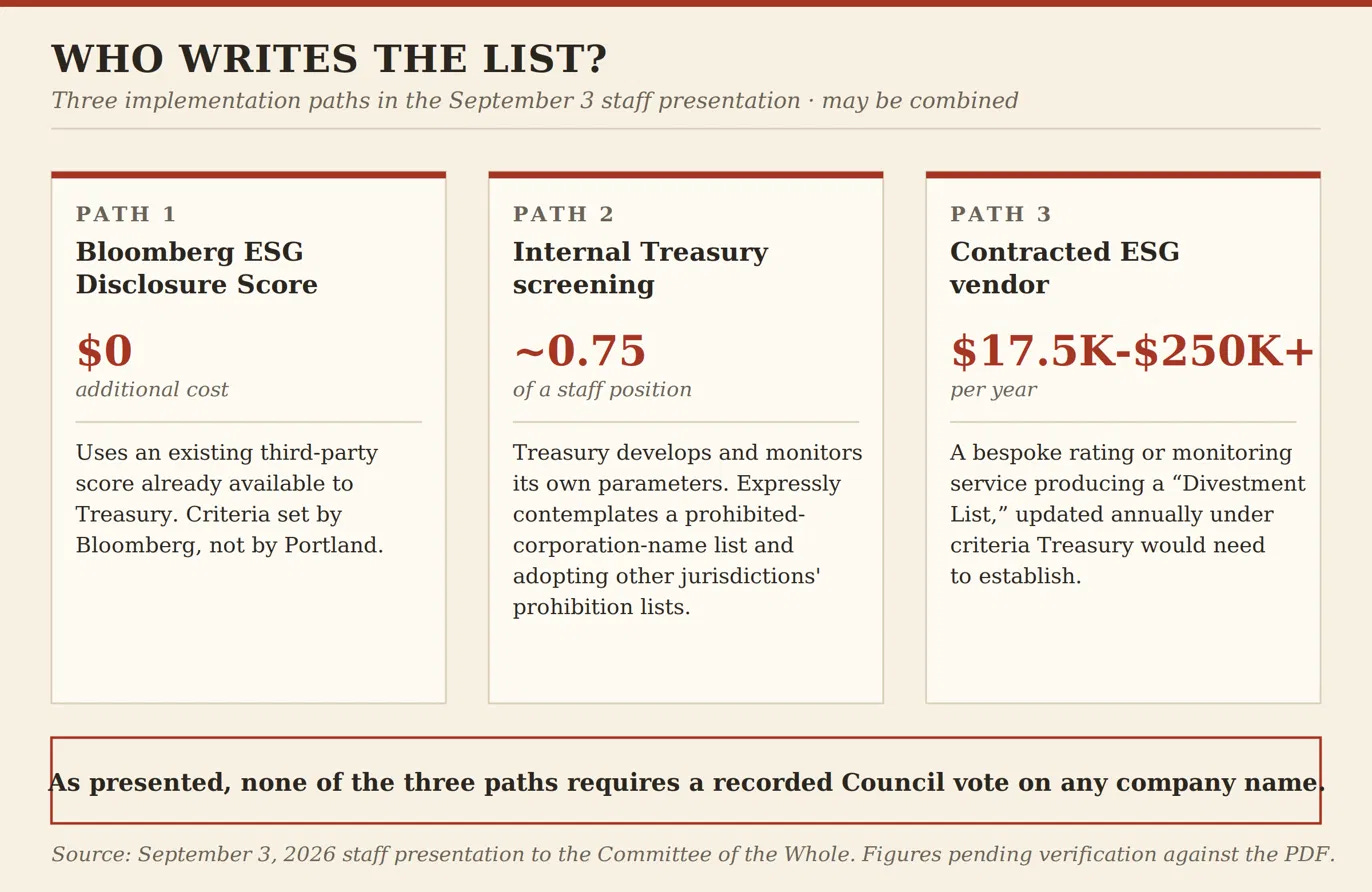
The internal option expressly contemplates monitoring a prohibited-corporation-name list and adopting partial or complete prohibition lists used by other jurisdictions. The customized approach would produce what the presentation calls a “Divestment List,” updated annually under criteria treasury would need to establish.
This is the institutional danger. The structure could allow council to approve broad moral categories once and leave the consequential decisions to staff, another jurisdiction or a contractor: what evidence counts, which conflicts qualify, which companies are implicated and when a company comes off the list. Council members might never have to cast a recorded vote naming Israel, Amazon, Microsoft or any other target.
That result is not inevitable, and the presentation is not a final policy. But it is plainly possible under the options now being considered. The answer is not to speculate about the private motives of every councilor. The answer is to close the accountability gap before the machinery is adopted.
What I am saying, what I am not
I am not saying every supporter of an ethical-investment policy is executing a DSA script. Several self-identified Jewish Portlanders invoked tikkun olam, tzedek and their own family histories in sincere arguments for a standard applied “no matter where in the world” abuses occur. They deserve to be answered on their own terms.
I am not saying every opponent has engaged the policy honestly. Some opposition testimony simply labels the proposal anti-Israel without examining how the mechanism would work. The most persuasive objections are procedural: Write the rules before naming companies; require evidence before designation; apply the same standard to every country, including the United States; permit a company to respond; establish removal criteria; and require elected officials to vote publicly on any resulting list.
Nor am I claiming that the December resolution proves a conspiracy. The record proves something more useful. An Israel-specific political commitment preceded the neutral policy. The neutral policy supplied governmental authority that the pledge lacked. And the proposed implementation structure could turn broad language into named exclusions without requiring the council to own each decision in public.
Born at night, but not last night
This is why the whole exercise makes me angry in a way that goes beyond Israel or investment policy.
For 18 years, I was in business with Max Baer Jr., who played Jethro Bodine on “The Beverly Hillbillies.” The role made him famous and then imprisoned him. He was forever typecast as Uncle Jed’s naive foil, and his on-screen acting career effectively ended. Baer was anything but naive. He became a successful movie producer and made millions.
I once asked him whether it bothered him that people still treated him as if he were Jethro. He gave me the line I have never forgotten: “I always remind myself that I was born at night, but not last night.”
That is what is insulting about Portland’s process. We are being asked to act as though we cannot read a calendar. The Israel-specific pledge came first. The generalized policy came six weeks later. The testimony identifies the expected companies and conflict. The staff proposal now explains how a prohibited-company list could be created and maintained without a separate public vote on every name.
Perhaps the eventual policy will be genuinely universal and procedurally fair. If so, its sponsors should have no objection to proving it: published standards before designations, consistent application across countries and conflicts, an evidentiary record, notice and an opportunity to respond, objective removal criteria and a recorded council vote on the final list.
I was born at night. Portlanders were not born last night. A neutral policy does not become neutral because the original target has been deleted from the final draft. Neutrality has to be built into the rules, the evidence and the accountability for the result.
Where this leaves Portland
Nowhere official, yet. Staff’s timeline calls for an options report this month, a process report in November, work sessions extending into next spring and possible adoption alongside the FY 2027-28 budget. That is time enough to build safeguards, or time enough for a broad coalition, a mobilized advocacy campaign and an outside vendor to assemble a mechanism that no individual elected official must fully own.
My testimony asked for the safeguards: rules before names, evidence before designation, one standard for every country and a public vote attached to any list that results. I do not know whether one written page changes anything against dozens of organized submissions. But I would rather be the voice on the record asking who gets to write the list before Portland discovers that the answer is someone who never has to stand for election.
Sources
• “Before Portland Builds the Blacklist” (author’s discussion paper):

• Portland DSA, “National City Council Pledge”: https://portlanddsa.org/national-city-council-pledge/
• Portland Mercury on the pledge: https://www.portlandmercury.com/news/2025/11/14/48120998/with-a-tenuous-ceasefire-in-gaza-portland-councilors-pledge-to-investigate-the-citys-links-to-israel
• Willamette Week on the pledge and Council math: https://www.wweek.com/news/2025/10/29/a-pledge-signed-by-peacock-reopens-a-rift-on-the-portland-city-council-even-as-details-remain-vague/
• Councilor Green’s official statement joining the pledge: https://www.portland.gov/council/districts/4/mitch-green/news/2025/10/16/portland-city-councilor-mitch-green-joins-pledge
• Hillsdale News PDX, “At HNA Meeting, Green Pressed on Pledge”: https://www.hillsdalenewspdx.com/post/at-hna-meeting-green-pressed-on-pledge
• Resolution 37723 and official vote history: https://www.portland.gov/council/documents/resolution/adopted/37723
• City written-testimony archive, item 2026-304: https://www.portland.gov/council/documents/public-hearing/investment-policy-update-public-hearing/testimony
• September 3 staff presentation (PDF): https://www.portland.gov/sites/default/files/council-documents/2026/Investment-Policy_COTW-Pres_September-2026.pdf
• Investment Policy public-hearing page: https://www.portland.gov/council/documents/public-hearing/investment-policy-update-public-hearing
Robert Miller is a Portland-based investor and gaming-industry executive. He writes The Center Held on Substack.
Mr Miller, you continue to provide insight and truth. Thank you.
These council activities further exemplifies the obnoxious and evil intent of the DSA. Original Democrats should be ashamed. They should oust the DSA from their party and force them to organize independently.
The ignorance of these actions is a direct result of the poor educations that these DSA individuals possess. I conclude, you did not, that they are antisemites. Not one of them could survive a debate with any Jewish rabbi.
These members will hopefully lose in November:
Mitch Green, Sameer Kanal, Candace Avalos, Jamie Dunphy, Angelita Morillo and Tiffany Koyama Lane.
We need to vote out any representative affiliated with the DSA and ensure we keep them far away from political power in Oregon/Portland. This place will be ruined if they are allowed to continue on, as we are already experiencing.