


By Robert S. Miller
Portland is a remarkable place. A man can fly a $30 million Black Hawk helicopter over Afghanistan, come home, exchange it for a defunded Portland police bicycle, and lose an election to a democratic socialist because the Chamber of Commerce apparently can't add, subtract or divide.
Meet Eli Arnold. Arnold spent 17 years in the Army, including flying Black Hawks in Afghanistan. He returned to civilian life, joined the Portland Police Bureau and eventually rode with the Central District bike squad. From a $30 million flying machine to a bicycle. I suppose that qualifies as government downsizing.
He ran for City Council in 2024 with endorsements from the police and firefighters' unions, Willamette Week, and the Portland Metro Chamber. The Chamber told District 4 voters to rank Olivia Clark and Eric Zimmerman first or second; Arnold and Tony Morse could come third or fourth.
Clark won. Zimmerman won. Arnold lost. The third seat went to Mitch Green, a democratic socialist.
The chamber had successfully counted to two. Unfortunately, Portland was electing three.
And here is the part that makes this a uniquely Portland story. Eli Arnold was a Bernie Sanders delegate in 2016. The Chamber of Commerce helped elect its first two choices, a democratic socialist took the remaining seat and the Sanders delegate was left standing. You really couldn't make this up. Although Portland seems determined to keep trying.
The numbers behind the joke
I had access to Multnomah County's 2024 cast vote records, which preserve the rankings people marked on their ballots. NW Examiner Editor Allan Classen asked a useful question: How many voters placed each candidate among their first three preferences?
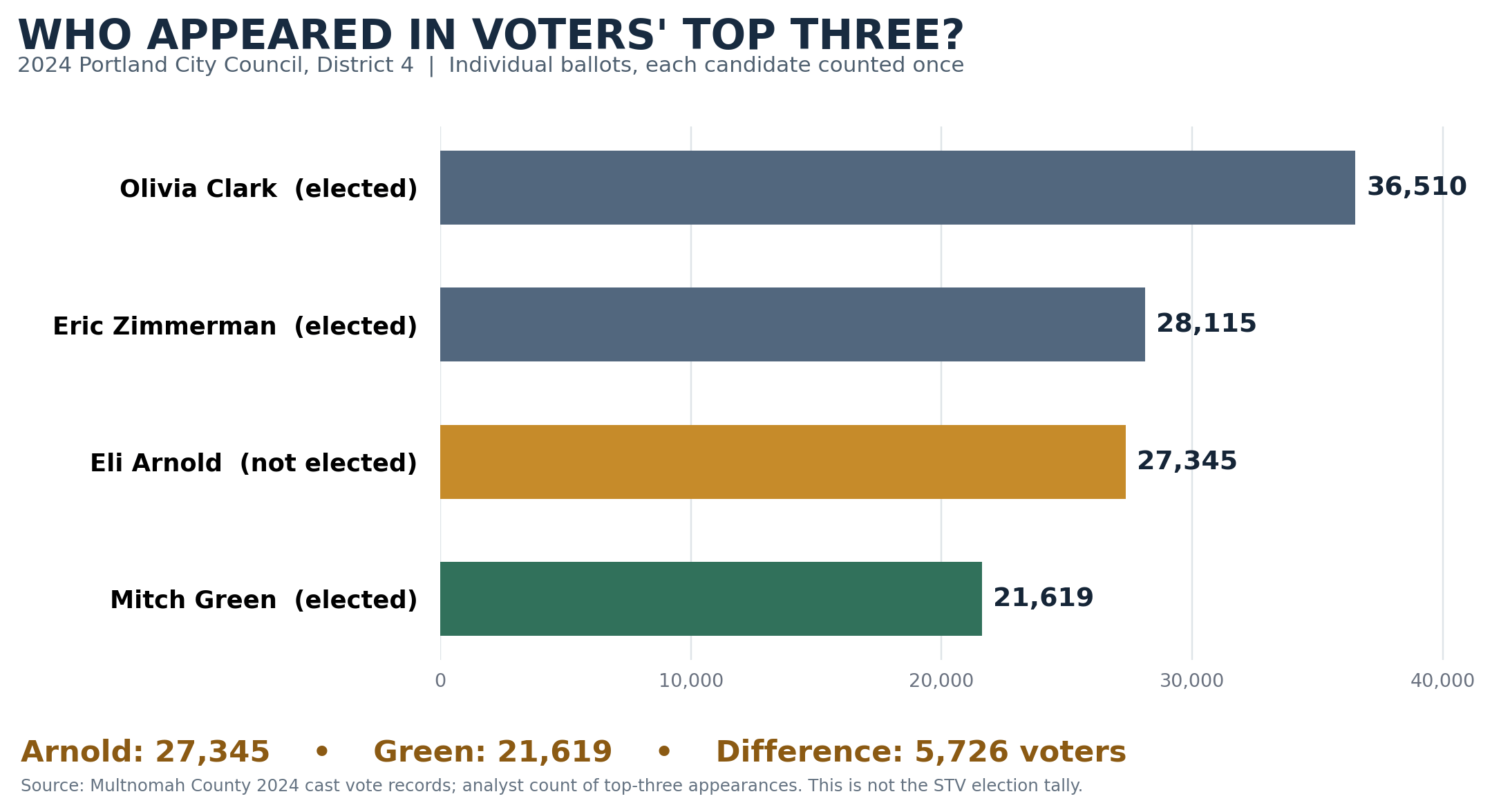
Here is the part that surprised me. Arnold appeared among the top three choices of 27,345 voters. Green appeared among the top three of 21,619. That is 5,726 more voters including Arnold among their first three choices, yet Green won a seat.
The result sounds ridiculous until you remember what Portland adopted. In a three-seat district, proportional ranked-choice voting generally requires 25% of the vote plus one to elect a candidate. Its purpose is not to choose the three candidates who appear most frequently in everyone's top three. It is to allow different constituencies to win seats. Green began with more official first-round votes than Arnold and collected enough transfers from other candidates to cross the threshold.
That is not a counting error. Proportionality and breadth of preference are different objectives. We ought to be able to say so without pretending either measure answers every question.
Arnold's problem was closer to home
Arnold's more immediate contest was with Zimmerman. In the official first round, Arnold had 8,123 votes, 118 more than Zimmerman's 8,005. Our ballot analysis counted 13,538 second-place ranking marks for Zimmerman, compared with 6,209 for Arnold. A small lead in first preferences was not much use against that difference in later preferences.
The chamber's recommendations placed Zimmerman before Arnold. That instruction certainly establishes priority; it does not tell us how many voters obeyed or whether the chamber intended to elect all three. If Clark and Zimmerman were the objective, the chamber's arithmetic worked rather well. If Arnold was supposed to win too, it did not.
In September, I examined the ballot records for my essay on Portland's political machines. The strongest reciprocal first-and-second-choice pairing I found was Clark and Zimmerman: Roughly half of Clark's first-choice voters ranked Zimmerman second, and 46% of Zimmerman's ranked Clark second. That is not evidence of a coalition unable to do arithmetic. It is evidence that the coalition's first two candidates were very well positioned. Arnold was farther down the ladder.
This is a curious form of political friendship. Imagine inviting someone to dinner, praising his character and explaining that there are two chairs. He is welcome to stand behind them.
By the time Arnold was eliminated, Zimmerman had accumulated the stronger position. Arnold's transferred votes then helped Zimmerman cross the finish line. The chamber had endorsed Arnold, but it hadn't put him first. Those are not the same things.
Green's allies used another strategy. Portland DSA (Democratic Socialists of America) explicitly urged District 4 supporters to rank Green first. Other progressive candidates were eliminated, and transfers helped Green reach the winning threshold. That does not prove that the chamber elected Green, much less that it intended to. It demonstrates that the two organizations assigned different priorities within the same electoral rules.
Were Arnold's friends incompetent, or did they understand the machinery better than he did? The ballots cannot settle intent. The question is much more interesting than a complaint about somebody else's victory.
The election he won on my computer
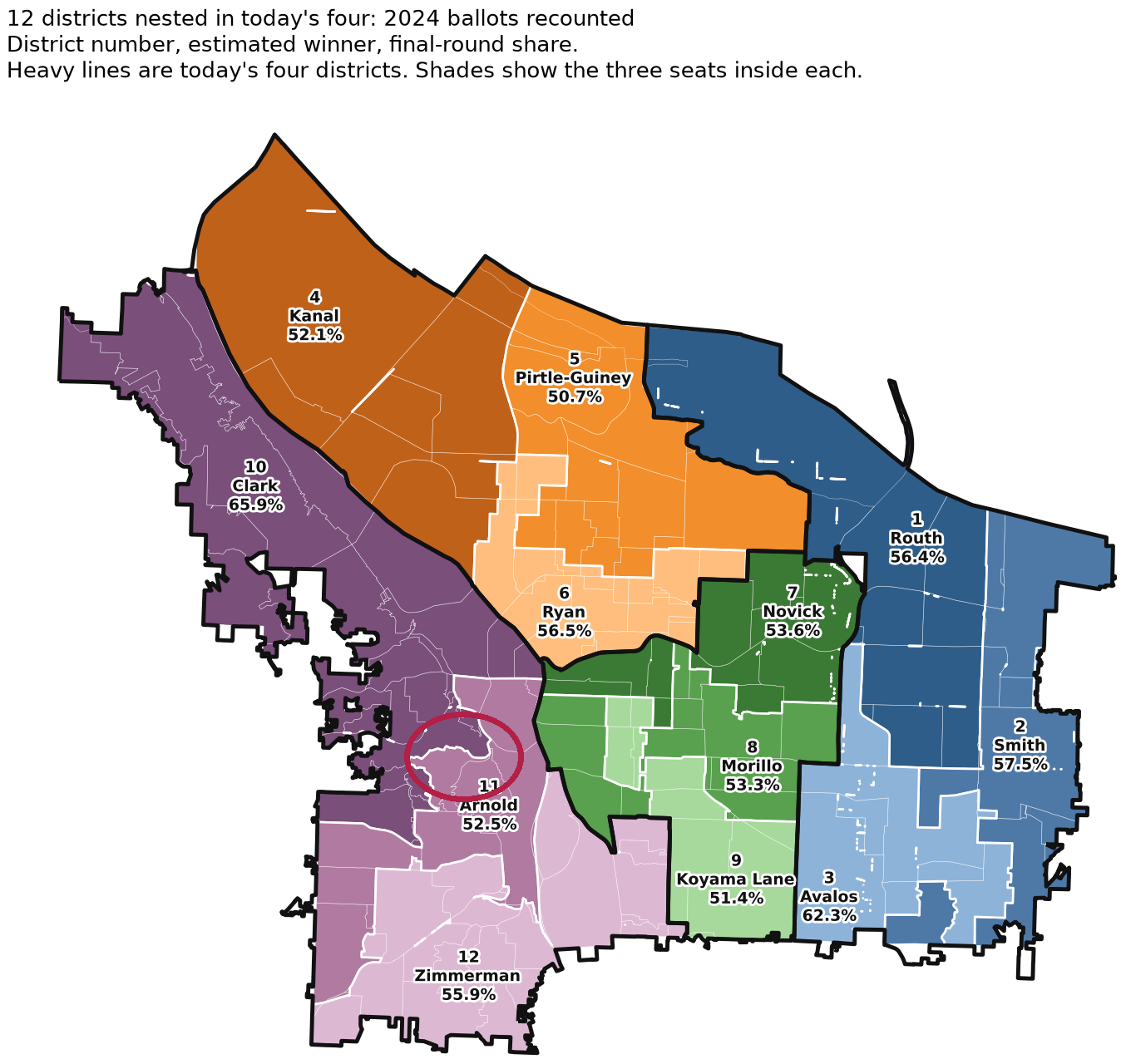
Then I tried something different. I took the 2024 cast vote records, kept voters in their precincts and modeled a Portland City Council elected from 12 single-member districts rather than four three-member districts. Each new seat was counted using single-winner ranked-choice voting. For this design, I split each of today's four districts into three, so voters were still choosing among the same 2024 candidates.
It is a simulation, with important assumptions: Candidates were allocated to one district, the precinct boundaries are coarse, and people would surely campaign and vote differently in a real one-seat race. It has not been independently verified. But the exercise produces a splendid conclusion.
In the modeled district including Downtown, South Portland and Ashcreek-Crestwood, Eli Arnold wins with 52.5% of the continuing final-round vote. Green receives 47.5%. Clark and Zimmerman win the two other seats carved from the old District 4.
I also tested a 13-district version. Arnold appears again in the modeled winning column, this time 51.9% to Green's 48.1%. That does not establish how an actual election would have turned out. It does show that boundaries and electoral design can change the answer derived from the same historical ballots.
And then reality intervened
Arnold ran again in November 2026. The three incumbents, Clark, Zimmerman and Green, led in the preliminary results. Unlike 2024, Arnold was no longer starting neck and neck with Zimmerman: in a November preliminary first-round tally, Zimmerman had 13,616 votes and Arnold 6,956. The gap existed before the transfer count began. The 2026 results were not yet certified when this article was prepared.
That second defeat cannot be explained away as another trick of the counting rule. Candidates, campaigns, incumbency, public judgment, and the composition of the electorate all changed. The system may matter; it is not the only thing that matters.
What did we learn?
Not that Arnold was the best candidate. I have never met him, and I cannot make that judgment for the voters. Not that Green's election was illegitimate; his votes were counted under the rules Portland adopted. Nor that the Chamber was necessarily inept. Its first two preferences were elected, which is a rather awkward fact for an arithmetic joke.
What Arnold's story reveals is the difference between being endorsed and being prioritized, between broad voter acceptance and proportional representation, and between an election result and the assumptions behind our preferred way of electing people.
A useful charter discussion would measure those differences and test alternatives, not merely announce that the winners prove the rules good or the losers prove them bad.
Meanwhile, I have finally managed to elect Eli Arnold to the Portland City Council. All it took was redrawing the city, changing the electoral rules, and rerunning the ballots on my computer.
Unfortunately, his council seat exists only in the simulation. I suppose the good news is that he won't have to ride his bicycle to the meetings.
Sources and methodology
Multnomah County official 2024 District 4 tally and cast vote records; Portland Metro Chamber 2024 voter guide; Portland DSA 2024 voter guide; NW Examiner, “Inside the Portland City Council Sweepstakes” (September 2026); R. Miller, “Districts and the 2024 Ballots” (November 2026, unreviewed working model). Original election and model sources: multco.us and portland.gov. The district simulation holds historical rankings fixed and reallocates candidates; it is not a forecast or a verified election recount.
Robert S. Miller is a Pearl District resident and president of a gaming technology company. He uses AI tools to gather public records, run the numbers and check facts.
"Meanwhile, I have finally managed to elect Eli Arnold to the Portland City Council. All it took was redrawing the city, changing the electoral rules, and rerunning the ballots on my computer. " Nixon vs McGovern... Bush vs Gore... The Village Idiot vs Kamala... Man, if I could pull off that trick I would have changed history!
Ranked choice voting seems to have survived judicial challenges, so it appears to now be a common fixture among local and state elections. But the hybrid of ranked choice, combined with the utterly outlandish system used by the City of Portland where Council candidates coming in 2nd and 3rd in elections get to sit on the Council with equal voting power as the 1st place candidate, hits me as fundamentally undemocratic and an electoral version of extreme affirmative action to elevate minority views to majority status. I would love to see this outrageous arrangement challenged in the courts and find its way all the way to SCOTUS where I predict it would be found contrary to the U.S. Constitution.