

by Robert S. Miller
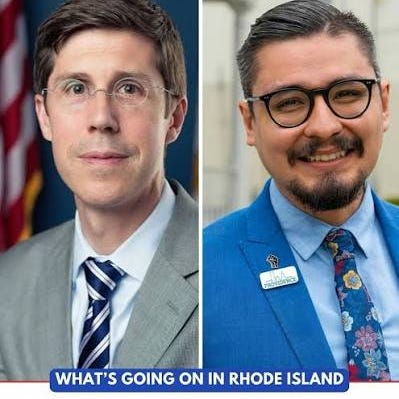
On Tuesday night, for the first time in the history of Providence, R.I., a sitting mayor lost his own party’s primary. [1]
The winner was David Morales, a 27-year-old state representative and a member of the Democratic Socialists of America. He was endorsed by Sen. Bernie Sanders and backed by the Working Families Party.
In July, he held a fundraiser with New York Mayor Zohran Mamdani, and he ran the Mamdani playbook openly: rent stabilization, affordability, social media over television. [2]
The incumbent, Brett Smiley, a 47-year-old first-term mayor and a former gubernatorial chief of staff, was the establishment’s man in a city that had never once removed an establishment’s man this way. Unofficial results with all 82 precincts reporting: Morales 14,021, Smiley 12,678. About 52.5% to 47.5%.
[3] On Nov. 3, Morales faces Dave Talan, the lone Republican to qualify, in a city that has not elected a Republican mayor in decades.
[4] The same night, in the same state, Gov. Dan McKee lost his own primary, the first sitting governor in the country to lose renomination since 2018. [5]
Readers of this series will recognize the personnel. The Working Families Party is the organization whose machinery carried a slate into Portland’s council chambers in 2024, an operation this series documented transaction by transaction: the transfers from Brooklyn, the phone and text vendors, the in-kind allocations filed under each candidate’s name. Every dollar had a receipt.
The Democratic Socialists of America is the organization whose endorsement agreement sat at the center of that coordination. Whether the two organizations coordinate with each other is a question no filed document answers. What the record shows—in Portland and now in Providence—is that they keep converging on the same candidates, and the candidates keep winning.
There is a second Providence story, and for Portland it is the more important one. On the same Nov. 3 ballot, Providence voters will decide Question 7, a citizen-initiated ordinance directing the city to refrain from investing in the sovereign debt of, or in entities complicit with, foreign countries conducting ethnic cleansing, apartheid, illegal military occupation or genocide. [6] Complicity has a definition: Companies that directly and knowingly enable and contribute to the violations. [7]
The measure also names its referees. Which countries qualify is to be determined by United Nations experts, United States court rulings or definitions in federal policy, and rulings of the International Court of Justice. [8] Its backers have identified about $2.5 million in city funds they say would be affected, naming Caterpillar and Axon Enterprise. [9]
The measure did not come from the machinery that carried Morales. It reached the ballot by petition, through a seldom-used initiative provision of the city charter triggered by more than 10,000 signatures gathered by a coalition called Providence for Palestine. The council placed it on the ballot unanimously. [10] The language names no country. The campaign for it and the campaign against it, both say plainly which country it means. [11] Last November, Somerville, Massachusetts passed a similar measure that named Israel outright. [12] Providence’s version does not need to.
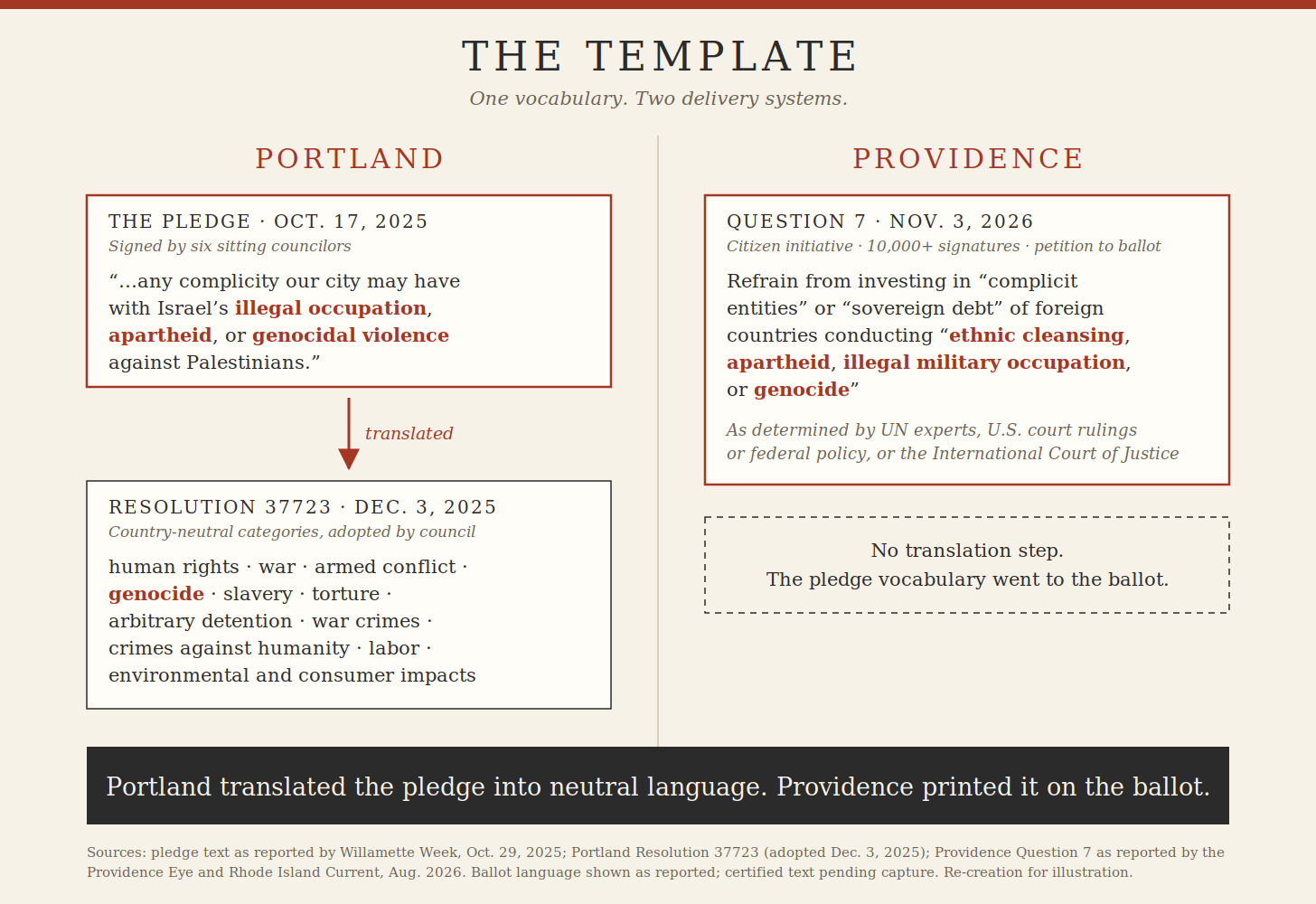
Portland readers have seen the ballot’s vocabulary before, but not where you might think. Resolution 37723, the investment policy Portland’s council adopted last December, speaks in universal categories: human rights, war, armed conflict, genocide, slavery, torture, arbitrary detention, war crimes, crimes against humanity. The vocabulary on the Providence ballot is older and more specific. It is the vocabulary of the pledge: the commitment six Portland councilors signed on Oct. 17, 2025, to investigate the city’s complicity with “Israel’s illegal occupation, apartheid, or genocidal violence against Palestinians.” [13]
As I reported last week’s installment, Portland’s method was translation: a country-specific pledge converted into country-neutral policy language, with the destination set before the categories were written. [14] Providence’s method is publication. The same words, occupation, apartheid, genocide, with ethnic cleansing added, go straight onto the ballot. No translation step, no council drafting process, target named by everyone except the text itself.
All three men who ran for mayor of Providence this year took positions on Question 7. Morales supports it and calls it the right thing to do. Talan, a board member of the Rhode Island Coalition for Israel, opposes it and calls it hateful. And Smiley, the incumbent the voters just retired, opposed it on different grounds: He called it legally unenforceable. [15]
Note what the losing mayor’s objection was. Not the politics. The administrability. Who determines which countries qualify, by what standard, at what cost. That is the question Portland’s Finance and Governance Committee spent Sept. 3 examining without resolving. In Providence, it will now be answered, or not, by referendum. A city electorate is about to be asked to determine by majority vote which foreign countries are conducting genocide. Whatever you think the answer is, consider the question. The measure travels lighter than the answers do.
One more parallel. Most of Providence’s pension money, a May 2026 city investment report shows, is not directly invested in individual companies or countries. [16] Most of the money is beyond the measure’s reach, a condition Portland readers will recognize from the Sept. 3 record. The vote is about the vocabulary, not the portfolio.
The second article in this series closed with a warning that what Portland watched in 2024 was a rehearsal: same machinery, same director, new national money. That reading has now been tested against an event. Providence was not influenced by Portland and did not need to be. That is what a playbook means. It does not spread by imitation. It spreads by being run, city by city, by national organizations with national calendars, against local incumbents who each believe their situation is unique. Smiley believed it. He ran on housing built, crime down, schools recovered, and he said at his own polling place that the progress could stop if voters made a different choice. [17] The voters made a different choice by five points.
Portland’s method—this series has argued—cannot be made illegal, and the state has twice confirmed that no law reaches it. The only court left is the one that meets on Nov. 3. It turns out that court has more than one docket. On the same Tuesday, Providence will elect a mayor and decide Question 7, and Portland will fill six council seats across the two districts where every seat is up. Two cities, one calendar.
They are not running the same play against you. They are running the same play everywhere. The program is now printed in two cities. You are still holding it.
Robert Miller is a Pearl District resident who has spent five decades in the gaming industry. He holds a Ph.D. in operations research from Louisiana State University, writes The Center Held on Substack.
NOTES
RESOLVED since v1: measure confirmed as Question 7; Talan confirmed as lone Republican general-election opponent (RI Current, WPRI, Epoch Times), resolving the earlier no-Novemberopponent conflict; adjudicator list and complicity definition sourced (Providence Eye, RI Current); backer figures corrected to Caterpillar and Axon Enterprise, not Chevron (JTA); template thesis recast: Providence ballot vocabulary matches the Oct. 17 pledge, not Res. 37723, whose categories are the universal list per the author’s own published Examiner piece. Exhibit THE TEMPLATE built accordingly.
[1] First-ever primary loss by a sitting Providence mayor: WJAR claim. Verify independently and capture.
[2] Mamdani fundraiser (July) and WFP backing of Morales need primary-source captures. Sanders endorsement confirmed (NBC, WPRI). Morales is a state REPRESENTATIVE; JTA’s “state senator” is wrong (NBC, WPRI, Boston Globe agree).
[3] Vote figures are the state’s unofficial election-night reporting as rendered by Epoch Times (8:15 a.m. Sept. 10, all 82 precincts). Before print, pull the RI Board of Elections page directly and cite it. Certified results will lag.
[4] Talan lone Republican to qualify: Epoch Times, Sept. 10, 2026 ("Talan was the only Republican candidate to qualify"); Rhode Island Current, Sept. 9, 2026 ("will face Republican Dave Talan, 77, in the Nov. 3 general election"). No Republican mayor in decades: stated directly by Epoch Times; the underlying fact is that the last Republican elected mayor of Providence was Vincent "Buddy" Cianci in 1974, and Cianci left the party in 1982 (GoLocalProv Cianci timeline; NPR obituary, Jan. 28, 2016). Fifty-two years.
[5] McKee first-sitting-governor-since-2018 claim: Epoch Times.
[6-8] Ballot language shown as reported (Providence Eye; RI Current renders the ordinance as “severe violations of human rights such as ethnic cleansing, apartheid, illegal military occupation, or genocide”). Outlets differ slightly.
[9] Backer figures: Andrew Lapin, JTA, Aug. 24, 2026, "Providence voters to put Israel boycott movement to major test at the ballot box" (supporters "identified around $2.5 million in city funds," citing Caterpillar and Axon Enterprise). Syndicated in Times of Israel, Forward, Jerusalem Post. Boston Globe, July 30, 2026, reports the city holds no Israeli sovereign bonds directly, only about $119,000 through a Vanguard index fund, per city spokesperson.
[10] Petition path: RI Current, Aug. 31, 2026. Section 209 of the city charter; first round of 1,005 accepted signatures received by the council April 16 (City Clerk Tina Mastroianni); council declined to enact, triggering a second round requiring 5 percent of qualified voters. Coalition composition same article: Jewish Voice for Peace RI, Reclaim RI, RI DSA, AFT Local 6516. Over 10,000 signatures collected in the second round, 6,036 accepted by the Board of Canvassers (Ocean State Stories, July 31, 2026, quoting Mastroianni; Steve Ahlquist substack, July 31, 2026, per Providence for Palestine release). Unanimous placement: council resolution submitting the ordinance to voters passed unanimously in a special session July 30 (Ahlquist, July 31). Precision point: the council unanimously placed the question on the ballot; it did not enact the ordinance.
[11] Both sides name the target: JTA, Aug. 24, 2026 ("both its proponents and opponents have framed the measure as a referendum on Israel and the global Boycott, Divestment and Sanctions movement"). Opposition on record: Ken Schneider, president, RI Coalition for Israel, at the Aug. 25 rally: "It’s absolutely targeted right at Israel... it’s all about Israel" (RI Current, Aug. 31). Proponent side: JVP organizer Zack Kligler quotes in the same coverage.
[12] Somerville: Question 3, Nov. 4, 2025, passed with 55.7%, 11,489 to 7,920, unofficial (Boston.com, Nov. 4, 2025; JTA, Nov. 4, 2025, "In a first, a ballot initiative to divest from Israel has won at the ballot box"). Ballot language named Israel: divest from companies that "engage in business that sustains Israel’s apartheid, genocide and illegal occupation of Palestine." One distinction to hold in reserve: Somerville’s question was nonbinding; Providence’s Question 7 is a binding ordinance. "Similar measure" survives, but an opponent will point at the difference. Body claims sourced here: Somerville population about 80,000, less than half of Providence’s, and Providence as "the largest American municipality ever to place divestment before the voting public" (Lapin, JTA, Aug. 24). The sequel: Somerville’s council voted 9 to 2 on Nov. 25, 2025 to work toward an implementing ordinance (Boston.com), and the city began exploring enactment in June 2026 (JTA). "Nonbinding" is aging.
Robert, you are terrific to be following the DSA et Al's actions. Thank you for enlightening us.
By the way, have any of the DSA voters ever bothered to know the definition of genocide?
Is Albina Vision Trust dabbling in apartheid lite? Just askin'.