

By Bob Weinstein
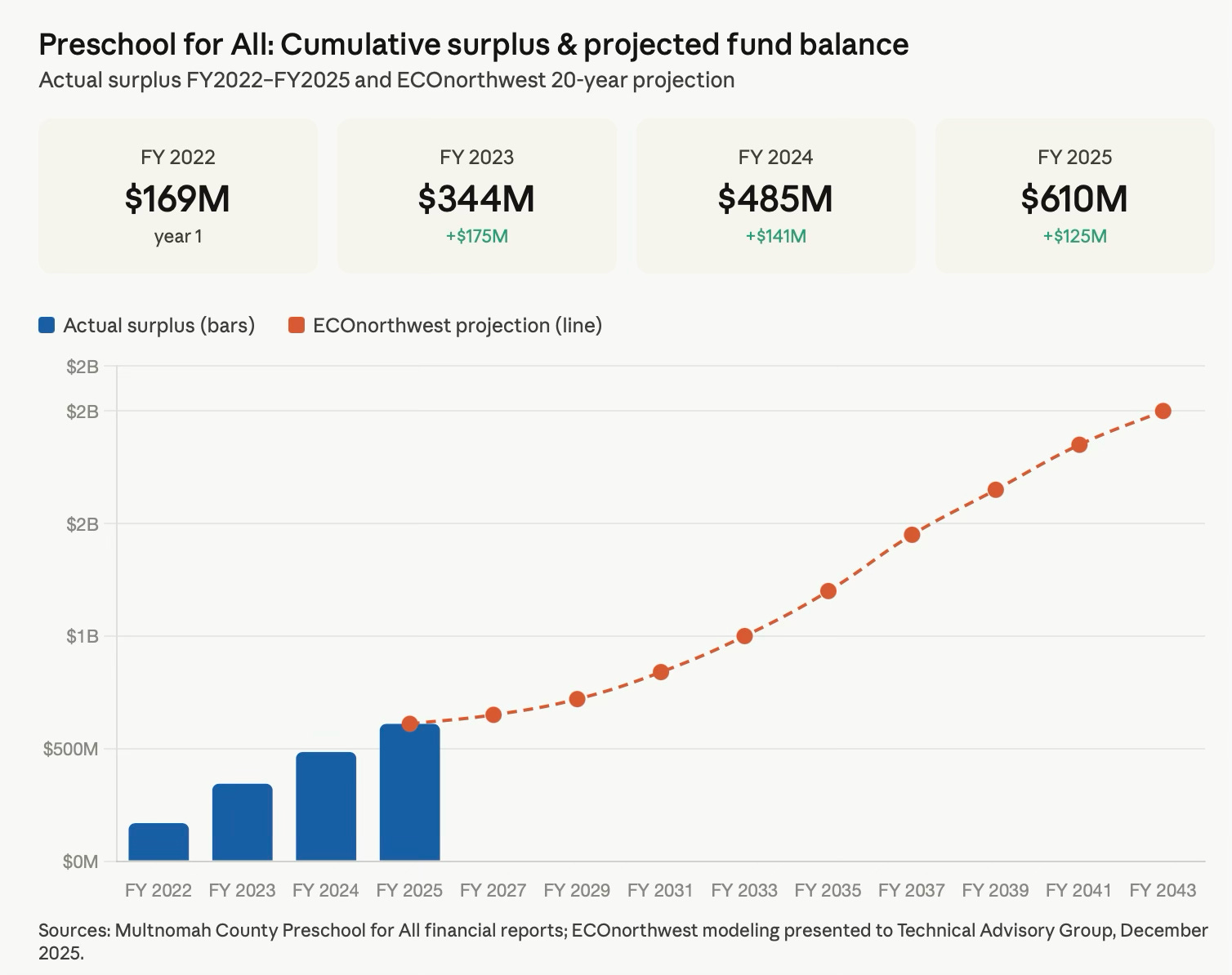
Multnomah County’s Preschool for All program is sitting on a $610 million surplus, and the official recommendation after months of review is essentially to do nothing.
A recent article in Willamette Week on the Preschool for All Technical Advisory Group describes a cautious set of recommendations: delay a future tax increase, study potential changes and leave the core structure intact. What the story underplays, however, are two facts that fundamentally change how those recommendations should be understood.
DSA’s fingerprints
Before diving into the numbers, it’s important to be clear about something else. I understand firsthand the value of early learning. The research is clear: high-quality preschool gives children, especially those from lower-income families, a genuine head start that pays dividends for years.
When the program was first conceived, it was intended to supplement, not supplant, existing programs already funded by federal and state sources, including Head Start and Oregon’s Preschool Promise. The goal was to fill gaps, not to build a parallel empire.
What derailed that vision was a political intervention. In April 2019, the Portland chapter of the Democratic Socialists of America seized on the preschool concept as a vehicle for their “tax the rich” agenda. The DSA’s involvement reoriented the program’s political identity away from child development and toward income redistribution, introducing a funding model that prioritized the size and permanence of the tax over the actual needs of the program. In the process, it put PFA in direct competition with the very federal and state programs it was supposed to complement.
Surplus massive and growing
The program has been over-collecting from taxpayers since its inception. And it is now projected to need far less money than originally claimed.
I have reviewed Preschool for All’s financials over multiple fiscal years. The pattern is consistent: every year, the county underestimates revenue and overestimates expenses, producing a surplus that grows relentlessly.
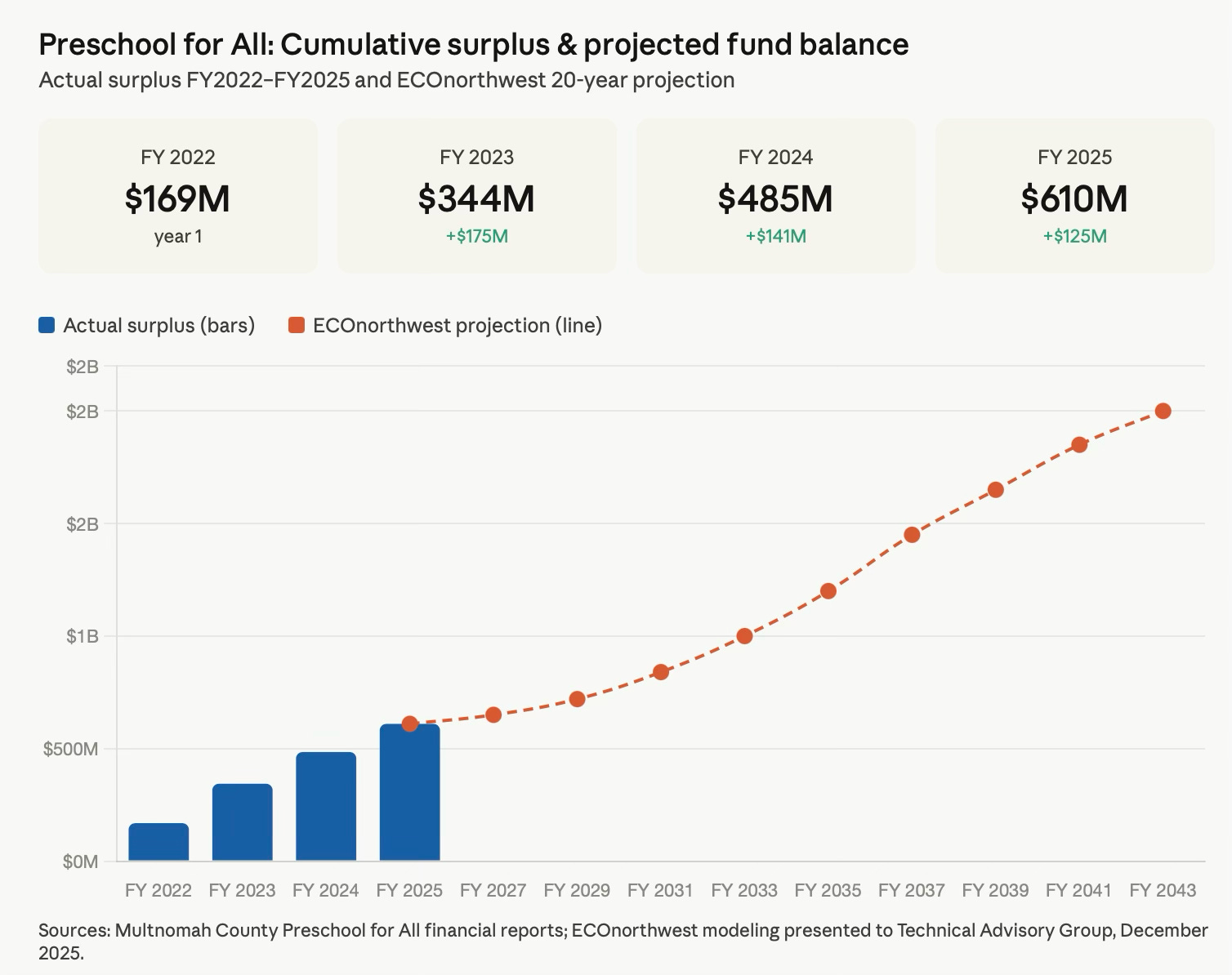
FY2022: $169 million
FY2023: $344 million
FY2024: $485 million
FY2025: $610 million
This is not normal variance. It is a systematic mismatch between what the county says it needs and what it actually spends.
Whether this reflects persistent forecasting errors or deliberate and excessive conservatism, the outcome is the same: taxpayers are being charged far more than is necessary to fund the program as it exists today.
Built for more children than exist
Now it gets worse. The financial mismatch becomes even more difficult to justify in light of updated enrollment projections.
The program was originally built on a claim that it would need to fund roughly 11,200 preschool seats to reach universality. New demographic modeling from ECONorthwest presented to the TAG in December puts the real need at 7,500 to 8,300 seats.
In other words, the program has been collecting revenue sized for a system nearly 50% larger than reality requires. Yet the tax structure remains unchanged.
The financial implications are staggering. With lower enrollment and continued revenue growth, ECOnorthwest projects fund balance could reach $2 billion by 2043 if no changes are made. That projection was reported in Willamette Week in December. There was no coverage of the TAG’s final recommendations, despite being central to understanding the stakes.
Refusing to index is a tax increase
The decision not to index tax thresholds to inflation is not a technical nuance. It is a policy choice with predictable consequences.
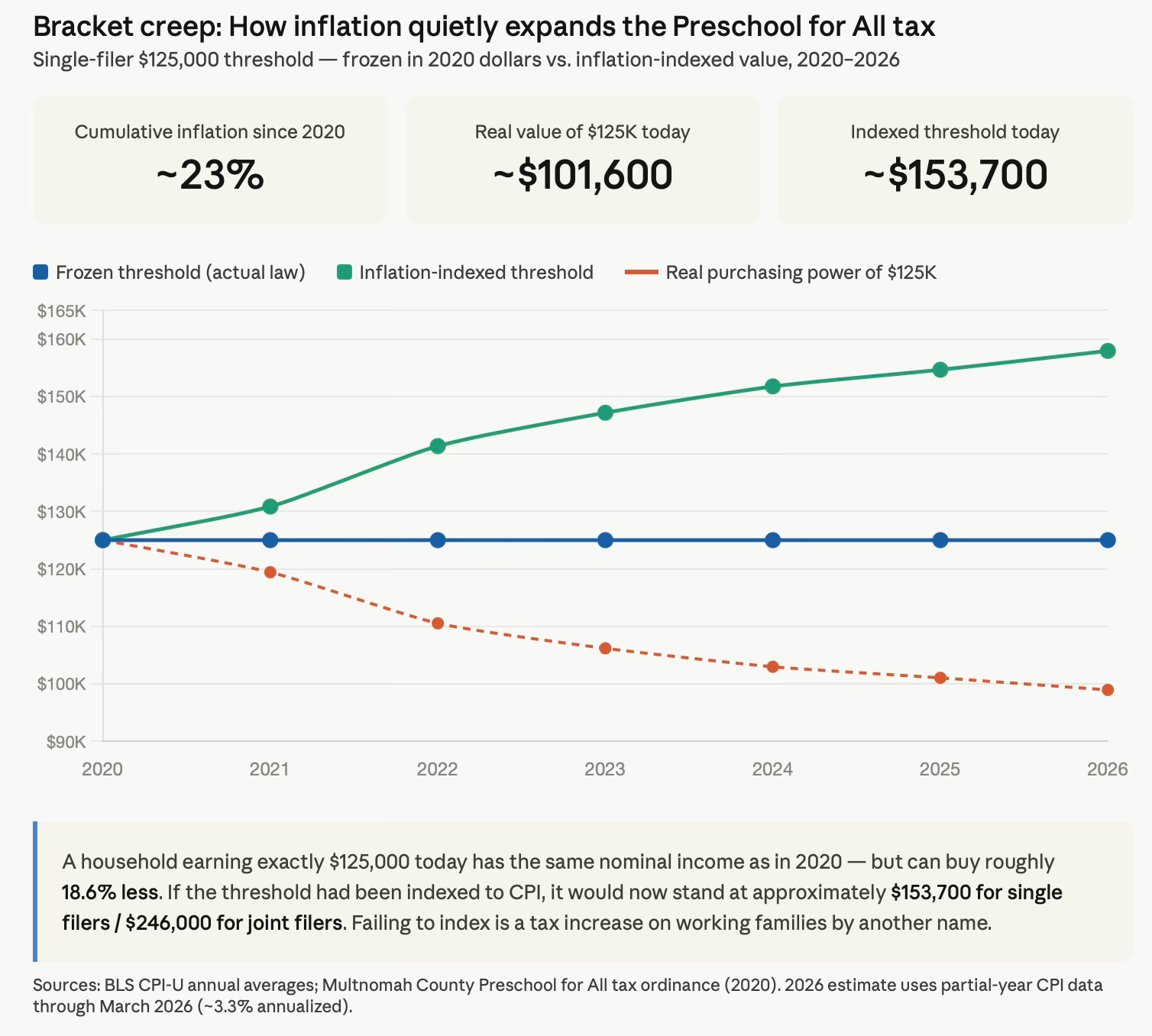
The income thresholds triggering this tax, $125,000 for single filers, $200,000 for joint filers, have not changed since 2020. Over that period, inflation has significantly reduced their real value. A household earning $125,000 today has the purchasing power of about $101,600 in 2020 dollars.
Every year the county fails to index these thresholds, the tax quietly expands its reach, pulling in dual-income working families, nurses, teachers and tradespeople who were never the intended targets of a levy marketed to voters as a tax on high earners.
The TAG report acknowledged this plainly, noting that “indexing preserves the real value of voter-approved thresholds,” while not indexing “removes a source of automatic revenue growth,” and then recommended doing nothing about it anyway.
That framing obscures what is really happening. “Automatic revenue growth” is simply bracket creep: a gradual expansion of the tax burden onto households with incomes that longer represent wealth in 2026 Portland.
We need no more studies: the data is already in hand.
The TAG’s recommendations are framed as a cautious middle ground, but in context, inaction is not neutral. The county has been over-collecting for four straight years. The program needs far fewer seats than originally claimed. The surplus is on track to reach $2 billion. And the tax continues to expand through bracket creep. Against that backdrop, calling for more studies is not prudence; it is a choice to preserve a status quo that benefits the county’s balance sheet and no one else.
The county must act by late August to implement changes for the 2027 tax year. More studies will not alter the fundamental picture. The relevant facts already point to the same conclusion: this is a program that has avoided accountability since the day it launched.
The DSA’s fingerprints are on this problem.
It is worth noting the irony here. Portland DSA championed Preschool for All as a “tax the rich” initiative, framing it as a matter of economic justice for working families. Yet today, despite claiming to champion working families, DSA and its allies in county government actively oppose indexing the tax to inflation, a reform that would directly protect working families from bracket creep. The result is a county fund that has become “rich” in the literal sense: a surplus exceeding $600 million, accumulated while the program serves fewer children than originally promised and while bracket creep quietly expands the tax onto households never intended to pay it.
Voters deserve clarity
Fortunately, we have an election this year. Voters should ask candidates Julia Brim-Edwards, Shannon Singleton and rumored candidate Sharon Meieran where they stand on two straightforward questions:
Should the tax thresholds be indexed to inflation?
Should the scheduled 0.8% increase in the existing 1.5% PFA tax—equaling a 53% increase—be suspended indefinitely?
These are not abstract policy debates. They are questions about whether Multnomah County will continue to accumulate hundreds of millions of dollars in unspent revenue while quietly expanding a tax far beyond what voters were told in 2020—all while claiming there is insufficient funding for homelessness and the District Attorney’s office.
Thank you for this clear explanation and the numbers!
Thank you Bob, you have written a really clear and readable explanation of the Preschool for All boondoggle. It's like Paul Krugman took an alias and started posting about Portland! We need that.
I know your post is about the county, but I wish someone would audit the prioritizations and data analyses Portland/MultCo/Metro produce and rely on to inform policy. I've looked at a couple rubrics and data sets closely and was taken aback by what I saw.