


Linda Witt leads Pearl District volunteers who monitor spillover effects of the Northrup Street Shelter, which has provided overnight accommodation for up to 200 individuals since last September.
While most who comment on the subject provide predictably rosy or grim projections, the Pearl District Neighborhood Association Shelter Advisory Committee produces monthly measurements and observations that attempt to balance positive and negative evidence.
Witt’s January report turned toward the darker side.
“I’m sorry to be Debbie Downer,” Witt said, beginning her report to the association with a story about a “big drug bust” on Northwest 13th Avenue and an arrest by Safeway involving guns and car theft.
“If you get the sense that you’re not safe when you walk down Marshall to Safeway … maybe there’s a reason.”
By six of eight metrics she tracks, things are getting worse.

Witt hit a nerve in City Hall when she later asserted that the reduction in shuttle service to the Oasis Day Center in Old Town violated Mayor Keith Wilson’s promise to the neighborhood.
“We’ve been sold a bill of goods,” she wrote in an email to the NW Examiner. “It’s not just the shuttle. There is a broader pattern of backpedaling and unfulfilled commitments.”
“I am not going to react every time Linda sends the media a response,” wrote Rob Layne, spokesperson for Portland Solutions, the mayor’s program to address homeless and livability problems.
As to Witt’s charge of betrayal, Layne wrote, “Linda is in constant—near daily—communication with our community engagement team, as well as with other parts of the city. I appreciate her engagement, but if it is not an operational issue for the shelter itself, I do not have a comment.”
Layne said Witt is wrong about what Wilson promised the neighborhood at a PDNA town hall meeting attended by 600 people last July. There was no specific commitment to provide a shuttle, he said.
“At the Portland Center Stage town hall, the mayor said that once the Northrup Shelter opened, the Pearl would no longer see people sleeping outside near the shelter or in the business district,” Witt said.
Further, “shelter staff and outreach teams will make a plan with each individual” and transportation would be provided connecting people to social services, she said.
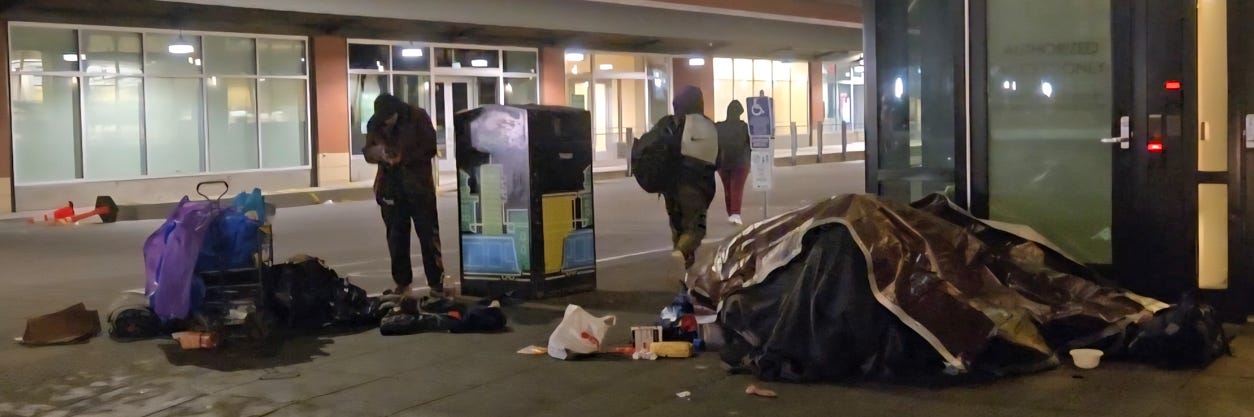
are dispersed in the morning.”Witt said that is not what has happened.
As shelter occupancy has risen to a peak of 155, cases of drug addiction, mental illness, assaults among shelter occupants have also gone up, she said. Meanwhile, social workers to guide people toward services and recovery programs have been trimmed down to two.
“Last night (Feb. 9), during the hour before Northrup Shelter check‑in, I drove the perimeter of the shelter and counted 51 people loitering within a single block of the site,” Witt said. “The mayor had repeatedly assured Pearl residents that shelter participants would not be allowed to gather in the neighborhood before evening check‑in or after morning release.
“Yet every night, dozens of people are allowed to violate those stated guidelines. Neither the city’s outreach teams, nor Salvation Army staff, nor Urban Alchemy (Portland Love) enforce the rules the mayor described.
“Bottom line is that the shuttle is being repurposed to serve all the [city] shelters, and being pulled from the Northrup-Oasis route that the mayor promised. The city is now saying it will be available only on an ad hoc basis [at the direction of] a couple outreach people who sometimes don’t arrive at the shelter until all the guests are gone.”
City Press Officer Cody Bowman said, “over time, it became clear that using the shuttle as a fixed-route service limited its ability to meet the needs of participants across the entire shelter system … as an on-call resource.”
“Since implementing this approach, our City Outreach Team has seen a demonstrable improvement in participants dispersing to the day center rather than remaining in the immediate area.”
Layne also said progress in the neighborhood is evident.
According to data collected by the city and posted at https://www.portland.gov/shelter-services/shelter-services-data-dashboards and a Portland Police Bureau dashboard (www.portland.gov/police/open-data), conditions are “getting demonstrably better … in some ways exceeding” goals, he said.
The shelter dashboard, however, only displays occupancy levels and shows nothing related to community impacts.
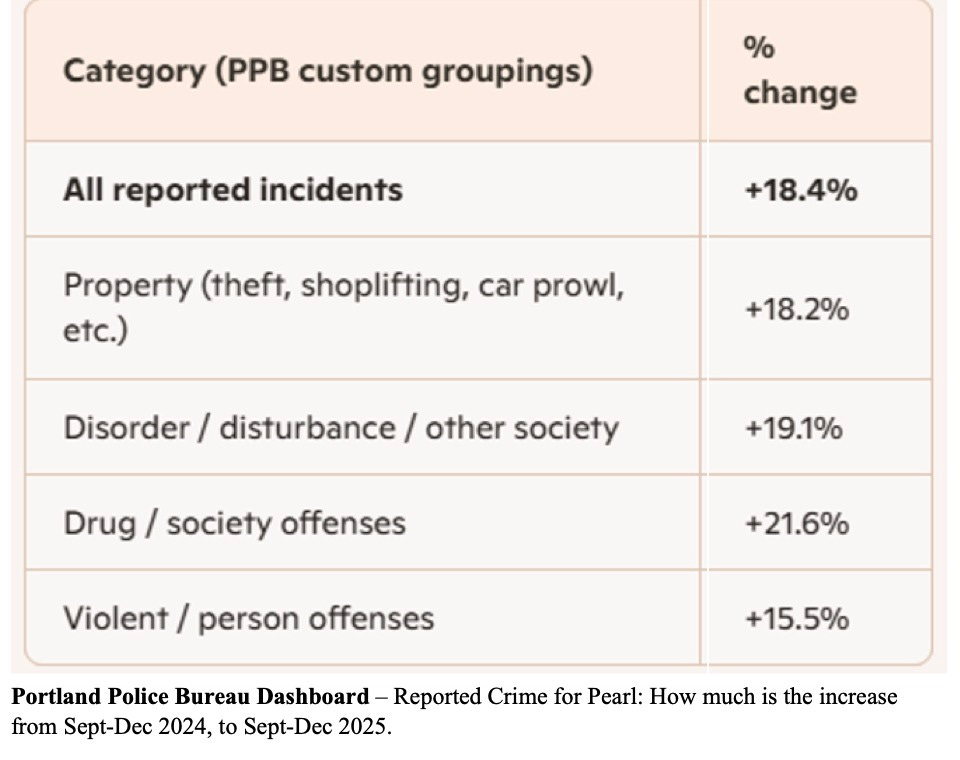
The Portland Police Bureau dashboard lists types of crimes by month and neighborhood. The most relevant breakdown compares crimes in the last four months of 2024 (before there was a shelter) versus 2025. Overall crime reports rose 18.4%, and the worst category was “drug/society offenses,” which rose 21.6%.
These figures do not include 1,800 incidents reported to the city (and PDNA) since the shelter opened.
Without unpacking the numbers and counterclaims, PDNA President Bruce Studer said, “Thank goodness we have 10 people going out every day to document what’s going on.”
Confirmation comes from beyond the neighborhood association.
Chase McPherson is executive director of the Northwest Community Conservancy, a nonprofit underwritten by local businesses and residents to provide security and humanitarian outreach in the Pearl District.
“In trying to get [people] to the day shelter,” McPherson told PDNA board members in January, “and then in the evenings into the night shelter, what we have noticed on our security team side is that between the hours of 4 and 8 p.m., we have a lot more people loitering about two to three blocks away from the shelter.
“Participants (or customers or clients) were told, ‘Don’t stand in line before an hour.’ Well, then they’re standing two or three blocks away, often in groups of three to as high as 20 to 25 at a time.”
An Old Town resident had a take on why the shuttle system was changed: To bring people from shelters across the city to the Oasis Day Center.
Others have noted that occupancy at the center is still sparse because users come in for immediate supplies and services and then move just outside, where substance abuse goes unchecked. Oasis has the capacity to handle more people; the surrounding neighborhoods may not.
Less than one mile from that shelter there is an industrial zone where the negative effects of the homeless/drug situation would be so much diluted.
Why do we put shelters in the most densely populated or visited areas where the social impact and the economic damage are the highest? There are many empty lots and empty buildings in the nearby industrial zones. There's Schoolhouse Electric less than a mile from the Northrup shelter and many other buildings closer. Why on earth do we not use these? No one lives there.
Having spent some time outdoors myself decades ago, I know I'd prefer the extra space and reduction in dirty looks. Also less hassle from the cops. Space is cheap so clientele could get more personal space. Given the low density, a heck of a lot fewer people would object.
Pluses would be:
Hundreds of thousands of vacant square feet making space cheaper.
More personal space for the clientele.
Less hostility from neighbors.
Most people feeling much safer most of the time.
Less damage to property values.
Less loss of property taxes.
It's just so horrible watching Portland would itself so deeply. Shouldn't the path that results in the least pain and damage overall be the right choice?