


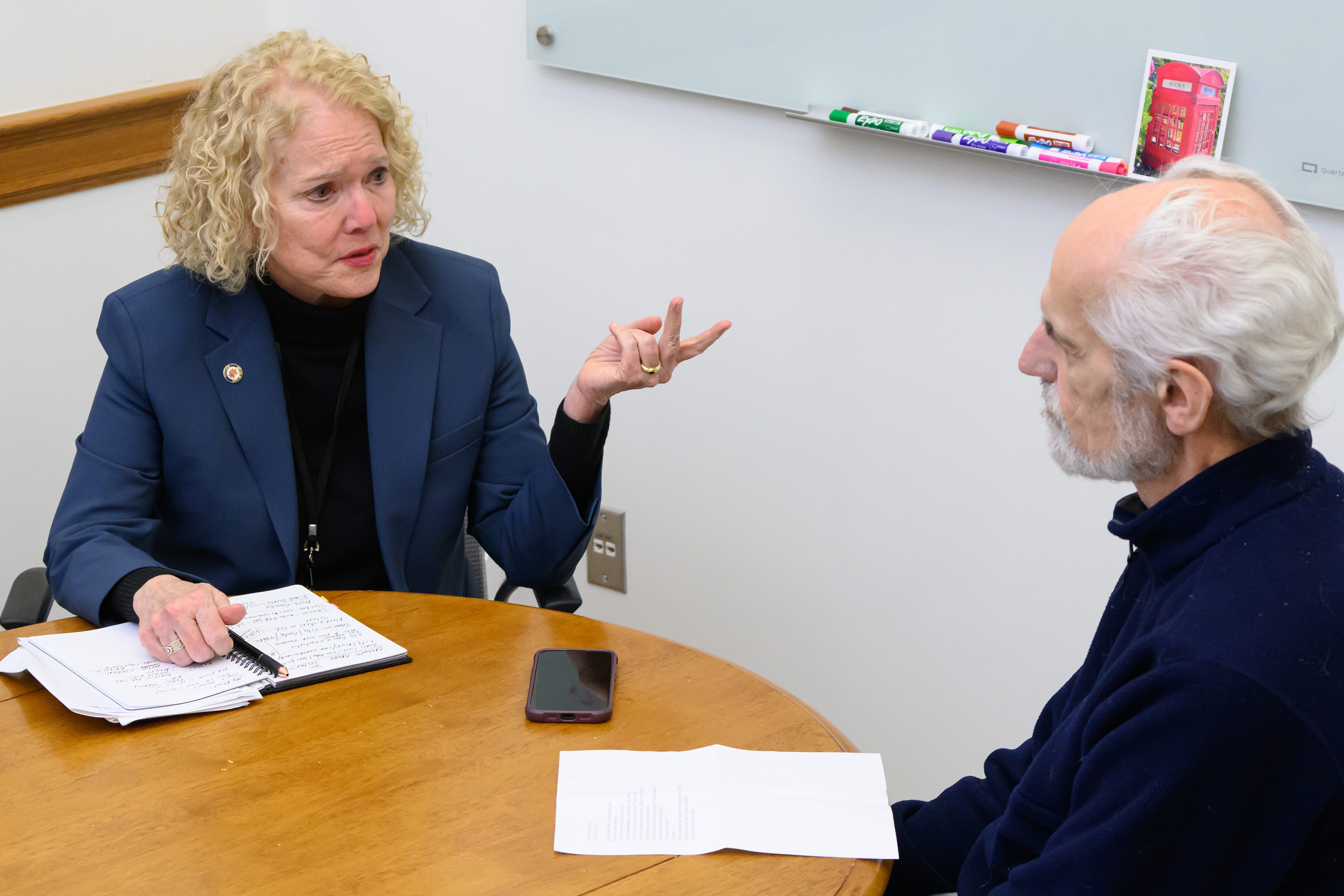
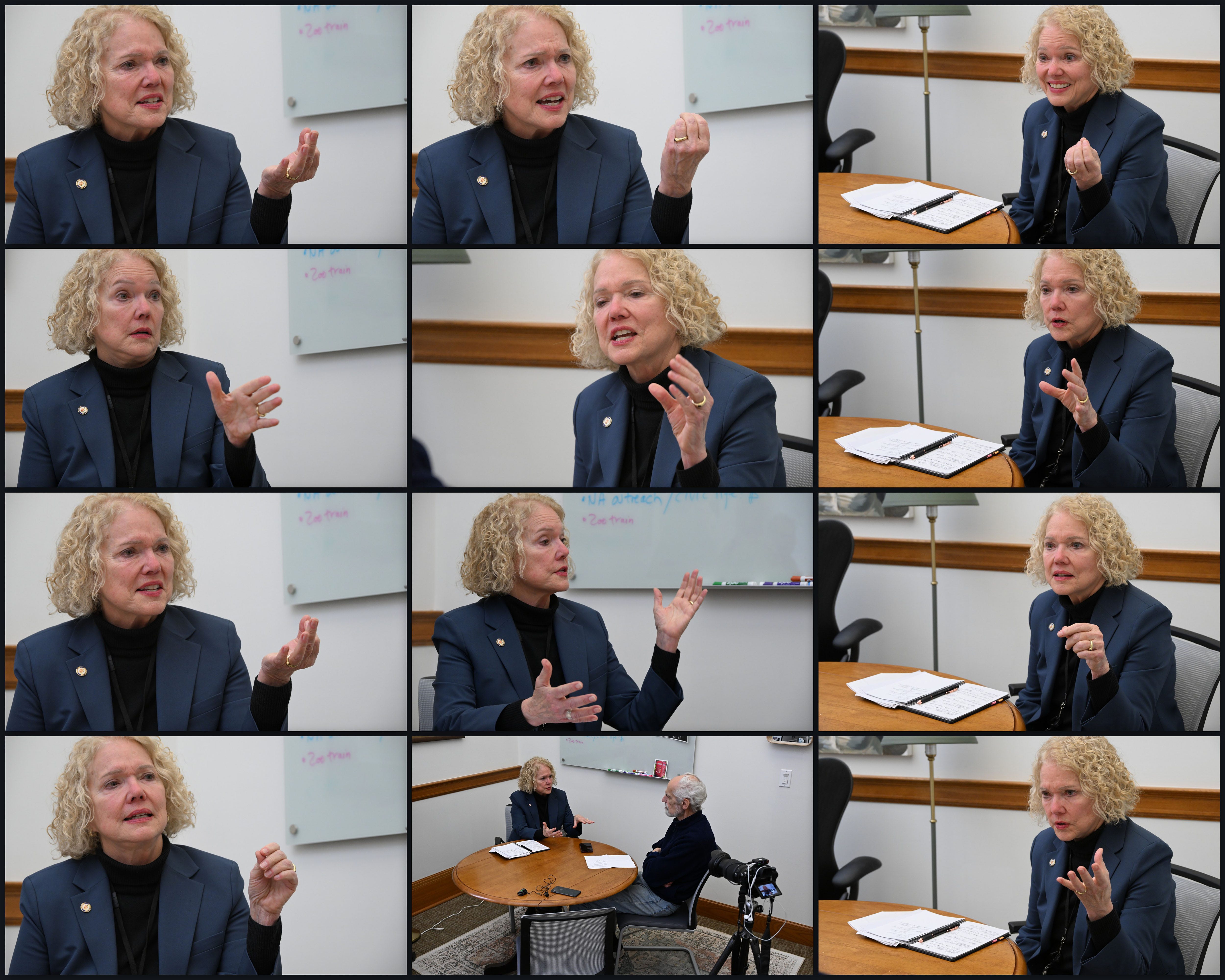
District 4 City Councilor Olivia Clark consumes less speaking time at City Council meetings than any of her 11 colleagues. But in a wide-ranging 45-minute interview with the NW Examiner — her first sit-down since she was elected two weeks ago as the council’s vice president — Clark had plenty to say.
“Don’t know if you’ve noticed,” she said, “but lately, I think I’ve been speaking up more. I just didn’t feel the need.”
And now she does.
In our conversation, which has been edited for clarity and brevity, Clark shares her thoughts on the Peacock caucus, Mayor Keith Wilson’s homeless plan, what she’s learned from the Northrup Street shelter rollout — and more.
Did you know what you were getting into?
Not exactly. I came out of retirement to run because I really thought we needed people who had experience at different levels of government or in the private sector.
A big surprise was resistance to setting priorities. I was surprised that people who got elected came in with a pretty angry attitude about the mayor, about the administration, about city government, about whatever it is. They were just angry. I was surprised that there was such animosity.
How do you feel about a de facto political party on council? Is that a good or bad thing?
I think it was an unfortunate thing. And I think that they’ve been called to task about it. I do believe that. I’m hoping that what the new council president has said, and other members of that caucus have said, that the caucus will no longer function that way, that people are leaving, that they’re not going to be doing that anymore. The proof will be in the pudding. I think the new council president had an interesting way of explaining it: There were people of a certain affinity that were just trying to organize themselves and figure out how to make things happen. OK, fine. That was then, but this is now. You don’t need that anymore. We do not need that caucus anymore.
Why are you often the “silent one” on the council?
I don’t feel like I need to express an opinion or pontificate on everything that comes up. There are other people that take up so much airtime.
What do you think District 4 needs most?
I was going to say, flippantly, that we need some sort of spiritual healing. Things are getting better. Eric [Councilor Zimmerman] and I both put money out of our office budget into PEMO [Public Environment Management Office] to clean up the I-405 corridor. We need a lot more of that.
What we really need — and not just in District 4 — is more police officers. We are so short. We have the same number of officers that we had in 1994 or ‘96, and we’ve grown by 175,000 people since then. That’s part of the reason that we have such a slow response time on 911. And that’s why we have so much overtime. There aren’t enough officers that day to staff a precinct. We need to be able to enforce the laws that we have on the books, and that would really help District 4 because of all the open-air drug use. It’s still a real problem for us.
Above, four quick questions for Councilor Olivia Clark. First question: “Did you know what you were getting into?” Video runs 1:57.
Are you still on board with the mayor’s homeless plan?
I think that we’ve all given the mayor the benefit of the doubt. We’ve all supported him because we know that homelessness and housing affordability is number one on people’s minds. He’s done what he said he was going to do, and now we’re waiting to see what the next step is. He’s just made his announcement about a certain number of affordable units. I think he’s done a great job in what he said he was going to do.
What do you learn from the rollout of the Northrup Street shelter?
Neighbors have to be vigilant and report what they see. It’s very difficult for this city to meet all the obligations that the mayor set out on his engagement zone: public safety, stop the drug use, stop the loitering, clean the trash up, etc.
Do you think the city bureaus are more responsive to the community now that council members don’t run them?
We’re not there yet. We had 26 bureaus that were all independent silos. Now they’ve been grouped into service areas, and they’re being tasked with professional city management to work across bureaus, to work with each other, and they’re going through tremendous culture change. This is a different way of doing business. They no longer have a politician managing them. They have professional city management. And so there’s going to be greater expectations and more accountability and more working across bureaus to solve problems. There’s a lot of change to come. A lot of what I would call culture change among city employees. And that’s aggravated by what they see coming in the budget.
How so?
We have a budget deficit. What is that going to mean for me? Am I going to have a job? So there’s a certain amount of anxiety. But I’ve certainly found the bureaus that I’ve been working with [to be] responsive, when I have a community issue, they’ve been responsive.
Are you meeting with neighborhood groups as regularly as you had hoped?
I think I’m doing more than I ever imagined. My priority is to make sure that the city continues to support the neighborhood associations. I’m hoping that the mayor sits down with each of us, like he did last time, when he crafted his budget. He met with each of us at least three times to hear about our priorities. And I think he intends to do that again. And I’ll make sure that funding the neighborhood associations is on my list of priorities.
It’s invaluable to the city to have active neighborhood associations that are conduits of information, both going to the city and from the city, and that they keep people engaged in their community.
In our District 4, it’s tough because you had a very organized northern part and a pretty organized southern part. Across the river—Sellwood, Eastmoreland, Westmoreland—had their own organization that really didn’t want to be a part of the District 4. I think Mayor [Ted] Wheeler just said, sorry, you’re in it. But I think that we’ve been able to manage that, or at least I feel I have, by being available to all of them, finding mutual issues.
What about your campaign? How do you say, you need to elect me?
I think I’ve done a pretty good job as a first-term councilor. My priorities reflect the district’s public safety at the top of the list, dealing with homelessness, supporting the neighborhood associations. I think I’ve done a good job. As chair of the transportation committee, the first thing I did out of the box was talk about asset management. That should concern everyone because all of us own something like $80 billion of assets that the former city councils for the last hundred years have really not cared for.
We are so far behind in taking care of what we own. I will continue to beat that drum. I put some money from my budget to set up a system for an asset management plan across all the bureaus.
How are we going to take care of what we have—parks, fire stations, 100-year-old water pipes? Really basic local government things. I’m one of the most boring people on the city council because I’m all about taking care of business: keeping us safe, making sure we have clean drinking water, that it’s safe. That’s the kind of person I am.
I’m also been working on issues specific to our district: the downtown, Keller Auditorium, the Zoo Train. Potholes are something I’ve been talking about a lot. Council passed my resolution on looking at other finance mechanisms for transportation, since the feds have backed out of things and the state’s not helping us right now. My resolution was to ask the City Budget Office to come back to us with ideas for how to raise revenue. They came up with 20 ideas. They’ve selected four that are most relevant. We are discussing that in my committee. Should we move forward? If there isn’t support for that, fine. But I think we’re going to have some vigilante pothole fillers.
The city has revenues for capital expenditures but not for maintenance or operations.
Exactly. Multiple city auditors over the years have issued audits saying you’re chasing shiny objects when you’re not taking care of what you have. I really attribute that to the form of government that we had for 100 years when you had politicians managing bureaus. We have a long way to go, and that’s why I did the asset management resolution. That’s why the city’s coming back with an asset management plan.
Clark presents the Peacock caucus as an unfortunate but temporary detour—an “affinity group” that should naturally dissolve now that the council has settled in. That framing misses the point. What that caucus said and did was not a personality problem or a transitional hiccup; it was the predictable result of the racial and ethnic identity ideology that informed the design of the new city council system itself.
Within that framework, race is not one political interest among many—it is politics. Anger is not incidental but constitutive; legitimacy flows from identity rather than persuasion; priority-setting is viewed with suspicion because it implies tradeoffs that dilute moral claims. From that perspective, governing as Clark understands it—procedural, pluralistic, managerial—is not neutral competence but complicity in an unjust status quo.
The caucus was therefore not obsolete on arrival; it was structurally incentivized. Expecting it to fade away misunderstands both the beliefs of its members and the incentives of a system that rewards factional moral authority over deliberation. Clark’s surprise reads less like insight than denial—or caution born of fear of offending colleagues or voters. Until someone is willing to say openly that identity-first politics is incompatible with effective city governance, this behavior will continue to be misdescribed as tone or temperament rather than ideology.
Glad to see that there are even-headed people on the Council. Hold steady, Olivia!