


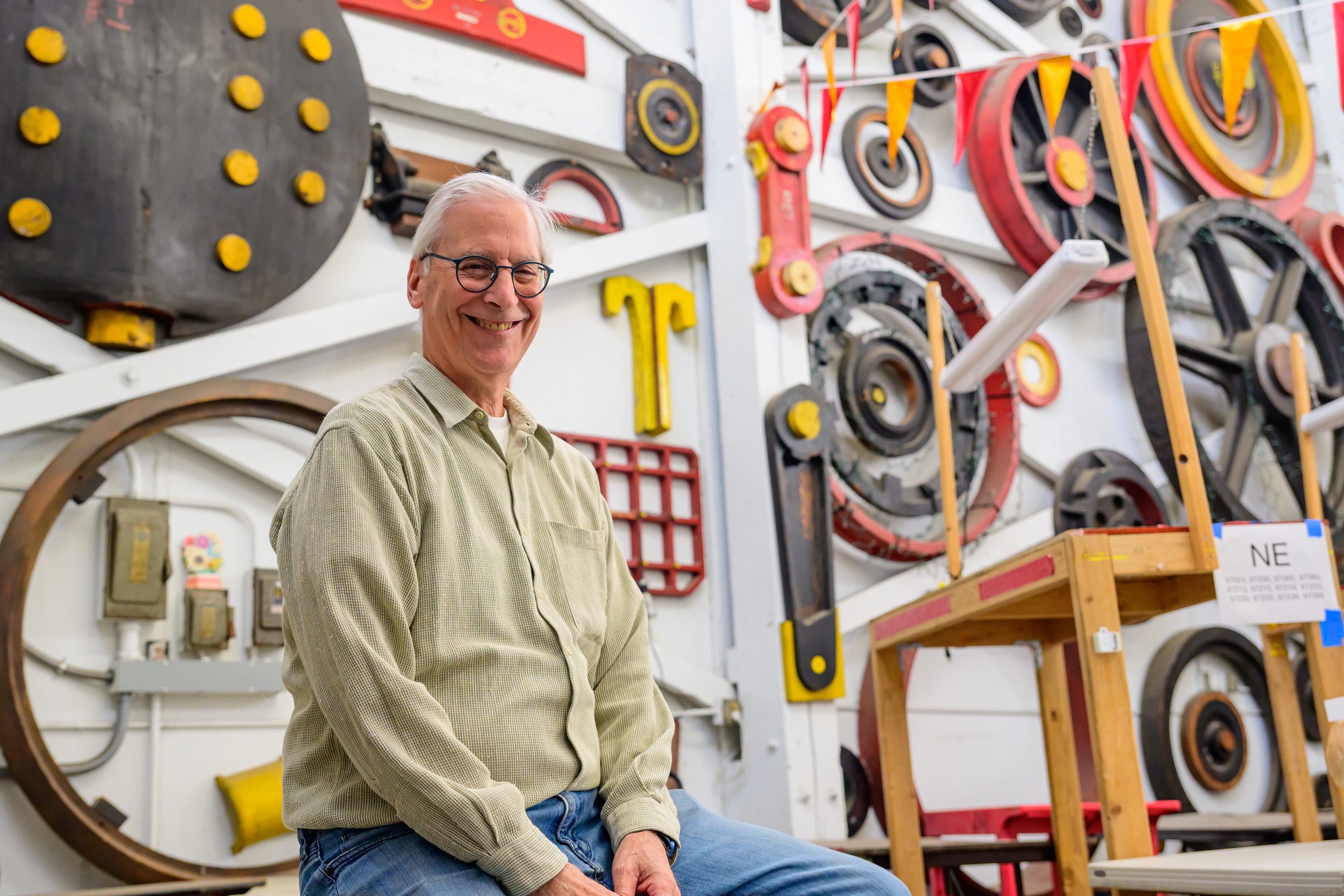
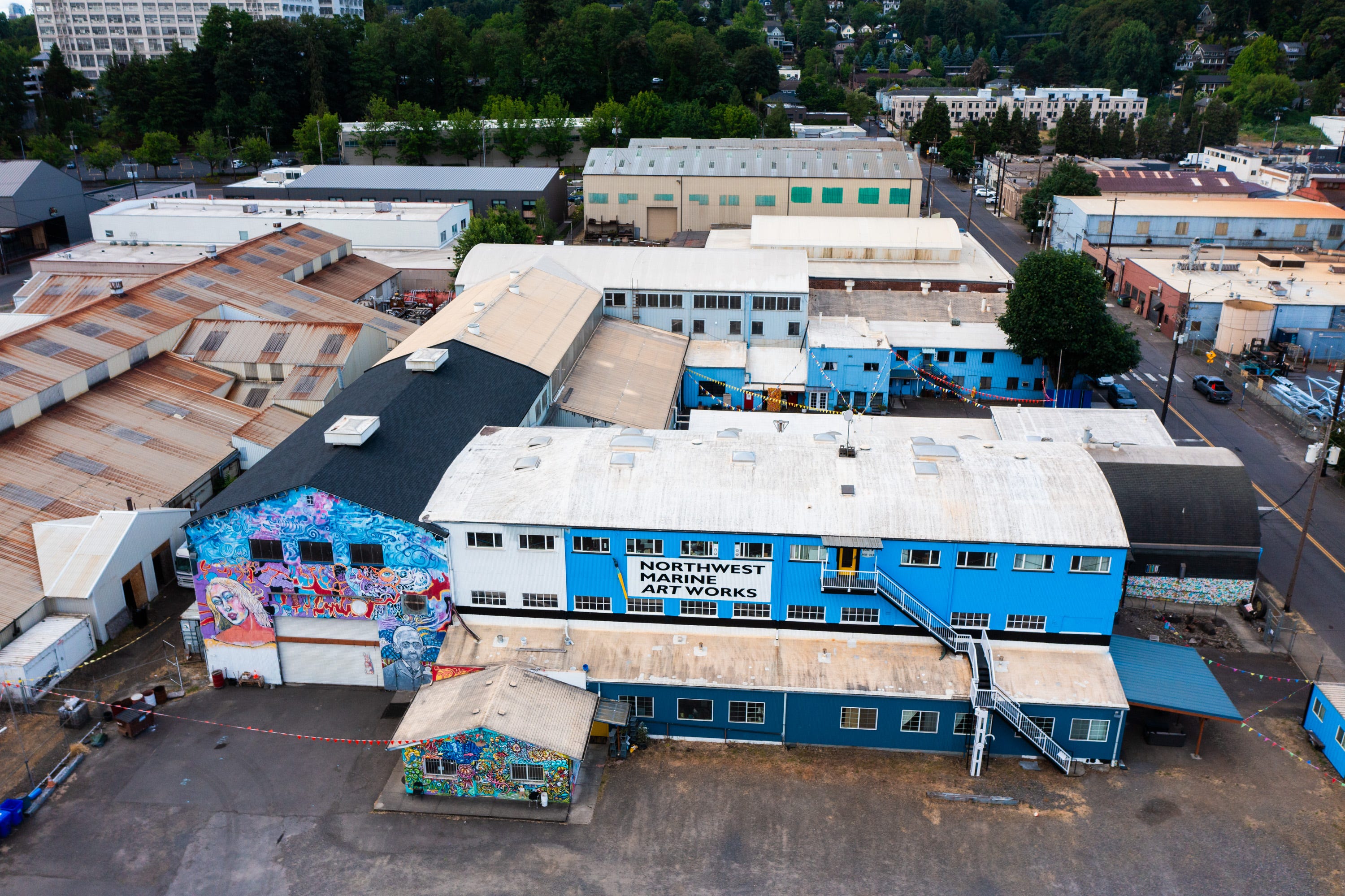
With a cheek-to-cheek smile Ken Unkeles tells us, modestly, that he prefers to think small. One might argue with that. After all, how many people do you know who would take the time, effort and considerable money to transform 62,000 square feet of nearly abandoned Northwest Portland industrial space into studio space for 75 artists — and in the process update the purpose and name of Northwest Marine Ironworks to Northwest Marine Art Works?
Besides making machinery for the timber industry, the ironworks company made parts for some iconic Northwest projects such as Portland’s Steel Bridge and the Bonneville Dam.
The company made parts for some colossal international marvels too, such as the Aswan Dam in Egypt. And Northwest Marine Ironworks also played a part in building the infamous Exxon Valdez oil tanker. That was the 987-foot long ship which ran aground in 1989, spilling 11 million gallons of crude oil into Alaska’s Prince William Sound.
By the time Unkeles bought the buildings in the early 1990s, the heyday of Northwest Marine Ironworks was long over and the hodgepodge of buildings was almost entirely empty.
In 2014, Unkeles got a seemingly crazy idea. He decided to turn 14 of his 15 buildings into studio space for artists. He’d pulled off similar renovations before, though on a smaller scale, with about a dozen other Portland buildings.
Unkeles also thought it might be interesting to document the process.
Enter David Poulshock, a longtime Portland avant-garde filmmaker who’d been renting space from Unkeles in a different building. Unkeles reached out.
Unkeles recalls he had something simple in mind, maybe a nice little 10-minute video about transforming his old building. “In my mind, I saw that fast frame thing, a time lapse where you see walls go up. That’s all I was thinking about.”
Clearly the businessman had never worked with an independent filmmaker before. Unkeles thought about the physical work involved in the renovation project. Poulshock, however, was already thinking on an entirely different wavelength. The film he had in mind had little to do with walls coming down and going up, but rather with space, place, art, time, life and transformation.
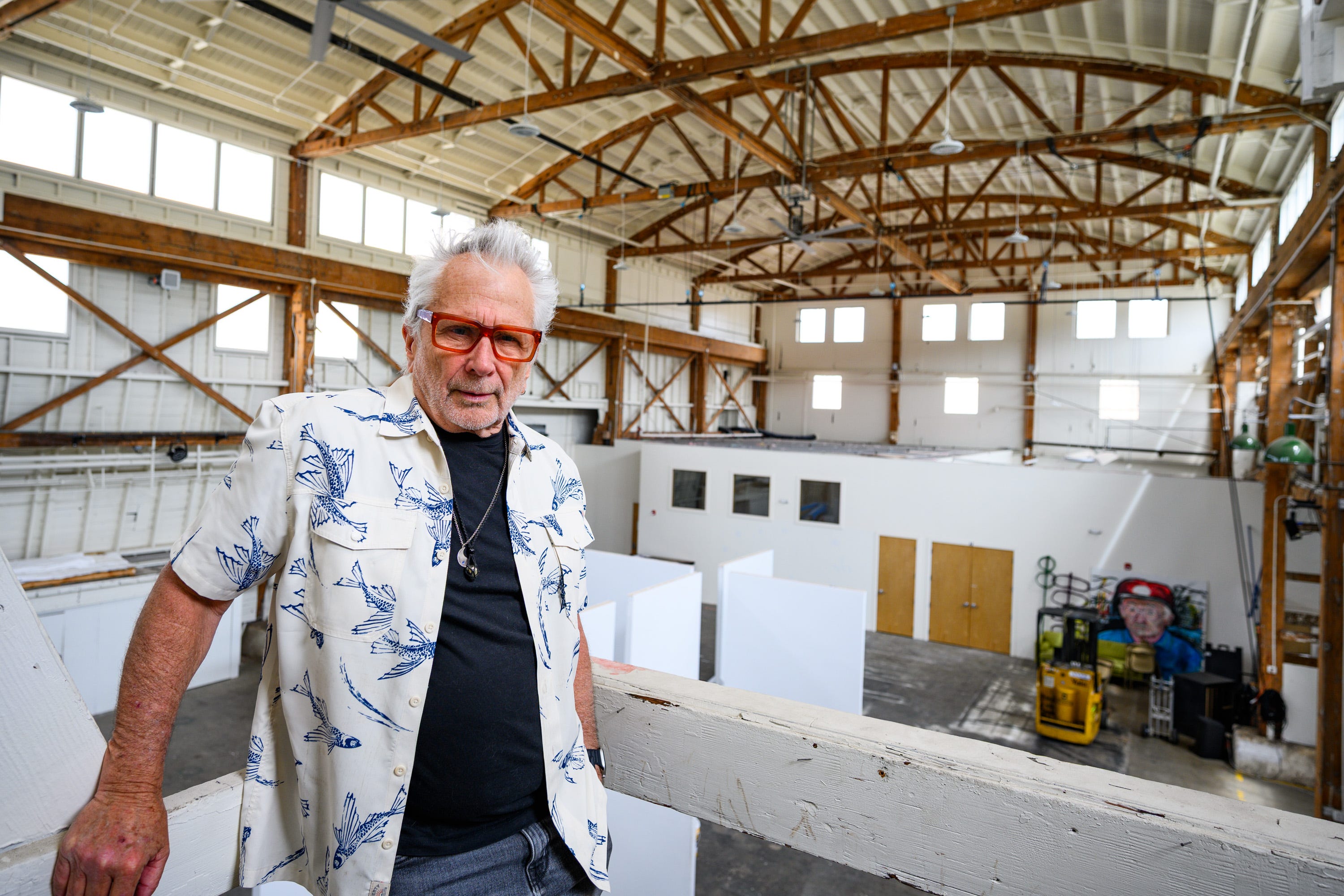
The filmmaker with lightning-white hair remembers his first conversation with Unkeles: “The plan was we’re going to document the construction and whatever, trials and tribulations. We’re going to document the artist moving in and then there’s going to be some kind of celebration and we’d shoot that. And then Tim moved in and everything changed.”
Tim would be Tim Stapleton. The late Portland painter unexpectedly became ‘the film’s heart and soul. Stapleton had already been diagnosed with ALS, a progressive neurodegenerative disease, when Poulshock met him. Stapleton died in 2020 before the film was finished.
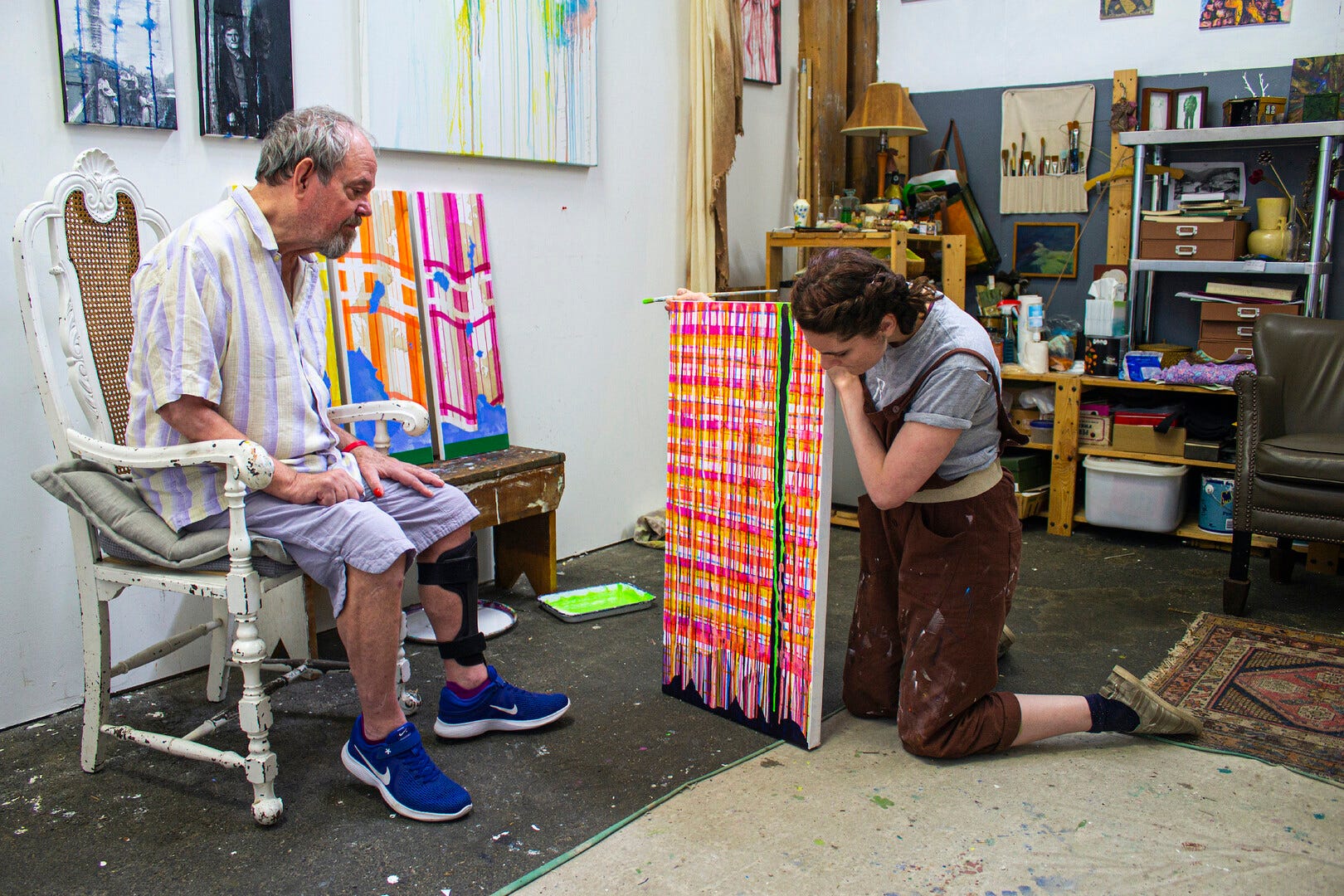
Inspired by Stapleton, Poulshock’s documentary film tells a profoundly human story — about an artist’s desire to create until the end of his life. The film chronicles Stapleton’s increasing physical limitations over time and his unwavering will to paint, even when he lay in bed, able only to instruct his assistant via Facetime on how he wanted her to apply paint to canvas.
Stapleton’s life and death and Poulshock’s philosophical mind — or as Poulshock likes to say “my jazzed out mind” — and six different cameras combine to tell a story about the meaning of life and art. The NW Examiner recently viewed a rough cut of the film, which was still being edited.
Poulshock asks the existential questions, “So the film’s question became, why make art? Why make this film? Why make anything if we’re all just going to die? … And the meditation on the meaning of art is sort of a meditation on the meaning of life and how to live and art is a way that we bring meaning to life, which is also how we bring meaning to space, which is what a place is.”
Poulshock pauses our conversation for a moment, then looks me straight in the eyes, and asks me a question, “Is that just way too esoteric?”
So yes, the film is esoteric and existential, but it’s also offbeat, even wacky at times. There are scenes in which jazz musicians set up shop in the still largely-empty Northwest Marine Ironworks and improvise on drums, keyboards and horns. It’s jarring, discordant and captivating. In one scene, Poulshock himself rides across the screen on a skateboard.
Unkeles hasn’t yet seen the film. Does he think the final cut will be what he originally expected? “No. God no.” Another one of those broad smiles crosses his face, then he quickly lets us know that he decided early on to just get out of Poulshock’s way.
The trailer (above) gives you an idea of Poulshock’s vision. One reviewer called the film a “disruptive meditation.” Another called it a “fever dream.”
More than a decade after Unkeles and Poulshock first discussed making a short video, the almost 2-hour long film — the final cut is still a work in progress — premieres in Portland this Friday, June 12 at Tomorrow Theatre, 3530 SE Division St.
Friday’s film is sold out, but a second screening has been scheduled for Friday, July 31 at Northwest Marine Art Works. Tickets are available here.
Learn more about David Poulshock and his work
The NW Examiner report on the recent Northwest Marine Art Works open studios