


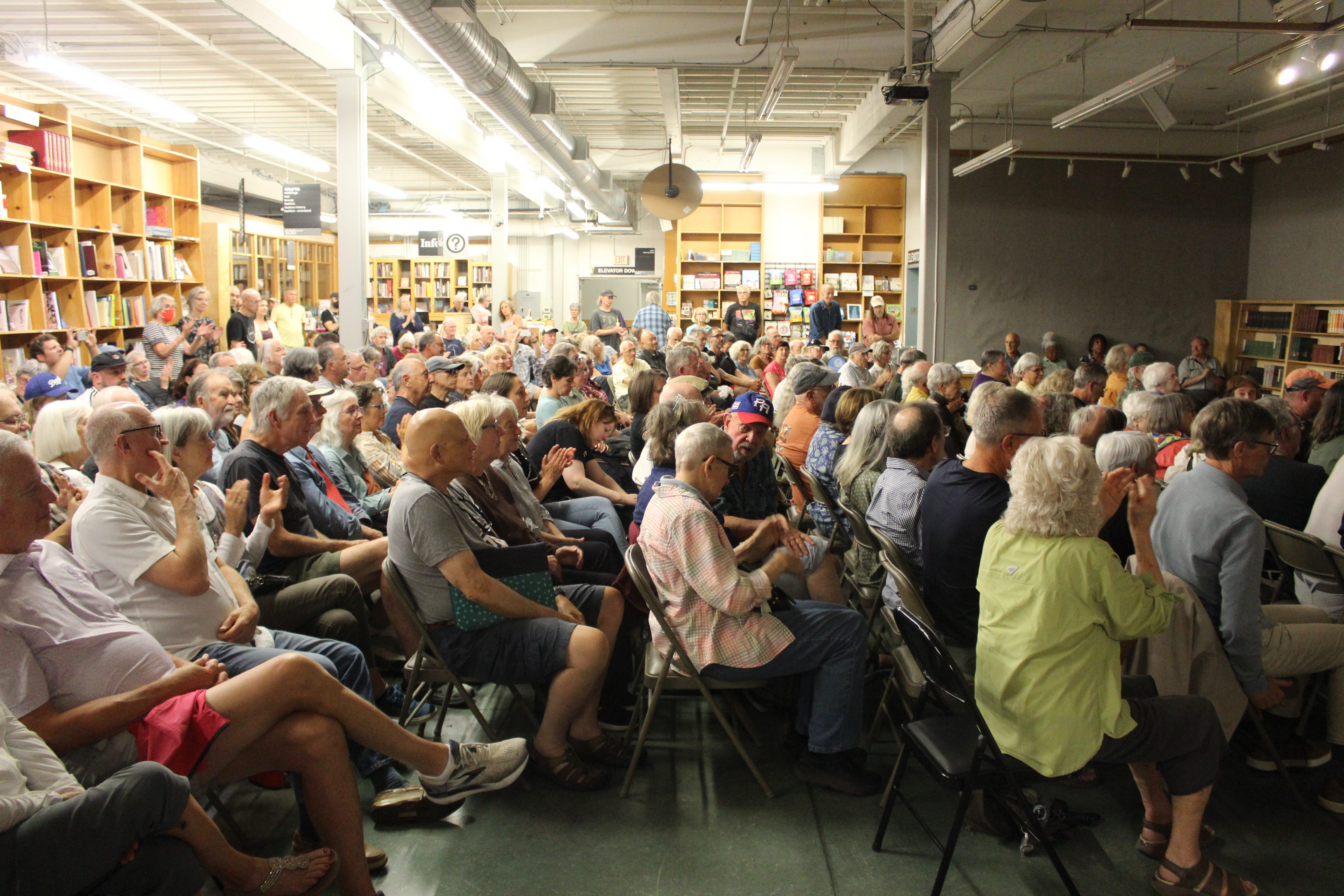
Not since the 1920s has the Ku Klux Klan inspired crowds of Oregonians to pack public forums. But the standing-room-only crowd of about 200 people at Powell’s City of Books didn’t gather to support the Klan, but rather to learn how the Klan became such a powerful political force statewide just a century ago and how a hate group could become dominant again.
Many Powell’s audience questions related to the Klan’s present-day incarnations and what history teaches us about stopping bigotry. Portland retired journalist Steve Law told stories of brave newspaper reporters and editors like Beatrice Morrow Cannady, who advocated for civil rights in spite of Klan death threats.
“I’m saddened to say, despite all of these heroic critics who risked their lives and livelihoods, that was not what killed the Klan; it was their own internal contradictions: greed, rivalry, corruption,” Law said.
What would inspire someone to write a book about the Oregon Klan in the 1920s? Law started his presentation by showing the view of Mt. Tabor from his home in the South Tabor Neighborhood, where turning back the clock just a hundred years, he would have seen the glow of fires as Klansmen burned six crosses, supposedly in front of a crowd of 2,000 people.
“They tended to exaggerate on stuff like meeting attendance and membership numbers,” Law said.
Exaggerations aside, Law bemoaned how Oregon’s ugly history as a hotbed of the Klan has gotten buried and vowed to do something about it. He joined the Friends of Mt. Tabor Park community association and spearheaded an effort to memorialize the terror the Klan caused at the park in hopes that such vile acts are never repeated. However, a Parks Bureau employee, worried that someone might be triggered by a small image of a burning cross, censored Friends of Mt. Tabor’s informational display, even though no public funds were used in its creation.
Law hadn’t forgotten about the censorship when he heard about German brass plaques that honor people who had been killed or displaced by the fascist state during the 1930s and ‘40s. While listening to a podcast featuring Bryan Stevenson, author of “Just Mercy: A Story of Justice and Redemption,” he realized that America not only doesn’t have the equivalent of Stolpersteine embedded in the sidewalks of Germany where Jews once lived. Stevenson contrasted the so-called stumbling stone memorials he saw in Germany with how many sites in the U.S. still honor Confederate officials and/or Klansmen.
At that point, Law told the crowd at Powell’s, he vowed to continue his quest to increase Oregonians’ awareness of their history, starting with a series of newspaper articles, which became the seeds of the 292-page “Peddlers of Hate,” accounting the Klan’s rise and fall during the decade.
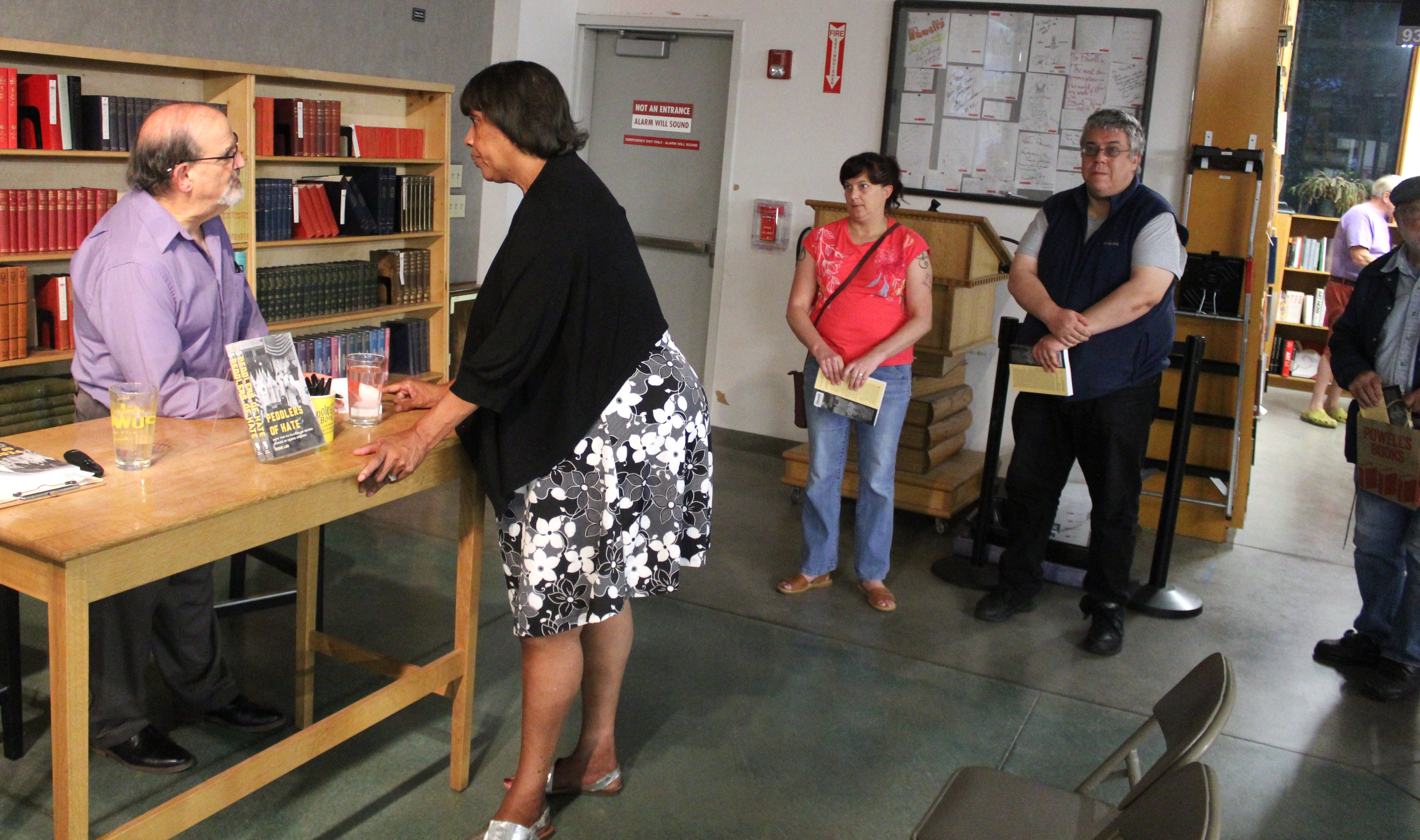
In Law’s view, Oregon has since had many political figures who act in the image of the Klan, even if they don’t wear robes. As an example, Law named Lon Mabon, who gained prominence in Oregon politics for spearheading a series of anti-gay ballot measures.
“A lot of people use hate to build up political power,” Law said.
Law extended the metaphor to present-day Make America Great Again acolytes, referencing a quote from President Donald Trump, who said some supporters of a Robert E. Lee statue were not members of the white nationalist “Unite the Right” group that attacked counterprotesters in 2017.
“Right now, wearing these robes is such a parody; they don’t do it anymore; it doesn’t lend you prestige to wear the Klan outfit anymore, so they come in different guises. Remember the good guys on both sides?” Law said.
Bravery shown by Klan critics, Law said, has parallels with the 10 House Republicans who voted to impeach in 2021.
“It’s kind of like being a Republican in today’s Trump World: You take on the leader and you risk retribution,” Law said.
But just as in 21st-century America, the press and politicians helped normalize hatred and made conditions ripe for the Klan’s spread during the 1920s. Law recounted the story of the Klan recruiting public officials and journalists to attend the organization’s “coming out” press conference in downtown Portland. It turned out that the Klan’s real motivation was to get rid of Catholic schools.
“Sometimes they tell the truth, like someone in the White House right now,” Law said.
Law generated uncomfortable laughter and the loudest groans of displeasure from his audience by recounting the Klan’s ridiculous rationalizations for bigotry that still echo among far-right groups today.
“Blacks have nothing to fear from the Klan, unless they preach and teach social equality. Negros must recognize that they live in the land of the white race at the courtesy of the white race,” Law said, paraphrasing a Portland speech given by the Rev. Reuben Sawyer, a Klan orator. “Klansmen didn’t see Jewish people as their enemy either,” Law said, “except those who rejected the teachings of Jesus. And the Klan wouldn’t fight the Catholic Church, he said, unless it injected itself into state affairs.”
Oregon Gov. Ben Olcott issued a strongly worded proclamation when he realized that the Klan was gaining power. Despite Olcott’s warning, the Klan succeeded in taking over the legislature and governor’s office.
The Klan’s anti-Catholic school ballot measure was successful among a majority of Oregonians who bought into the idea that it would be egalitarian to force all students through public schools. St. Mary’s Academy, the oldest continuously operated secondary school in the state, is still extant in downtown Portland, thanks to a Supreme Court ruling that made the Klan’s anti-parochial school ballot measure unconstitutional.
But the damage was already done. Dozens of Klansmen were armed and deputized by the Portland and Oregon State police. There’s strong evidence, Law said, that the Medford police chief who was a Klansman attended a “necktie party” to terrorize a man out of town. Law said it’s difficult to determine how many other acts of terrorism could be attributed to the Klan during the 1920s. The Klan did its best to destroy its written records statewide, and court cases involving the Klan proved difficult to prosecute, with many friends of the Klan in high places.
Law isn’t giving up on his quest to help install public informational displays about 1920s Oregon. Next year, Law hopes to travel to Eastern Oregon with Oregon Remembrance Project founder Taylor Stewart to memorialize the lessons of our history.
The "second-wave Klan" was hardly just an Oregon phenomenon. Native populism is a pre-modern instinct that is hard-wired and found in all political tribes. The emphasis on majoritarianism and illiberal values can emerge from progressive or conservative politics. Democratic President Woodrow Wilson and his Progressive Party imbued the 1920's "100% Americanism" movement with an elite patina. His resegregation of the American Government, eye-winks to eugenicism, and screening of DW Griffiths "Birth of a Nation" in the White House are hints to this despicable progressive legacy that one sees echoes of today on the left in the DSA. Horseshoe Theory in action.
Steve Law’s book is an interesting read with a wealth of historical detail, although the subtitle—How the Ku Klux Klan Seized Power in 1920s Oregon—seems deliberately provocative and may overstate the Klan’s actual control of state government, perhaps reflecting the demands of book marketing as much as historical precision. As someone deeply interested in Oregon history, I would suggest reading David Peterson del Mar’s Oregon’s Promise: An Interpretive History first. Del Mar provides the broader historical context that makes Law’s focused account of the Oregon Klan more meaningful. Overall, Law’s book is a valuable addition to the literature on Oregon history.