



When the Ku Klux Klan took over Oregon politics during the early 1920s, they picked a spot right here in the neighborhood as the headquarters of their anti-Catholic, anti-Jewish, anti-immigrant and anti-Black hatemongering.
Portland’s first Klan recruiter in 1921 immediately set up shop at the Multnomah Hotel. Lemuel “Bragg” Callaway, the Klan’s paid recruiter organizing a local chapter, saw Portland as ripe for the taking, as described in former Portland Tribune journalist Steve Law’s new book “Peddlers of Hate.”
“The second version of the Klan built its following by bashing Catholics, immigrants and other minorities,” Law said, “so this century-old saga remains eerily relevant today.”
At the time of the Klan’s arrival, a fifth of Portland residents were immigrants, and more than one in every 11 Portlanders were Catholic. Anti-Catholic forces had just seized control of the Portland School Board in the spring 1921 election, defeating a four-person slate endorsed by the City Club of Portland and by three of the four daily newspapers.
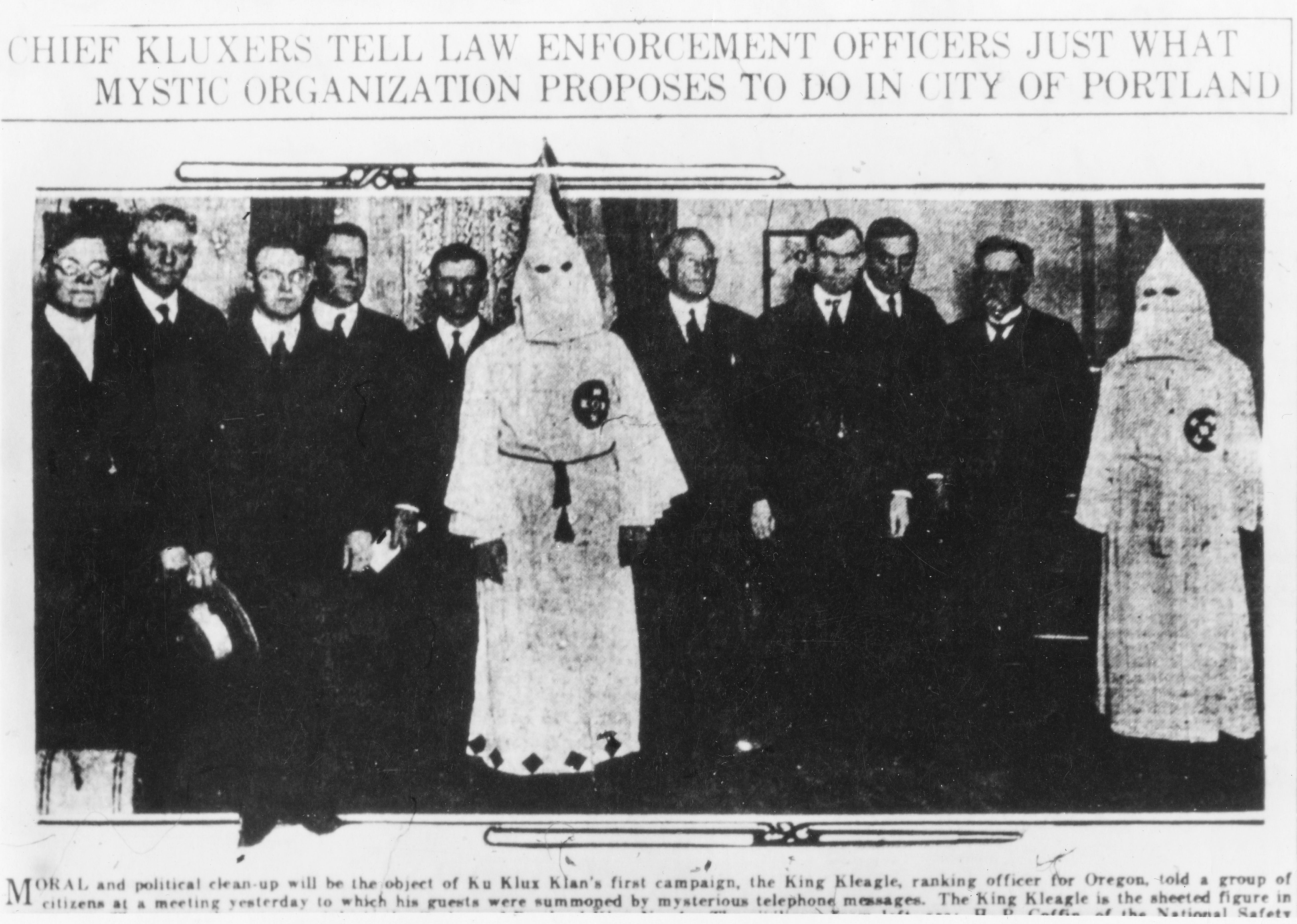
The Portland Telegram published a banner headline “Portland Invaded by Ku Klux Klan” in June 1921, just five days after Callaway’s arrival, but the article aided the Klan in its recruitment efforts. Callaway was fired, presumably for breaking the Klan’s code of silence, but then two other Klansmen scored a public-relations coup at the same hotel, which is now listed on the National Register of Historic Places and operates as the Embassy Suites by Hilton Portland Downtown.
Unidentified Klansmen contacted city and federal law-enforcement officials, along with members of the press, to the Oregon Klan’s coming-out presentation at the Multnomah Hotel. City and federal officials answered the call and arrived to the hotel to be greeted by two hooded Klansmen, later identified as “king kleagle” Luther Powell and “exalted cyclops” Fred Gifford, who was appointed to run the Portland chapter so Powell could focus on opening up others around the state.
Once the photo of hooded Klansmen meeting with Portland officials was published, public curiosity about the hate group skyrocketed statewide. Days before Christmas, the Klan attracted more than 6,000 Portlanders to a paid lecture at a downtown hall now called Keller Auditorium. At the peak of the Klan’s influence, it had captured the governor’s and mayor’s offices and had about 50,000 white Protestant members.
“In its ascent to power between 1921 and 1924, the Klan could command audiences of thousands to attend its rallies, lectures, parades and cross burnings in every nook, cranny, city, town and village of the state,” said Darrell Millner, professor emeritus of Black studies at Portland State University.
“Law documents these events in intimate detail, naming names, dates, locations for all to see. It is a scary story.”
Powell’s City of Books, 1005 W Burnside St., will host a conversation with Law about the Klan at 7 p.m. on Wednesday, Aug. 26.
The 1920s Klan was very different from the post-Reconstruction Klan most people picture. It was a national mass movement with several million members at its peak, commonly estimated at around four to five million, and chapters from California to Maine. It promoted native-born white Protestant identity, cultural conservatism, Prohibition, and “100 percent Americanism,” while attracting parts of the white middle and working classes.
Anti-Catholicism and antisemitism extended well beyond the Klan; both were part of mainstream American life—almost Main Street prejudices. The Immigration Act of 1924 used national-origin quotas to sharply restrict immigration from southern and eastern Europe and effectively excluded immigrants from most of Asia. John F. Kennedy still had to reassure voters in 1960 that a Catholic president would not take orders from the Pope. Antisemitism was also reflected in university admissions quotas, housing restrictions, and private clubs. Portland had its own example: the Arlington Club admitted its first identified Jewish member, attorney Moe Tonkon, in 1969. Nor is antisemitism purely historical; even liberal Reed College recently settled federal civil-rights complaints arising from allegations of antisemitic harassment of Jewish students.
Oregon was overwhelmingly white, native-born, and Protestant, giving the Klan fertile political ground. What makes the period so interesting is that the Klan was not simply a fringe organization. For a brief time, ideas we now associate with extremism became part of ordinary Oregon politics. Its rise was also remarkably short-lived. By the middle of the 1920s, scandals, internal fighting, political overreach, and growing discomfort with its extremism began to destroy its respectability.
For me, that is the larger lesson. There are uncomfortable echoes today in parts of MAGA, particularly in replacement theory and other nativist ideas, including the question of who gets to decide who is American and what it means to be a “real American.” That does not make MAGA the modern Klan, but the historical pattern is worth watching: prejudice becomes far more consequential when it moves from the fringe into mainstream politics.
The Klan’s political power in Oregon was short-lived, but it remains a fascinating period of the state’s history, and one that is somewhat personal because several members of my family were involved with the organization.
I look forward to reading this new book, but for anyone interested in Oregon history, I strongly recommend Oregon’s Promise: An Interpretive History by David Peterson del Mar. It is an accessible history that looks beyond the familiar pioneer narrative and gives considerable attention to people and movements often left at the margins of Oregon’s story.
To enter the United States you were directed to Ellis Island. Not everyone was allowed in. It made our country safe. They did not ask for hand outs but had jobs, usually working two jobs. Living in a small studio with several other immigrants. Saved and started small business. too busy to cause problems or ask for hand outs.