

by Robert S. Miller
The Charter Commission wanted districts that would elect Black, Latino and Asian councilors. Portland’s minorities don’t live in concentrated enough neighborhoods for any district map to do that. So the commission replaced districts with a counting rule: any group that is a quarter of the voters and votes as a bloc gets a seat. The group that turned out to be a quarter of the voters and voted as a bloc was the DSA. The rule did what it was written to do. It was written for someone else.
Nobody redrew a map. That would have been crude, and somebody would have noticed. They gerrymandered the math.
The maps
Portland’s 20-member Charter Commission did the work in the open. It heard research on minority representation three times. The first study ran 100,000 computer-generated maps of the city at five, seven and nine single-member districts, looking for one in which a community of color would be a majority. There wasn’t one.
The Supreme Court has a test for exactly that situation, and it is 40 years old. Under Thornburg v. Gingles, a minority group is entitled to a district of its own only if it is large enough and compact enough to be a majority in one. If it isn’t, the Voting Rights Act requires nothing. The commission’s own research said Portland’s minorities fail that test.
The law said stop.
The commission kept going. Its progress reports say single-member districts would keep people of color from electing a candidate of their choice because they are not concentrated in any part of the city, and that multi-member districts elected by proportional ranked choice would let a candidate with 25% support win a seat. If geography would not produce the seat, the counting rule would. Twelve seats, four districts, three per district and a quota of a quarter plus one.
The three changes went to voters as one measure: the new form of government, the districts and the counting rule. A poll the commission never saw found that Portlanders overwhelmingly wanted them on the ballot separately. Commissioners said they were too interdependent to separate.
On June 14, 2022, the commission voted 17 to 3 to send the package to the ballot. The three who voted no were David Chen, David Knowles and Vadim Mozyrsky. Mozyrsky’s alternative was seven single-member districts.
The trick
Let me show you the trick, because it is a good one. Portland elects three councilors from each of four districts. Under the single transferable vote, the election quota for one of those three seats is a quarter of the valid vote, plus one. Not a majority. A quarter. That is how proportional representation is designed to work: A cohesive minority can win representation without needing 50%.
Now suppose an organization can get roughly a quarter of the voters in each district to rank its candidates in a disciplined order. It can secure one seat in each district: four reliable seats on a 12-member council. Count to seven and it needs three more votes. That is where coalitions, slates and binding political commitments become important. The mathematics does not hand anyone a majority. It gives a well-organized minority a durable starting position.
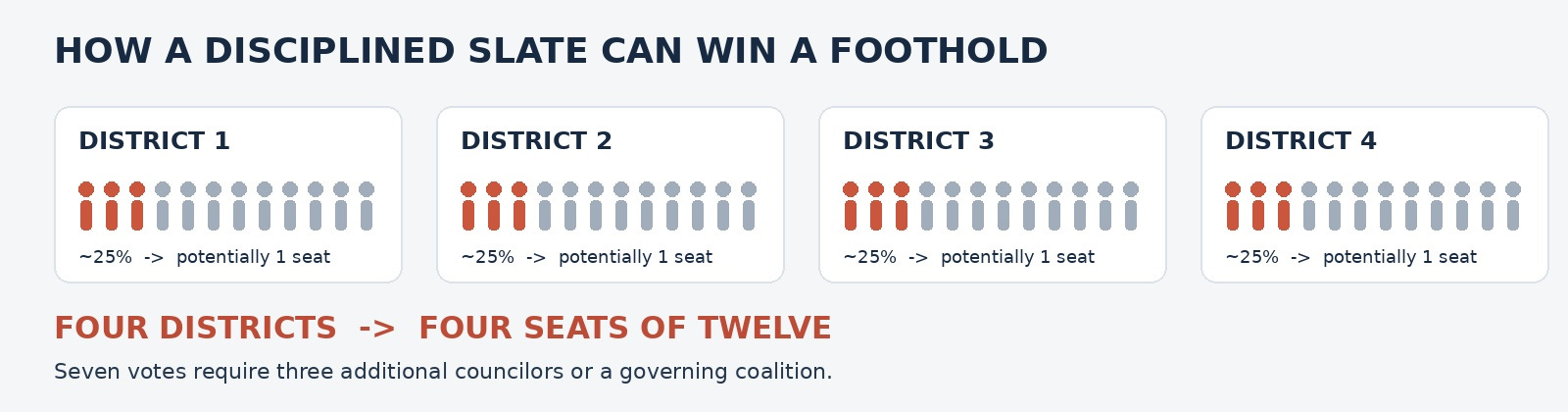
You never needed a majority to establish a foothold. You needed a list and the discipline to follow it.
I spent 50 years in gambling. Gamblers trust the game, not the house. Here the incentives built into the game deserve a hard look. The disciplined slate is an awfully attractive bet.
So organizations did what organizations do. They wrote pledges. Candidates signed them before the election. The determination can precede the discussion. A councilor may arrive at the dais with a position already promised to somebody other than the voters. That is not a conspiracy. It is the strategy the rules reward. But it raises a question worth asking: Whose judgment did we elect?
The rule is blind to race, geography and intent. It rewards exactly one thing: a bloc that is a quarter of the district and votes in order. The commission assumed that bloc would be communities of color. The one group in the city with a membership list, a pledge and a ranking order was the DSA.
Now ask what that does to an independent voter. If your first choice gets a quarter of the district plus one, she is elected whether or not anyone coordinated. But an independent’s first choice almost never does, because independents don’t agree with each other about who that is. Twenty-one candidates ran in District 4, and the unaffiliated voters spread their first choices across most of them. A quarter of the district voting independently elects nobody. A quarter of the district voting in order elects one.
So your vote counts in full only if one of two things is true: you are part of a bloc, or you rank deep enough that your ballot keeps transferring until it lands on a winner. Most people do neither. They rank two or three, the ballot exhausts, and the seat goes to whoever had the list. Under this system an independent vote is a bloc of one, and the rule only counts blocs.
Who paid
Measure 26-228 was not free. The yes campaign, Portland United for Change, reported $1,036,881 in contributions during 2022 to the Oregon Secretary of State. Here is where it came from.
Donor Amount
1 Coalition of Communities of Color Portland $211,213
2 Oregon Ranked Choice Voting Advocates Corvallis $177,872
3 Building Power for Communities of Color Portland $118,096
4 ACLU Oregon Portland $101,500
5 FairVote Action Takoma Park, MD $75,000
6 Northwest Health Foundation Portland $50,000
7 Unite America PAC Denver $50,000
8 North Star Civic Foundation Portland $44,676
9. Christy Eugenis, Portland 20,000
10 James Kelly, Kimberly, OR $20,000
The arithmetic of the list:
• Ten donors: 84 cents of every dollar
• Sixty-six individual Portlanders: nine cents of every dollar, $96,003
• Out of state: $138,302, 13 percent
• Coalition of Communities of Color and its political arm, Building Power, together: $329,000, nearly a third of the campaign
The organization whose constituents the counting rule was written for paid for the counting rule.
Unite America describes its mission as reducing polarization. It put $50,000 into Portland and got four socialists on the council.
None of this is a conspiracy. The people who paid to build this system are not the people who captured it. Good-government reformers and equity nonprofits bought a system that rewards disciplined slates, and the disciplined slate that showed up was not the one they had in mind.
The witnesses for the prosecution
You do not have to take my word for the problems. Take theirs.
The NW Examiner sent a written questionnaire to District 4 candidates, incumbents and challengers alike. Three respondents already hold council seats. One is trying to win one. Their responses point to two related problems: who gets represented and whether the resulting government can govern. The summaries below are paraphrases of their responses, not verbatim quotations.
ELI ARNOLD, challenger. No District 4 councilor lives in the northwest or southeast portion of the district. He recommends single-member districts. Think about that one. The district was drawn to give neighborhoods a voice, yet some parts of it have no councilor living among them. The man asking for a seat is pointing at the empty chairs.
OLIVIA CLARK, 4 incumbent. The city should eliminate ranked-choice voting or change Portland’s particular single-transferable-vote arrangement. Clark is challenging the election mechanism itself. The combination of multi-member districts, transferable voting, and public matching funds merits scrutiny as a system, not as three independent provisions.
MITCH GREEN and ELI ARNOLD, incumbent and challenger. Their responses describe unelected administrators approving severance and nondisclosure arrangements without timely council oversight. That is a governance problem rather than a mathematical one. But it is no less consequential: Who is accountable when public obligations are created outside public view?
ERIC ZIMMERMAN, incumbent. A 12-member council without sufficient executive checks struggles to decide. He favors eight councilors and a mayor able to break a tie.
Zimmerman proposes a different council size from mine, but we agree that the present allocation of responsibility deserves reconsideration.
Three sitting councilors and one candidate. They have not supplied one unanimous reform program, and not every complaint is about election arithmetic. But together they are telling us that parts of the machinery do not work. The incumbents are among the system’s winners. The challenger is asking to join them while questioning its design.
The way out
The impossible has happened. I have become radicalized.
Not by a culture war. Not by a party. I have been radicalized by a question I did not expect to be asking at 78 in a city I chose at 68: Do the people of Portland have the right to representative government?
I thought that one was settled. In 1964, Supreme Court Justice Earl Warren wrote that legislators represent people, not trees or acres. One person, one vote. I was a junior in high school. Nobody I knew thought it would come up again.
In 1986, a Louisiana progressive named Sam LeBlanc told me what we should expect from the people we elect. He called it pretty good government. It took me years to understand how ambitious that modest phrase was. People with different convictions accept the rules, do the city’s work and answer to the voters who sent them. A coalition can help a candidate win an election. It must never be allowed to acquire their vote after they take office.
So what does a city do when the people it elected under a system tell it the system is broken?
The charter provides for periodic review, but we do not have to wait. There are two doors. The council can refer a charter amendment to voters. Or citizens can organize an initiative, collect signatures, hire lawyers and pay for a campaign. The second door is harder to open, but it does not depend on councilors voluntarily changing the system under which they won. Somebody paid a million dollars to build this system. Somebody will have to pay to change it. The first check will tell us whether the civic coalition is a coalition or just a mailing list.
Here is the reform I would put before voters. It is my proposal, informed by the councilors’ concerns, not a plan on which those councilors have collectively agreed.
Five fixes. One ballot.
1. Nine districts, one councilor each. Nine neighborhoods, nine councilors, each one living among the voters who elected them.
2. One vote per voter, and a majority to win. A runoff between the top two if nobody clears 50%, the way Portland elected its commissioners for a century.
3. A mayor who can say no. Meaningful veto authority, subject to an override by six of the nine councilors.
4. No secret severance. Public approval of severance commitments above a defined threshold, without routine confidentiality clauses that conceal public spending.
5. Pledges on the record. If a candidate accepts the city’s matching funds, every organizational pledge is filed promptly with the Auditor so voters can read what has already been promised before they vote.
That last one does not need an initiative. The matching-fund rules are city code, not charter. The council can adopt it by ordinance, and the councilors who told the Examiner the system is broken can vote on it before the year is out.
Nine neighborhoods, nine councilors, each one living in the district whose voters elected that councilor. The west side becomes two districts, East Portland beyond I-205 becomes two, and the middle becomes five, with Sellwood on the east side of the river where it belongs. Those are concepts, not surveyed boundaries. The Independent District Commission would draw the real lines.
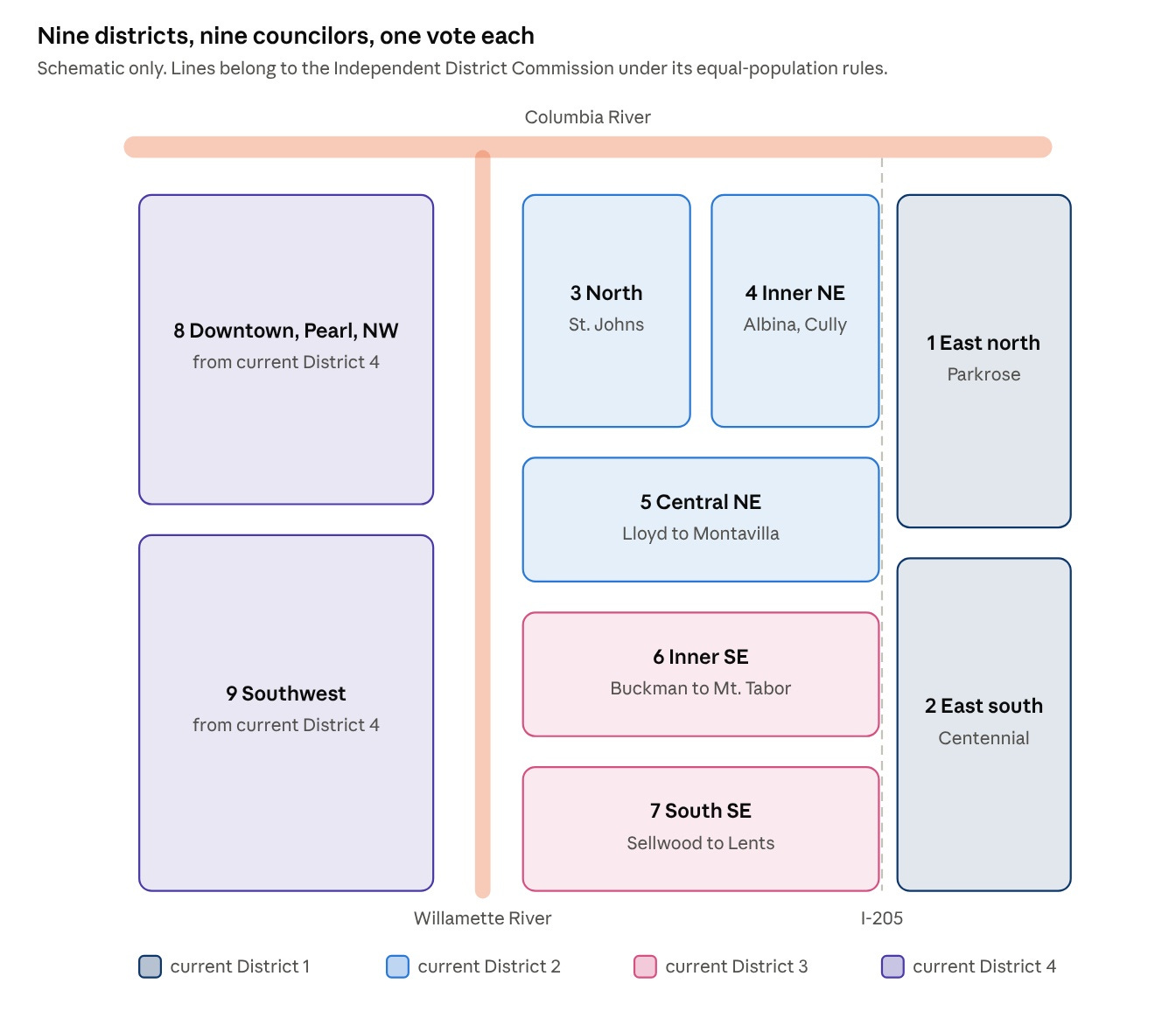
None of that strikes me as radical. It is an argument for municipal government whose elected representatives are individually answerable to identifiable voters.
I said I had been radicalized. Here is what it amounts to. I want the people of Portland to have the right to elect their own representatives, one at a time, and I want those representatives to answer to the people who elected them and nobody else. That used to be the floor. In Portland it is now the ceiling, and the only way to raise it is to change the charter.
The commission ran 100,000 maps and could not find the city it wanted, so it wrote a rule that did not need one. The councilors gave us the diagnosis. The arithmetic exposed the incentive. The initiative is the door citizens can open themselves. Walk through it.
Next: what the initiative costs, who pays, and the calendar to May 2028.
Robert S. Miller is a Pearl District resident and president of a gaming technology company. He uses AI tools, Claude and ChatGPT, to gather public records, run the numbers and check facts.
The horror... When somebody other than nice white people and the business and real estate interests they represent tries to have real political power in Portland. The horror... the horror....