


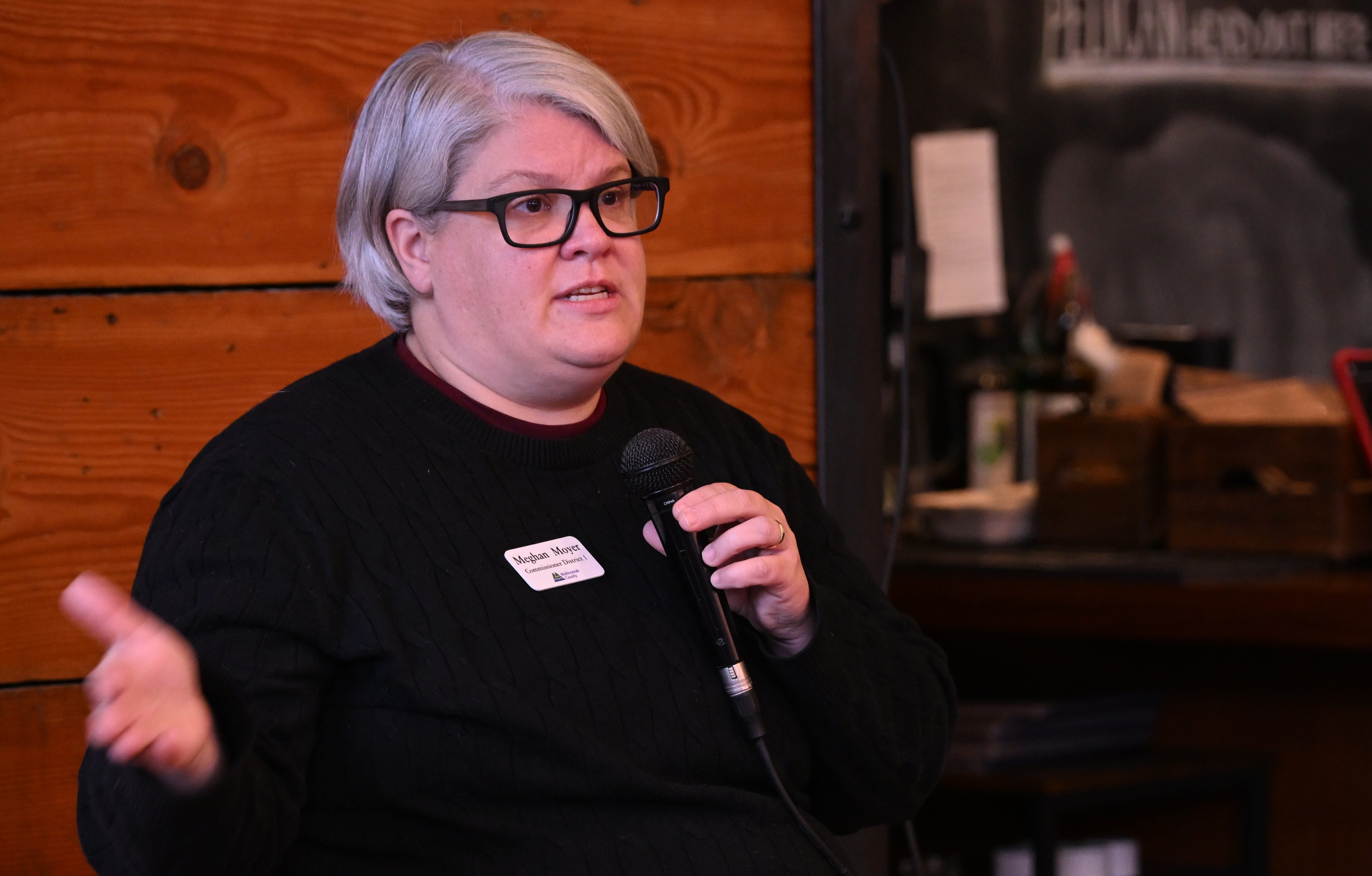
Multnomah County Commissioner Meghan Moyer insists that forcing people into drug treatment does not work. Nor does she support civil commitment to confine people who may be a danger to themselves or others, which she says is enormously expensive, violates their rights and is rarely appropriate.
Moyer has spent 20 years in social service policy work and speaks with a sense of her own authority. Her conclusions sound believable, especially to those not having direct experience with behavioral health and addiction issues.
When she spoke Friday at a community meeting in the Pearl District, a criminal defense attorney praised her as the rare public official who truly understands the issue. Certainly both have built their careers around protecting the liberties of individuals, a position easier to justify if one believes that social interventions have no value.
But is Moyer right?
There is evidence on the other side. The New York Times recently published an opinion piece by Keith Humphreys, a professor of psychiatry at Stanford University and former drug policy adviser in the Obama administration. In a study Humphreys cited, “2,095 addicted patients found that one year after treatment, those whose care was mandated were somewhat more likely to avoid drug use than were those who entered treatment voluntarily. Further, compared with their peers who had voluntarily sought treatment within the justice system, the patients whose care was mandated were less likely to be rearrested.”
Humphreys noted that a 2023 medical review of 22 studies revealed “a lack of high-quality evidence” in favor of or against involuntary treatment for addiction.
If his overview is fair, it appears that the impetus for entering treatment has far less to do with the outcome than other factors.
But Moyer brings a particular bias to this subject. When she ran for County Council, she was asked to explain why, in her position with Disability Rights Oregon, she would not support a suit against the city of Portland for failing to keep sidewalks clear for passage by disabled citizens. Moyer replied that she believed that the plaintiffs were primarily interested in protecting their property values, and that stigmatizing the homeless was useful in achieving that aim.
In other words, Moyer put the public image of homeless persons above her former agency’s mission to enforce disability law and policy, and she did so because she disapproved of motives she attached to those she saw as political adversaries.
None of this came out at Moyer’s talk in the Pearl District. She struck a middle-of-the-road position on most topics and drew generally appreciative reactions.
She must realize the harm reduction approach to substance abuse is losing popular support. The Portland People’s Outreach Project that for months distributed supplies and drug paraphernalia without question on West Burnside has moved on. That was not before discrediting their no-judgment philosophy that rained havoc and intimidation on the surrounding neighborhood.
The all-carrot-and-no-stick approach is also coming apart locally regarding Housing First, a strategy that has put addicts and people with behavioral health issues into housing without prior treatment, resulting in trashed apartments, intolerable problems for other tenants and the economic ruin of nonprofit landlords attempting to operate low-income housing. Central City Concern issued a comprehensive report declaring Housing First without requisite treatment to be unsustainable.
Even if voluntary treatment works better than forced treatment, as Moyer believes, that’s not the full test. We have to ask if voluntary-only treatment works for the rest of society. If local businesses fail, public spaces are unsafe and filthy, residents move away, property values crash and tax revenues slump, social resources will not exist to provide treatment to anyone.
This goes beyond considering the greatest good for the greatest number; preserving civil society itself is at stake.
I attended this Friday meeting, and it was basically Meghan Moyer enthusiastically agreeing with all the problems pointed out, but then quickly pointing her finger at pretty much every other elected official for why we can't do anything about these problems.
A night shelter in the Pearl creating massive negative consequences for the neighborhood? Moyer agrees and apparently sternly told the mayor that more needed to be done. What about the County's resources as the mental health authority, as well as hundreds of millions in homeless services tax revenue every year to address this problem? No plan was mentioned, and certainly Moyer has not proposed a plan before the County Commission.
People with serious mental illness roaming our streets, sometimes hurting themselves, sometimes hurting innocent passersby? Well, that's the governor's fault, and according to Moyer she knows Governor Kotek is upset by her scathing criticism. Beyond upsetting other politicians -- no plan. This January, the state legislature's expanded civil commitment law will go into effect. The county has hundreds of employees that can initiate temporary civil commitment to diagnose and triage the needy. But Moyer didn't see a way to expand civil commitments because, well, the governor isn't doing her job and the judicial commitment process was too cumbersome. (Again, let's not forget that the county is the local mental health authority).
Rampant drug use and overdoses on the streets and a deflection center that is failing to get people into treatment? Moyer acknowledged that numerous counties (including Washington and Clackamas) are doing a better job at getting people into treatment. So why has she not gathered three votes on the County Commission to change our failed policies to ones more similar to that of Washington or Clackamas Counties? Apparently Moyer has a plan, and hopefully the people overdosing on the streets can hang in there long enough for that plan to see the light of day.
Our low cost housing is too expensive? As someone that has built low cost housing for nonprofits, Moyer agrees. She believes the county should build low-cost housing. How does the county get into the the housing business without raising taxes or taking money away from other services? Or for that matter why would the county be any better at lowering construction costs than the city or metro? Well, there's no real plan so the pesky details don't matter much.
I appreciated all the concerned residents that raised good points about the future of their city. However, I came away wondering how our District 1 representative could agree with all the problems but not point to any policies that she's passed on the County Commission that would meaningfully address those problems.
It is also important to note that mandated treatment is capable of reaching the entire population, including those who are unable or unwilling to seek help.. We need both.