


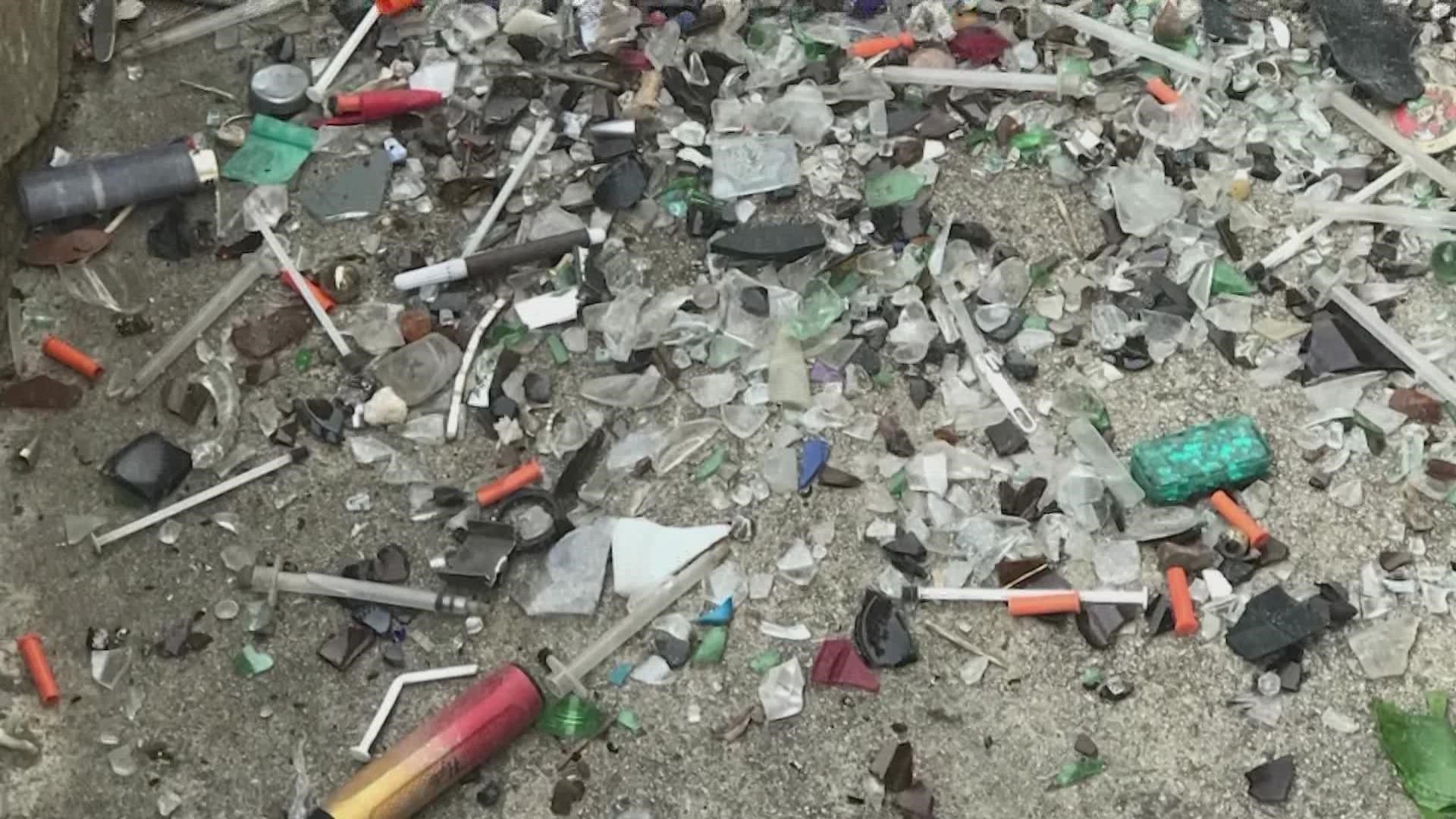
I have never pretended to cover state or even city news comprehensively. But my hyperlocal gaze keeps catching flashes of the bigger picture.
I have had a front-row seat as Portland’s harm-reduction absolutists are being exposed in a way that could tip the Oregon governor’s race. Republican nominee Christine Drazan has been working with a cohort of residents mobilized around the drug paraphernalia handouts that went on at Northwest 19th and Burnside streets for several years. Their concerns did not even command the agendas of the two affected neighborhood associations, yet the whole state may be paying attention to this saga by November.
An unabashedly anarchist group called Portland Peoples Outreach Project had been handing out syringes, pipes, hygiene products and snacks near the McDonald’s on West Burnside for about a decade, drawing throngs of drug users who in turn attracted drug dealers. People shooting up in plain view, sprawled out bodies blocking the sidewalk and frequent mental health episodes—all amid campsites and piles of garbage—were only half of the story.
Drug dealers who found the lawless pocket ideal for their purposes acted to see that their marketplace was not disrupted, which neighbors were doing by protesting and drawing news coverage.
Turf warfare involves intimidating citizens so they do not call the police or interfere with illegal activities.
A Stadiumhood Neighbors woman was threatened by groups of masked hoodlums taunting her with chilling reminders that they knew where she lived.
Multnomah County District Attorney Nathan Vasquez saw a KPTV news clip last year and went on air, declaring that his entire staff was outraged upon seeing video of threats and intimidation against neighbors of this hot spot.
“That particular piece—that upset me,” Vasquez said. “No person should be harassed or threatened in any manner.”
Viewers of any political affiliation would have found the scene upsetting, but state Sen. Lisa Reynolds had another concern: Limiting these no-rules needle handouts would put a crimp on anyone engaged in “harm reduction,” an approach addressing the secondary health consequences of used needles.
This practice has wide acceptance in the medical profession and among local social agencies, but studies they rely upon assume qualified providers endeavoring to move addicts toward treatment. PPOP, which moved its 19th Avenue distribution spot to the Pearl District this year, takes no measures to promote recovery. Its core tenet is that everyone has the right to decide what they put into their own bodies without outside judgment. Needless to say, PPOP does no outreach to the neighborhood residents that it impacts.
There may be a division of opinion as to whether harm reduction has its place, but reckless operations such as PPOP are not something a mainstream politician would be expected to defend.
However, District 17 state Sen. Lisa Reynolds put off Stadiumhood Neighbors and their hyper-local partners, Friends of Couch Park, for three years as the situation stewed. The only elected official willing to take them seriously was Drazan, the senator from Canby who is again running for governor.
Reynolds could have known Drazan was interested in the statewide implications of a story pitting caretaking neighbors against drug dealers terrorizing them. But Reynolds controlled the path proposed legislation had to travel, and she saw a threat to harm reduction practices anywhere as a threat to harm reduction practices everywhere.
“It would have done away with harm reduction,” she said.
Never mind that the bill would only have applied to mobile distribution sites and then only near schools.
Asked to explain her dire prediction, she told the Examiner, “If you draw a 2,000-foot radius around every school and preschool, I suspect there’d be very few corners left in Portland where harm reduction supplies could be distributed from a mobile service.”
Neighbors and Sen. Drazan were willing to reduce the radius to 1,000 feet, but Reynolds’ feet were planted. She killed the bill in her committee without exploring such modifications.
Was the end of harm reduction an exaggeration?
“That’s fair, but it certainly would have eliminated mobile distribution of harm reduction supplies,” she told the Examiner after re-election to her senate seat last month. “So that’s a valid point.”
The senator may be more conciliatory now, and she is advocating for a Multnomah County licensing system for mobile harm reduction suppliers. But she and her party may be asked again and again why they took the side of illegal drug consumption and its enablers against the good neighbors when it mattered.
The fear of infectious disease is so strong within the public health department that they are unable to see past their noses. The other health concerns and safety concerns don't seem to matter a wit to them. Degradation of neighborhoods, the fact that the diseases like HIV and Hep C now have good treatments, and the collapse of civility, safety, and beauty in the city. Needle distribution is spreading the harm, not reducing it. I think the public health department will walk this back gradually, first by endorsing the ordinance and then by getting PPOP the heck out of Oregon. Eventually, the county will stop passing out needles to drug addicted people. Common sense tells most everyone that it is a horrible idea to pass out needles to people injecting drugs that can kill them and do kill them. This is what happens when you give too much power to a few who then train others to jobs and not think about what they are doing. When this goes away, hopefully soon, Portland can better focus on mandatory abstinence treatment for four to six weeks for those who have near death overdoses on city streets. It is sad to see needle distribution become a mantra in the medical community. Equally sad to see physicians like Reynolds, Meieran, and Dexter, all silent on this issue. I think the ordinance which comes up on June 11 is a pivotal moment on this issue and you can bet that all the forces pushing needle distribution will be doing everything to stop it. They don't know that the grass roots push to stop needle and drug paraphernalia distribution will eventually win out no matter the outcome.
The State's goal for those addicted to meth, fentanyl should be full recovery, involving detox, post detox supportive sober housing, consistent peer support and help with stabilized housing and social agency. We have never committed to this goal as a State, County or City. Instead, we have committed to Housing First, Harm Reduction, Anti-Jail or Civil Commitment, growing a job program for those with behavioral health problems and anarchistic ideologies. No wonder we have an intractable homeless problem that just keeps growing itself along with the behavioral health problem itself. Our goal is everything BUT solving the problem that most of us want solved, including addiction and unstable housing. We will not make drug addiction or homelessness disappear, but if we focus seriously on Recovery for addicts, stable treatment for the mentally ill and we don't treat it as an inevitable problem that will continue to grow, we will get people housed, improve the lives of those will these illnesses, make Portland move livable for all of us and perhaps change its reputation enough to attract business, jobs and net taxpayers back to the City and County.
If these people were interested in Recovery for the people suffering from addiction to these drugs, they would implement needle exchange, with registration, peer support, incentives for detox and stable housing and referrals to longer term residential support facilities like Bybee Lakes or Team Portland so they can gain or regain agency in society. Clearly, this is not their mission. This is yet another example of what Lance Orton, another former addict like me, has call Compassionate Neglect. It is why Portland is suffering so badly economically today. Our politicians have become enablers rather than the source of the cure we all need.