

By Kara Shane Colley
I was at the second NW Examiner better ideas forum Sunday. A neighbor and I plan to launch a campaign to encourage business owners to take care of the sidewalk in front of their stores. I said, “We are going to make a sticker that businesses can place in their front window.”
A man at the meeting suggested, “You should really check out AI to see what it can do.”
I replied, “Absolutely not. I plan to pay someone in the neighborhood to make the sticker.”
All of sudden, people started speaking up: several clamoring about how great AI is and several declaring that AI should not be used in the creative sphere.
“AI is theft. It is stealing human creators’ output without permission and without payment,” I replied.
“I don’t think you understand what AI is,” he replied, before the moderator intervened.
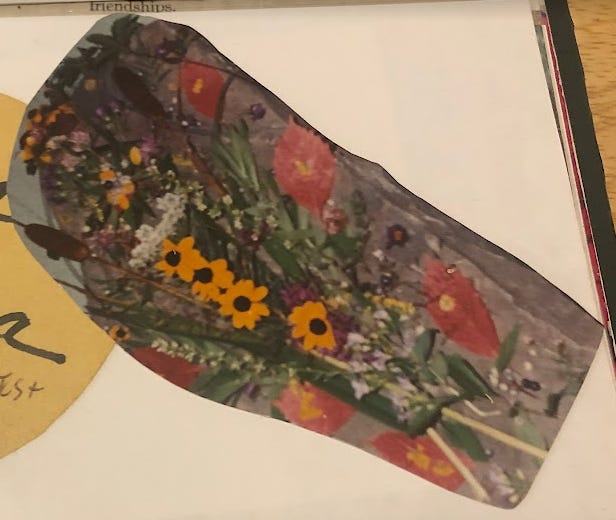
Until recently, I didn’t see myself as a creator; instead, I saw myself as creative. One afternoon, when I was in middle school, a friend and I spent the afternoon gathering wild flowers in the woods behind my house (in upstate New York). We made this wildflower collage:
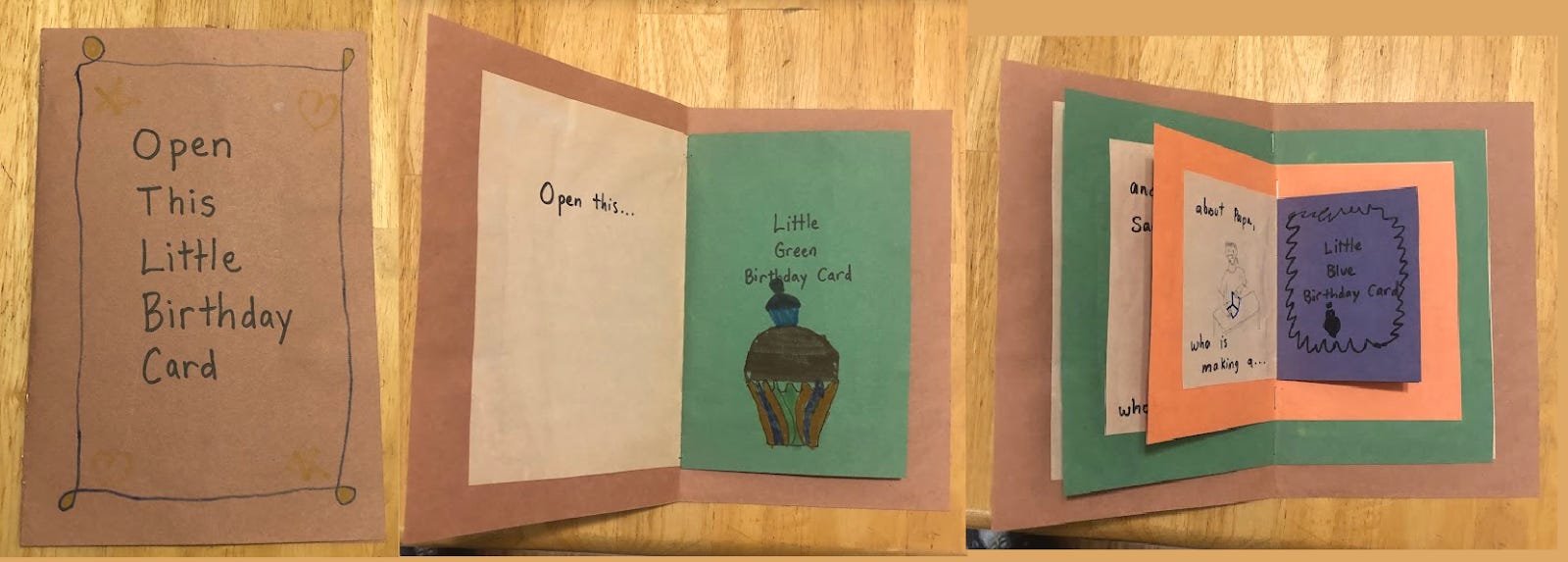
We have a tradition in my family where we make homemade birthday cards for one another. If I do say so myself, I have made some pretty amazing ones. This one is a card within a card within a card within a card.
I am currently working on a children’s math book that is going to be published later this year. Now, I do consider myself a creator. I have spent hours and hours of my time working on my book. And these hours have given me energy and life and fulfillment. But it also pains me greatly that my book could be fed into AI models and used to create another math book for commercial use WITHOUT my permission and WITHOUT any compensation.
So yes, to the people who are excited about using AI to create their own slide deck or their own new app, it is amazing what AI can do. But AI is also theft and it is taking away what it means to be human: our creativity.
Some of you old-timers might remember the "Dune" books of science fiction by Frank Herbert (1920-1986). A footnote in the first of these explained the "Butlerian Jihad" as the future's popular, religion-driven, and violent reaction against what we now call AI. The movement's credo was "Thou shalt not make a machine in the likeness of a human being." Computers everywhere were destroyed as blasphemous idols. The new plan was to develop human potential rather than machines. You can't get more 60s than that!
OK, "Jihad." Herbert was writing long before Islam had been demonized. (The Islamic context of his books has been expunged from the movies.)
The billionaires Americans have been sucking up to for years aren't trying to understand consciousness or intelligence or even biology -- they want to create something better than human beings that will eventually replace us as a reliable, cheap source of labor -- including the labor of most experts and knowledge workers. The rest of us are involuntarily funding the development of our competitors and replacements.
Concern about the value of human creativity is understandable. The satisfaction that comes from making something by hand—whether a piece of art, a book, or even a simple design—should not be dismissed. It is reasonable to worry that new technologies could cheapen or replace that kind of work.
But it may help to distinguish between **creative work** and the **research process** that often sits behind it. In historical research, a huge amount of time is spent on basic but necessary tasks: transcribing old documents, sorting through hundreds of pages of material, putting events in order, and pulling scattered references into a coherent story. Those steps can take far longer than the actual writing.
Tools that can quickly transcribe old newspapers, organize large amounts of material, and produce a structured draft with citations can dramatically speed up that process. The important parts of the work—choosing the sources, checking accuracy, judging what matters, and shaping the final narrative—still depend on human judgment.
Seen this way, the technology does not necessarily replace creativity. It can help researchers work through large bodies of material much faster. In fields like history, where information is often scattered across many documents, that can make it easier to uncover and explain episodes that might otherwise remain buried in the archives.