


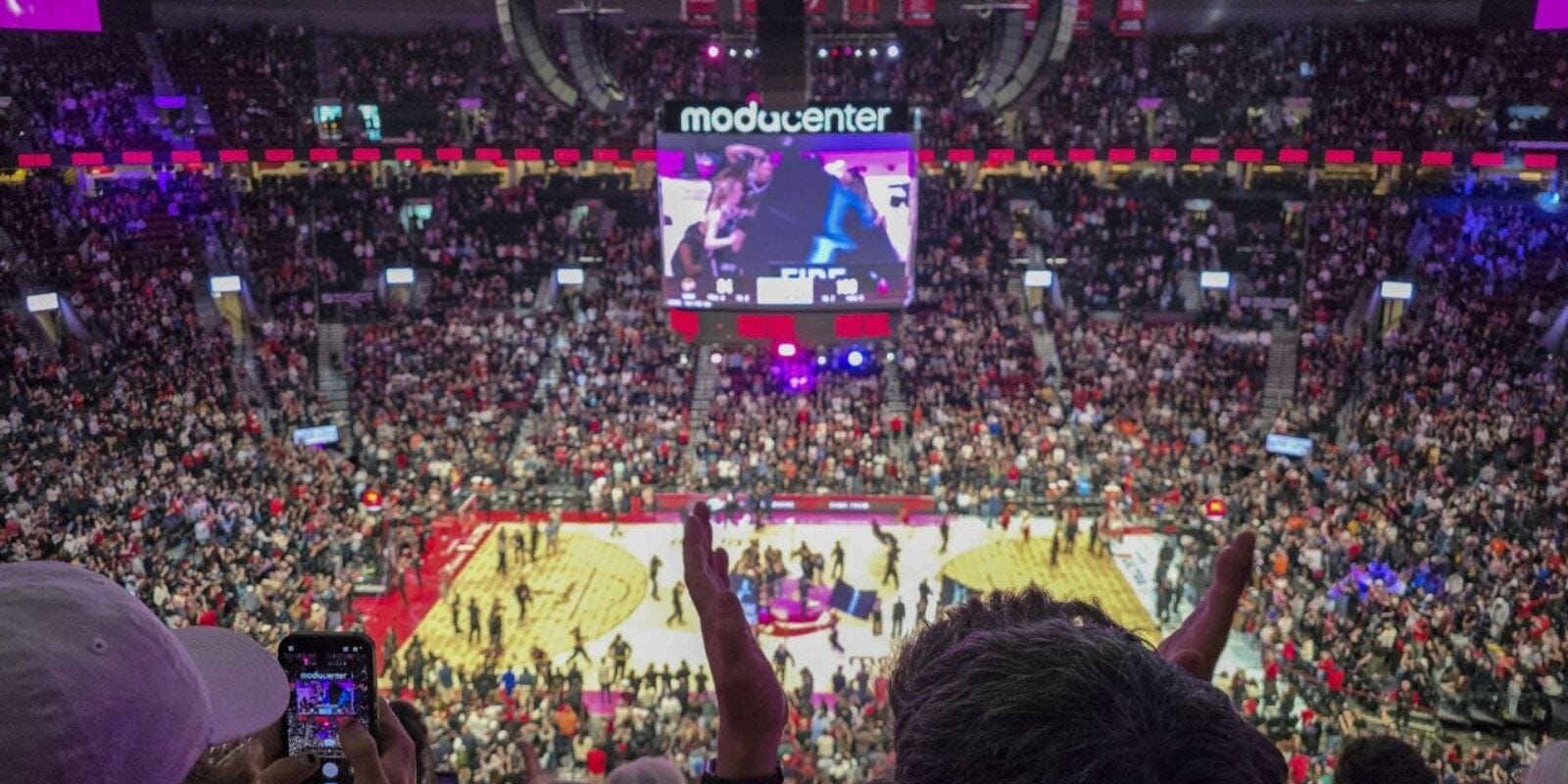
The city’s online survey regarding funding for Moda Center upgrades is a push poll, designed to influence views under the guise of an opinion poll.
Take the survey and see for yourself. Readers first read this piece of boosterism:
“Every year, the Moda Center attracts 1.5 million visitors to 150 events and generates $600 million for the local economy. It also supports thousands of jobs.”
Participants are then asked to rank the importance of benefits of the project:
Make Portland a top destination for sports, concerts and events.
Stimulate the economy by providing living-wage jobs and support local businesses.
Protect the city’s assets by updating structural, technology and operating systems.
Keep the Trail Blazers in Portland.
Leverage committed public dollars from the state of Oregon toward the project.
Seek additional private dollars toward the project.
Community benefits, like good jobs, public transportation, affordable access, neighborhood development, public spaces and the right to unionize.
Provide an anchor for the future redevelopment of the lower Albina neighborhood.
(Nowhere is there a place to rank the negative effects of the deal.)
You get the drift. Fortunately, Blazer fans and tech professionals Edan Krolewicz and Jonathan Pulvers are presenting another side at ripcitynotripoff.com.
Take the survey, join a city-sponsored pop-up tour from 3-4:30 p.m. on Sunday, June 14 at Waterfront Park by the Salmon Springs Fountain, and read materials on the “Rip City, Not Rip Off” website.
Then let your city councilors know what you think. Their plan to vote on a $120 million city contribution to the project is set for Aug. 12.
The public debate over the Moda Center renovation has so far been framed around questions that serve ownership's interests rather than the public's — should Portland keep its team, can the city afford not to act, isn't there a hard deadline? These are the wrong questions, or at least not the first questions. The first questions are whether the city has met its basic obligation as the owner of a public asset, whether the proposed funding mechanism is even lawful, and whether Portland's elected officials have demonstrated the professional competence and political courage this negotiation demands. On all three counts the record thus far is deeply troubling.
The city has not met its obligation as a public asset owner, and the failure is not subtle. Consider what the city has not done:
- It failed to assemble the kind of experienced transaction advisory team — specialists in arena finance, comparable deals, and public asset valuation — that a negotiation of this scale and complexity demands. The other side retained Dan Barrett, who negotiated the arena deal in Raleigh on behalf of the public and extracted rent, private capital commitments, and development obligations from this same ownership group. Barrett now sits across the table representing the Blazers. Portland apparently brought no comparable expertise to the table.
- It failed to conduct and publish a systematic analysis of what other cities actually negotiated when public money went into arena renovations. Sixteen comparable NBA arena transactions are publicly available. Every single one involved a private capital contribution from ownership, and most involved rent. That record is the standard against which Portland's deal should be measured — and Portland's negotiators apparently never used it.
- It accepted and propagated a hard December deadline without being able to point to any legal basis for it. Neither of the enrolled bills underlying this deal contains that deadline. Portland manufactured urgency on ownership's behalf.
- It moved toward a funding commitment before lease terms were written — the negotiating equivalent of paying for dinner before seeing the menu.
- It conducted early negotiations under a nondisclosure agreement that appears to have prevented councilors from discussing terms with one another and with the public, leaving them without a shared factual basis at the moment when informed deliberation mattered most.
One further fact belongs here and has been largely absent from the public debate. Paul Allen built the Moda Center entirely with private money. Portland owns that building today because of that private investment. Tom Dundon paid $4.25 billion for the right to play in it. The current proposal asks Portland taxpayers to contribute $120 million toward a $573 million publicly funded renovation — every dollar of it public — while Dundon's operating company keeps the revenue it generates. Whatever one thinks of public arena financing generally, that specific sequence of facts has a plain English description that isn't "investment."
Is the proposed use of the Portland Clean Energy Fund even lawful? That this foundational legal question has received no public attention whatsoever — not from the press, not from the city's own lawyers, not from the business community whose members are paying the tax, not from any elected official — is itself a serious indictment of the quality of public discourse surrounding this deal. The ordinances implementing the PCEF initiative have the force of law, and they are explicit about purposes:
- Clean energy investments
- Workforce development
- Climate resilience programs benefiting Portland's frontline communities
It is difficult to imagine how all or even a significant portion of the city's proposed contribution could meet those eligibility criteria. The large retailers subject to the surcharge have a legitimate legal grievance that should have been stated publicly the moment Mayor Wilson floated the proposal. That neither they, nor the city attorney, nor a single elected official has said so publicly — that this question has simply not been asked in any forum this writer has seen — suggests that the opacity surrounding this deal has been even more effective than its architects perhaps intended.
How did Portland end up here? The most plausible explanation is also the least dramatic one. The city lacked the experience and specialized expertise this negotiation required, and its elected officials have been paralyzed by fear of being blamed for losing the team. Those two conditions together — not knowing what a good deal looks like and being too frightened to slow down and find out — produce exactly the outcome we are watching. Governor Kotek's intervention, which consisted of pressuring city and county officials to accelerate their commitments rather than improve their terms, reflects the same political calculus dressed in executive authority.
As for the suggestion that Portland will lose the Blazers if it insists on a market deal, the facts do not support it. The NBA just designated Seattle and Las Vegas as expansion markets, not relocation destinations. Dundon paid $4.25 billion for this franchise in this market. A credible superior alternative has not been identified by anyone. The relocation threat is the oldest tool in the arena negotiation playbook and it works precisely because civic pride overrides analytical scrutiny. It deserves scrutiny, not deference.
The city owns this building. It should negotiate like it does.
Portlanders who want to understand precisely how much this mishandled negotiation is likely to cost their city in lost revenue — it's not peanuts - and what an immediate course correction would look like, should read the work of Edan Krolewicz and Jonathan Pulvers at "Rip City, Not Rip Off." They have done the arithmetic, sourced every number, and defined what a fair deal actually looks like. Here is the link: https://www.ripcitynotripoff.com/
Here’s the thing—if we citizens “stick to our guns” and refuse to allow the climate fund (unused) to be put toward the Moda center rebuild and then cry about “taxpayer money” being used to fund the arena rebuild, Portland WILL lose the trailblazers. Once the blazers leave, this city will be eliminated from any short list of potential pro-ball team sites and no pro team will be moving here. I grew up here. I am proud of having an NBA team in our city. I have also lived in major cities and understand that the idea of “someone else” building your pro sports arena is an only-in-Portland fantasy. We aren’t owed any type of arena by team owners. The cities pay for these. We lucked out with Allen, but that’s over. There is a framework for using taxpayer money—it is called a jock tax, it affects the taxable income from the athletes who play there. Portlanders are more than happy to vote in opaque property tax increases with dubious metrics for success, but can’t fathom funding a municipal project with a measurable, net-positive impact? Give me a break. Fund the arena. Cry when you get your tax bill for the “homeless services” and walk down third avenue to see how well that money is being used.