

By Ken Thrasher and Phil Keisling
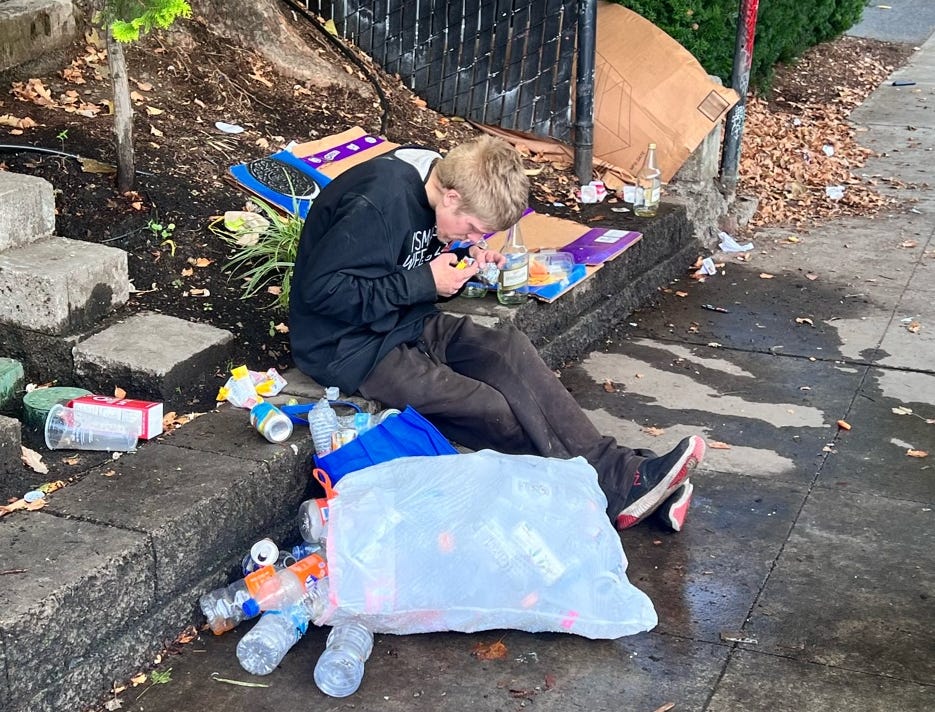
Oregon’s Bottle Bill remains one of the state’s most popular and iconic public policies. Originally designed to reduce litter and promote recycling, it’s recently evolved into a form of financial assistance for hundreds of self-described “canners” who regularly collect large numbers of redeemable containers for cash.
Unfortunately, Portland’s existing large-scale redemption centers—required to pay out immediate cash for up to 350 containers per person, per day—have inevitably become powerful magnets for litter, illegal camping, property crime and drug dealing.
We’re doing no one any favors—not affected neighborhoods and small businesses, and especially most canners themselves—to downplay or ignore these sad realities.
With a major redemption center near Delta Park now slated for closure after years of complaints from neighbors and nearby businesses, and retailers abandoning plans to open a new “alternative access redemption center,” state and local leaders need to recognize how badly our current approaches are failing.
This means acting on three fronts:
First, we need a one-year pause on any new redemption centers in Portland.
That includes the current push by the Oregon Beverage and Recycling Cooperative (OBRC) to move an existing bottle drop to a site just steps from one of Portland’s busiest, most complicated, and dangerous intersections at Southeast Powell Boulevard and Milwaukie Avenue. Let’s stop repeating the same mistakes in yet another Portland neighborhood while somehow expecting different results.
Second, the OBRC, a private, beverage distributor-controlled entity that annually reaps tens of millions of dollars from unredeemed deposits and scrap sales of aluminum cans, needs to be far more transparent about its operations and finances. Amid shrinking state revenues and OBRC’s state-sanctioned dominance in Bottle Bill container recycling, the public deserves full disclosure as to whether its costs and expenditures reflect the best approach to mitigating these unfortunate social and public health impacts.
Third and most important, let’s use this pause to convene key stakeholders—including grocers, recyclers, canners, neighborhood groups, small businesses and public health officials—to help the 2027 Legislature craft a genuine and durable solution to these challenges.
A key focus for such work should be continuing to significantly reduce—and preferably eliminate entirely—immediate cash from the redemption system. There are better and more generous options worth exploring, especially to help canners who rely on Bottle Bill deposits to afford basic life necessities.
Recent developments underscore the urgency of reform.
March’s announcement that it would close (and not try to relocate) its Delta Park redemption center will leave it with just one remaining bottle drop in Portland. That Northeast Portland location has too long been beset by similar complaints and problems.
In May, OBRC’s effort to site an alternative access redemption center—a new model authorized by the 2025 Oregon legislature’s passage of SB 992—went off the rails due to insufficient funding.
Even if the Oregon Liquor Control Commission had issued a permit for such a facility, OBRC wouldn’t have assumed operational and legal responsibility for it. That would have fallen to a small, well-meaning nonprofit, Ground Score Association, which would then move its existing outdoor bottle drop from under a Southeast Morrison bridge ramp.
A better indoor location for Ground Score’s operations is a good idea. But OBRC announced its original siting plans without any prior notice to nearby residents and businesses—and months before leaking underground storage tanks were discovered at this long-vacant building. It also has almost no parking spaces for canners who have vehicles.
More than 1,200 Portlanders have signed a petition urging relocation to a safer, more appropriate area. Neighborhood leaders have shown openness to alternative sites, even just a few blocks away, in more appropriately zoned industrial areas.
Unfortunately, OBRC is pushing ahead with this questionable site. At least one adjacent business has publicly declared it would close its doors if the site opens. And without any OLCC oversight, such an operation may have no limits on the number of daily redemptions for cash.
It’s clearly time for a major reset, with the ultimate goal of making the Oregon Bottle Bill even stronger. And building on other SB 992 provisions can help chart a constructive path forward.
Since last July, grocers with “blue and green bag” redemption programs are no longer required to pay cash for redemptions. The blue bag program allows redemption proceeds to directly benefit charities, while green bag participants receive a typically 25% bonus as a credit for purchases at the store.
This change has already reduced unsanitary container returns inside grocery stores, and this should not change. But it has also redirected traffic to existing redemption centers and smaller retailers, such as convenience and drug stores, who are still required to pay cash.
Getting cash totally out of the system would reduce drug trafficking. Better yet, a more robust green bag program could include these and potentially other cashless redemption options:
• Adding redemption funds directly to electronic Oregon EBT (food assistance) cards;
• Issuing non-cashable gift cards for use at participating retailers;
• Providing rent, housing or utility credits;
• Offsetting medical or insurance costs.
This approach would better help economically distressed Oregonians afford basic necessities, while improving neighborhood livability and reducing the burdens on already-stressed emergency services, health care providers and law enforcement.
For a half century, the Bottle Bill has served Oregonians well. These three actions—a one-year pause to look at realistic alternatives, OBRC being more transparent and accountable for its financial results and replacing immediate cash with more meaningful and generous assistance—could ensure its ability to better serve Oregonians for decades to come.
Ken Thrasher is the retired CEO of Fred Meyer, the state’s largest grocery store chain.
Phil Keisling served as an inner Southeast Portland state representative and as Secretary of State. He lives in Portland’s Brooklyn neighborhood.
If we really want to solve the problem, eliminate the bottle bill and the mandatory deposit. Only 10 states in the U.S. have container deposit laws, and reducing that number to nine is unlikely to have any meaningful effect on the trajectory of global warming.
Let’s be honest: many of the proposed alternatives would require creating new bureaucracy to administer them. At this point, it simply seems easier to repeal the bottle bill and deposit. If Oregon makes meaningful progress on homelessness and addiction over the next five to ten years, the state could always revisit the idea of a deposit system in the future.
This is another example of how Oregon has allowed a relatively small number of people struggling with addiction and chronic disorder to diminish the quality of life for everyone else. It goes back to a question I’ve raised before: how can such a small number of people do so much damage to this city and state?
Phil and Ken are forward thinking on an issue that has been a hallmark for Oregon but has turned into an issue in many ways. A one year pause to think through the issues is a good idea. I especially like the idea to take cash out of the system and replace it with non-cash incentives