


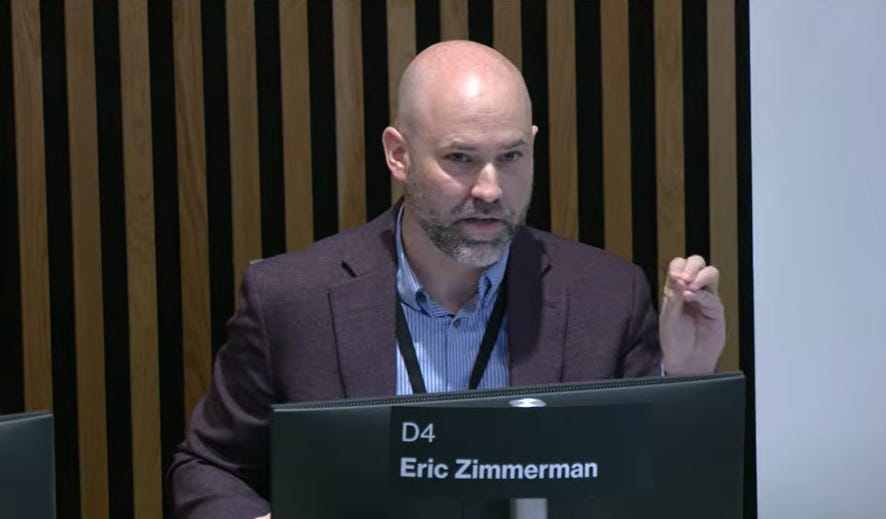
Cries from neighborhood activists about a sudden and unilateral move by City Hall to remove their historic role in city policy making reached District 4 City Councilor Eric Zimmerman, who responded forcefully at a council Budget Committee work session April 29.
“I want to highlight that as something I’ve now been hearing from neighborhood coalitions and neighborhood associations,” he said in a two-minute statement. “Not once has that director come and said, ‘This is what we plan to do,’ so I find that abrupt, and it reeks of the old war in this bureau that was a war against neighborhood associations.
“I’m damn close to just proposing an amendment to pull this entire program offer out put it somewhere else. Something tells me that the Office of Civic Life has an ax to grind here, and if we’re going to protect the neighborhoods we’re going to have to take drastic action.”
Zimmerman then described his idea of moving the neighborhood program to another bureau, perhaps one connected to the four City Council district offices. Emails from a Civic Life manager since February include a proposal to hire neighborhood coalition staff through a contract bidding process instead of the current system, which allows each coalition to establish their hiring practices.
“Why has this been such a surprise that frankly has members of our community’s hair on fire,” he asked, “and we’ve had no briefings on it.
Zimmerman is considering “a fairly drastic amendment to protect the neighborhood coalitions and neighborhood associations.”
Zarnitz memo
The councilor has seen a memo from District 4 Coalition President Todd Zarnitz in March:
As you are aware, the Office of Community & Civic Life is currently conducting an internal rewrite of the ONI Standards—the governing rulebook for Portland’s neighborhood system. They are executing this rewrite under a purely administrative process, bypassing City Council approval.
We have now uncovered how Civic Life obtained this unilateral authority. The previous City Council accidentally surrendered its legislative oversight of the neighborhood system by voting for a massive, 373-page omnibus charter transition package (Ordinance 191973). Buried deep within this document was a quiet code swap that downgraded our foundational rules.
This report outlines the findings and a possible strategy to present this evidence to the new City Council to restore their oversight.
Background: The Importance of Legislative Oversight
To understand the gravity of this code change, we must look back at the 2019 “Committee 3.96” fight. When former Commissioner Chloe Eudaly attempted a sweeping overhaul to dismantle our geographic neighborhood system, she ultimately failed.
She failed because of a strict system of checks and balances. At the time, Portland City Code 3.96.020(F) explicitly defined the ONI Standards as “Regulations adopted by City Council.” Because the executive branch had to face the legislative branch to enact changes, the community was able to lobby the Council, who ultimately refused to support the overhaul. The requirement for a City Council vote was our strongest legal shield.
II. The Investigation: The Missing Code Change When Civic Life recently claimed they had the authority to rewrite the Standards administratively, we checked the live Portland City Code. The definition in 3.96.020(F) had been altered to read: “Administrative rules” from the previous “Regulations adopted by City Council.” A footnote on the City Auditor’s website claimed the latest changes were made in April 2023 via Ordinance 191208. However, a review of that specific ordinance revealed that code changes to Section 3.96.020 were absent from the document.
III. The Discovery: Ordinance 191973
Realizing the City Auditor’s website contained an error, we dug deeper into the city’s legislative archives. We finally located the “smoking gun.” The downgrade of the neighborhood system was buried in Ordinance 191973, an enormous, 373-page omnibus package titled: “Amend Code to align with the amended City Charter in Portland Measure 26-228.” On Page 149 of the “additional documents” document in the supplemental materials folder, the text of Code 3.96.020(F) was quietly redlined. Under the guise of a massive “housekeeping” package designed to align the city bureaucracy for the new City Administrator form of government, the drafters struck through “Regulations adopted by City Council” and replaced it with “Administrative rules.”
IV. Implications
There was no public debate about the neighborhood system when Ordinance 191973 was passed. It is highly likely the previous City Council had absolutely no idea what they were actually signing. They thought they were voting on a structural alignment package, but in the process, they voted away their legislative oversight over Portland’s grassroots democracy.
Because of this stealth downgrade, the current City Administrator now holds unilateral power to adopt, revise, or completely overwrite the rules governing the neighborhood system with only a 30-day public comment period, and zero obligation to incorporate that feedback. No council vote. No legislative veto. No public appeal.
V. Next Steps
This discovery provides us with incredible political leverage. It shifts our argument from “we disagree with a code change” to exposing a bureaucratic sleight of hand pulled on the previous City Council.
A possible path forward might be to approach the current City Council members with the 373-page document, point to Page 149, and show them exactly how their predecessors were tricked into giving away their legislative power. We could then formally request that they pass a targeted, single-issue ordinance to amend Code 3.96.020(F), restore the ONI Standards as “Regulations adopted by City Council” and claw back the oversight they should rightfully own.
The memo will be discussed at the District 4 Coalition board meeting May 4.
Mon, May 4, 2026 6 p.m. - 8 p.m.
LOCATION:
District 4 Coalition Office, 434 NW 6th Ave #202, Portland, OR 97209
AGENDA:
https://docs.google.com/document/d/e/2PACX-1vRm52ipChBSCCVQp-zxTJ8VYsTxbUWPJ4O7BVozKnwcEw_6FoszGVcOQGol6hS-34792076pKp-ouYu/pub
ONLINE MEETING LINK:
https://us06web.zoom.us/j/82681340706?pwd=COPw6JH9watJVHEo6fMueY6RAtetqK.1
ADDITIONAL OPTIONS:
https://us06web.zoom.us/meetings/82681340706/invitations?signature=jXCMW9uafV93S-TagJC1UIEuQcvVsQ0io0WyKIQxezM
MATERIALS:
https://drive.google.com/drive/folders/12ikKo_pbu5CKpZiKd2RPSR56BXZDl65Z
WEBSITE:
https://districtfourcoalition.org/
Glad to see Eric Zimmerman stepping up to keep our neighborhood associations functioning as they should, rather than allowing Civic Life bureaucrats to succeed in yet another effort to silence an important voice for neighborhoods throughout the city.
I’ve never understood the hostility of some at City Hall- elected as well as staff-toward neighborhood associations (remember Eudaly’s efforts to write them out of code?), instead of taking advantage of the many volunteers who know and love their neighborhoods- and are ready, willing, and able to put time and energy into making this a better, more livable city!
Civic Life also made some unilateral decisions during the charter reform transition that dealt another blow to neighborhoods. They did so without any outreach or informing either the Independent Districting Commission or the Government Transition Advisory Committee. The next charter review must evaluate both the circumstances and results of their actions.