

By Robert S. Miller
The preliminary Nov. 3 returns put all six council incumbents seeking reelection in winning positions. The results are not certified, but the apparent outcome is the return of the same six people. The voters did not make a mistake, and their ballots were not miscounted. People are entitled to prefer candidates I would not choose. The voters did their job.
For the next five pieces I am going to make the case for three things.
Single-member districts, independently drawn. One identifiable representative per seat, chosen by a majority in a two-candidate final on the November ballot.
A clearly accountable executive. The mayor already directs the city administrator, proposes the budget and holds appointment and removal powers. I would add a defined legislative veto with a council override and leave the independent auditor exactly where the charter put it: outside everyone's reach.
A different use of the public's campaign money. Replace matching payments to campaign accounts with neutral, publicly provided access to voters: real candidate comparisons, forums, an equal basic chance to be heard.
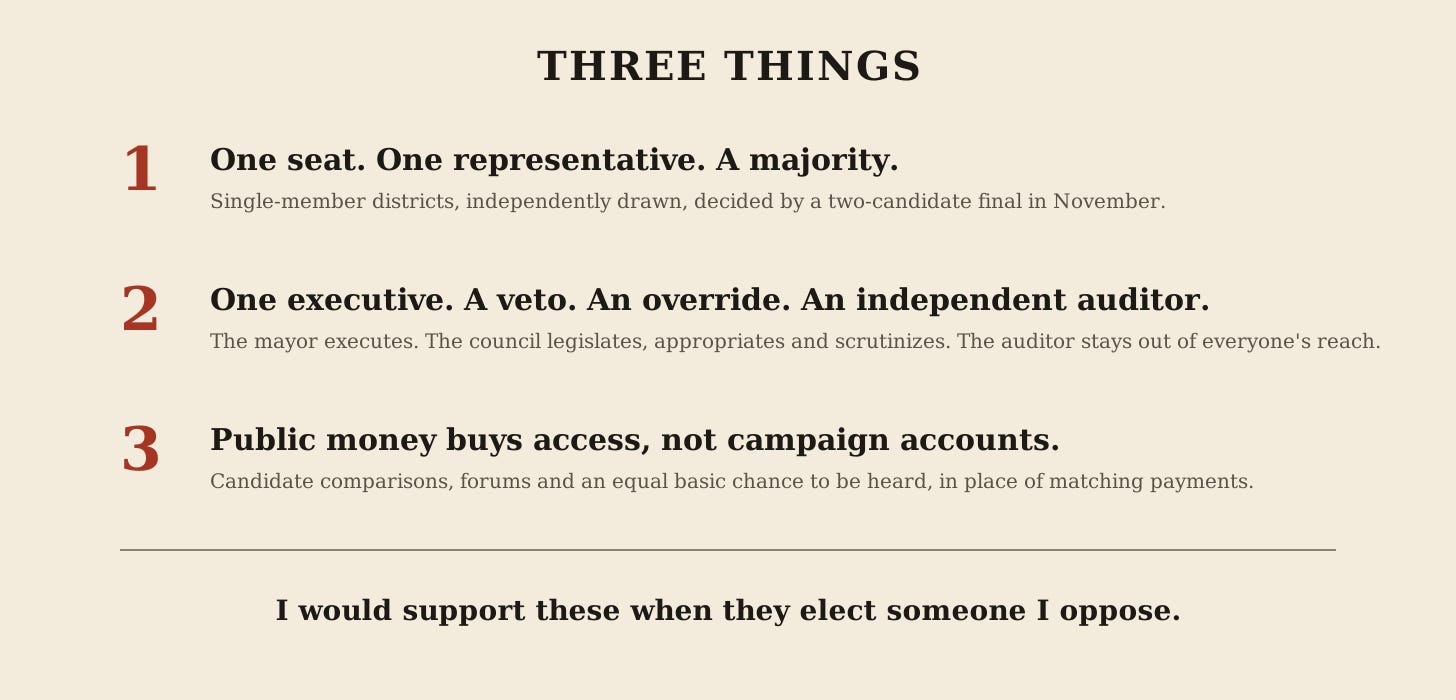
Not to reverse an election. Not to install a more agreeable machine. Not to restore councilors running bureaus. And I will support these when they help elect someone I oppose, or they are not principles.
That is the plan. This piece is why.
Paramount
The first time I visited Paramount, it looked exactly as I thought a Hollywood studio ought to look. After a lifetime of watching movies, it was reassuring to discover that I had learned something about the business.
The meeting was less reassuring.
I had brought a licensing proposal involving titles the studio owned. It was a good deal or certainly seemed so to me. It was slightly unusual, but unusual was part of the opportunity. We had found a way to make money from something the studio already possessed.
We could not get it done.
My business partner had made a fortune writing, producing and directing movies. Afterward, he explained that I had misunderstood what those executives' jobs required. I thought their assignment was to license titles and generate revenue. Their assignment was not to get fired.
You get fired for making a decision.
An opportunity declined leaves no evidence. Nobody can point to the revenue from a deal that never happened. Approve something unusual, and there is a decision with your name on it. I was describing an opportunity for the studio. They were considering a risk to their employment.
Those executives had a job description. Somewhere at Paramount had a document about maximizing the value of the library. Nobody in that room was reading it. They were reading the other document, the one nobody writes down, the one that says how you get this job and how you keep it.
Portland's councilors have the same two documents. In Portland, both are public.
The job description
The city did not leave the job to my interpretation. It wrote the standard down, in Chapter 1.03 of the City Code, and it is better than anything I would have written.
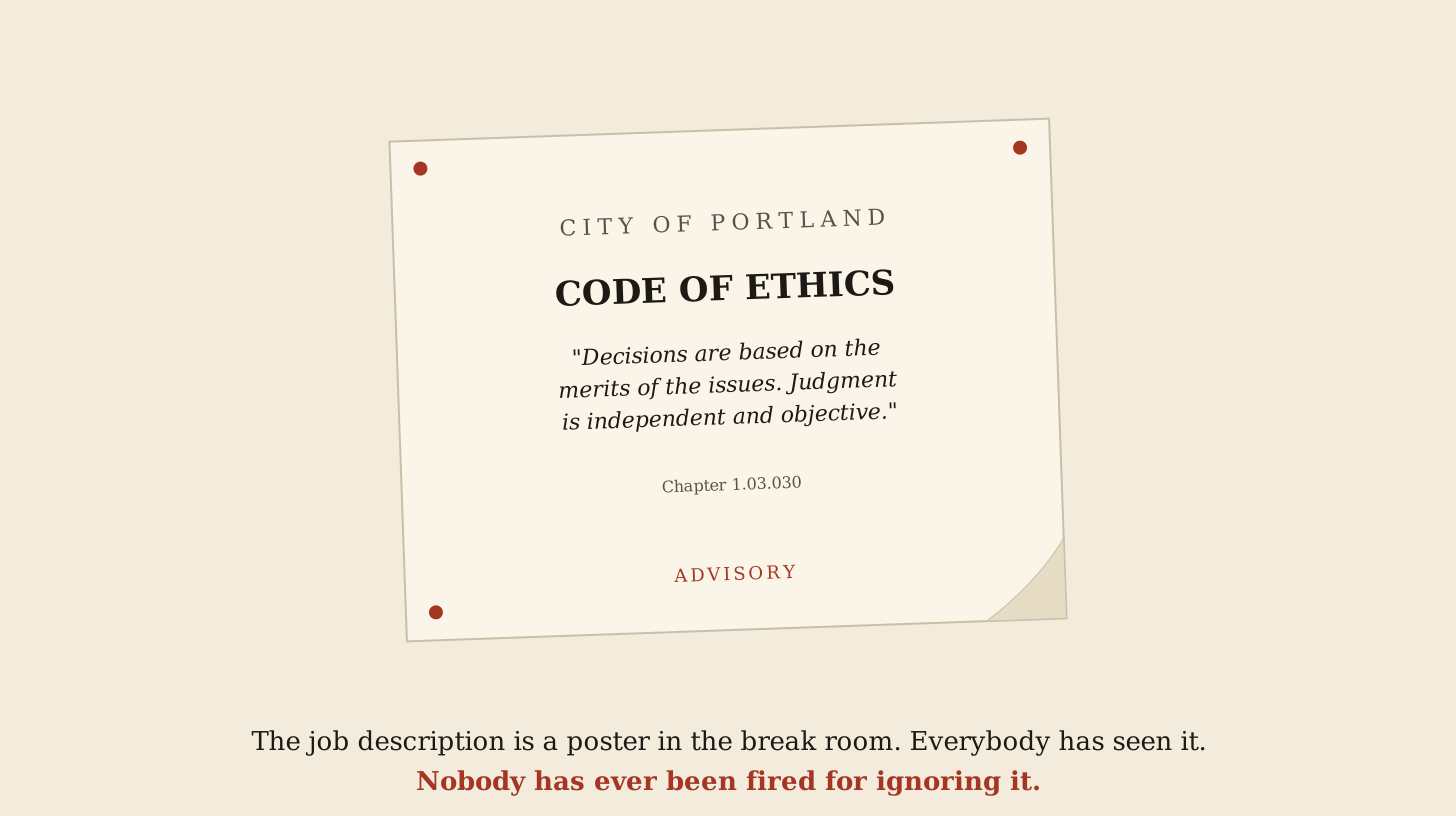
Code 1.03.030: "City officials' decisions are based on the merits of the issues. Judgment is independent and objective."
Code 1.03.020: policymakers "place long-term benefit to the public as a whole above all other considerations, including important individuals and special interests." The same section says the public interest includes protecting the rights of under-represented minorities. It bars political campaigns on city time or property.
Merits. Independent judgment. The whole public first. That is the job. I did not write it. The city did.
Then the city wrote one more sentence. Code 1.03.010: provisions of the chapter not otherwise enforced by law are advisory.
Read that again. Portland defined independent judgment for its elected officials, and in the same chapter declared the definition a suggestion. The job description is a poster in the break room. Everybody has seen it. Nobody has ever been fired for ignoring it.
So, what actually gets you hired?
How you get the job
In August I printed the terms Portland DSA publishes for the candidates it endorses, and I will not relitigate them here. The short version, from the chapter's own endorsement page: "DSA is your party." A priority relationship. Regular meetings. Coordinate your work in office with the chapter's priorities. Use the office to build and recruit for the organization. The 2026 voter guide adds the disqualifiers: accept a chamber of commerce endorsement, or oppose the Boycott, Divestment and Sanctions movement, and voters are instructed to give you no ranking at all.
That is not a conspiracy I assembled from suspicious photographs. It is the help-wanted ad.
Hold it against Code 1.03.030. The city says judgment is independent. The chapter says coordinate with us. The city says merits. The chapter says priorities. One of these documents is enforced by an organization that meets every month and endorses every two years. The other is advisory.
Now the other side because this cannot be a story about one organization. United for Portland told District 4 voters to rank Eric Zimmerman and Olivia Clark, in either order, and then gave this instruction: "Do not rank any other candidates." Eli Arnold was not on the list. That is not declining to make him the first choice. That is advice to leave him off the ballot. Future Portland Action Fund, usually counted on the same side, recommended all three. There was no business ballot. There were two.
I do not know why United for Portland cut Arnold. I know what the 2024 ballots showed when I counted them: Arnold lost that year to the discipline of his own lane. Clark's surplus went to Zimmerman over Arnold five to one. In 2026 the same lane wrote him out of the instructions. Twice is a pattern. When the county certifies this year's ballot records, I will run the same count and print it, whatever it says.
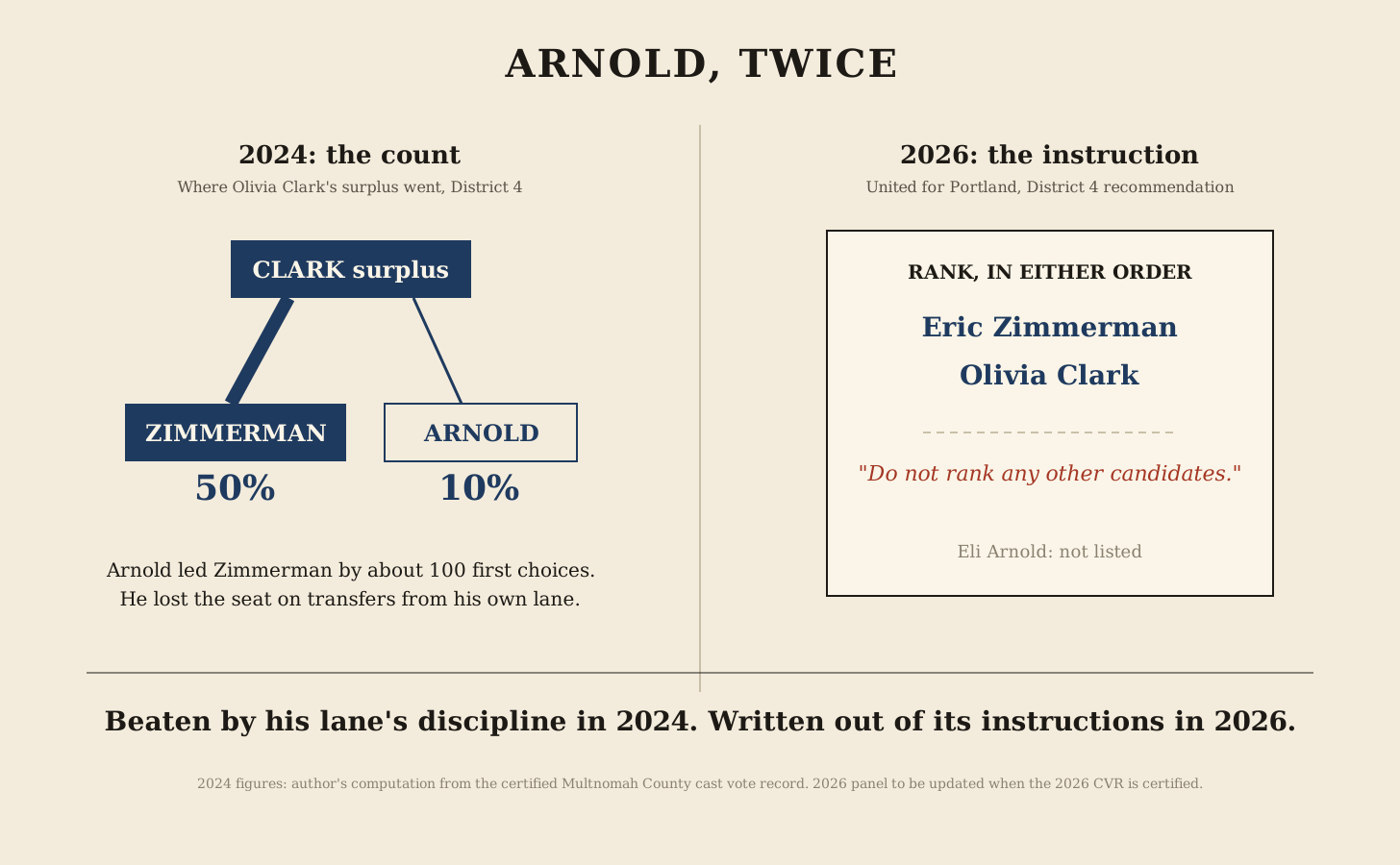
A ballot instruction is different from a standing expectation of coordination after election. I will not pretend it is. But both are hiring criteria, both are written by somebody other than the voters, and neither one mentions the merits of the issues.
How you keep it
Here the city's standard meets the chapter's, and the collision is one word long.
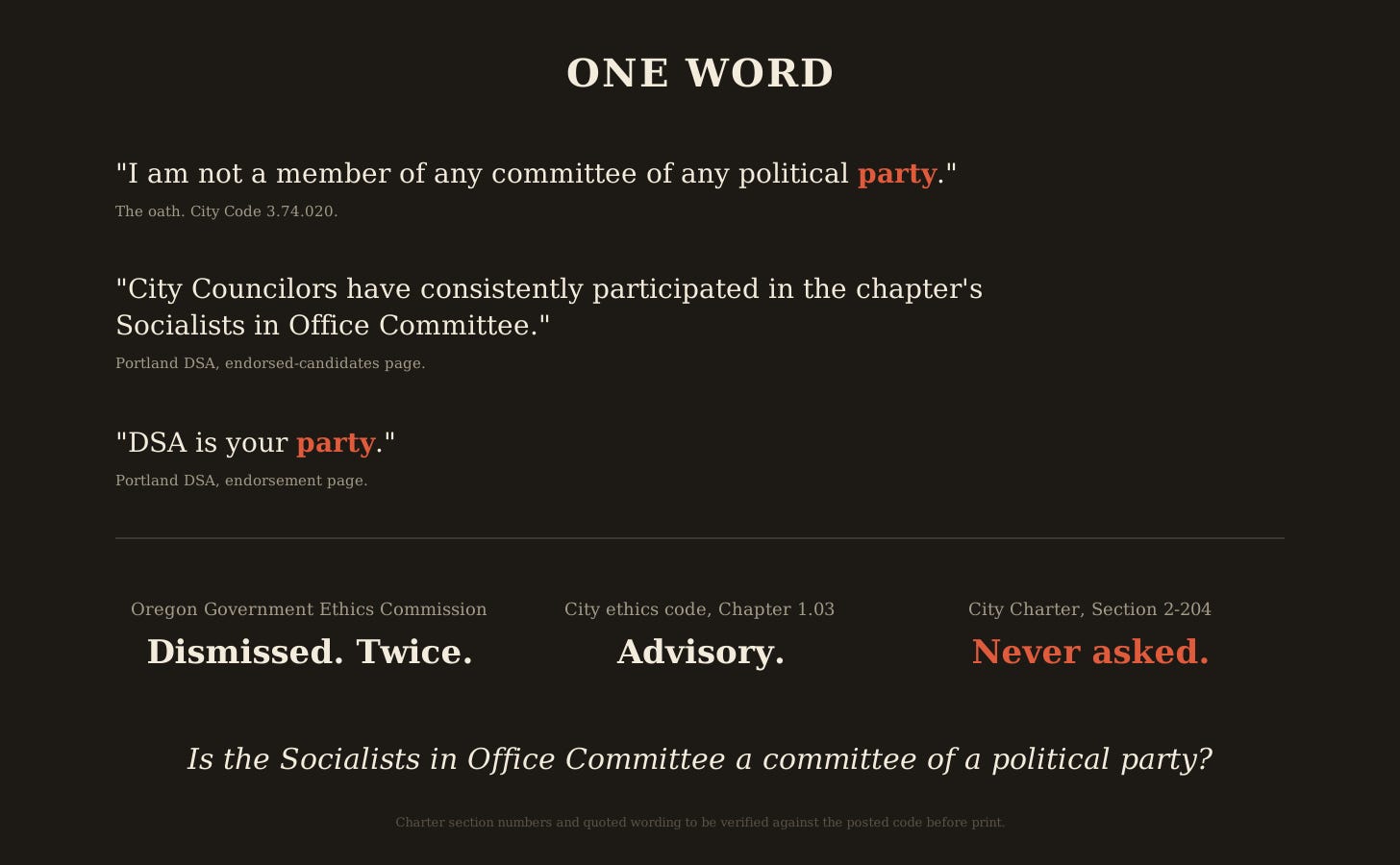
The chapter runs a Socialists in Office Committee. Its 2023 endorsement policy describes the committee's meetings with officeholders this way: "In these meetings, they will strategize, enforce DSA policy, and figure out how our actions can be coordinated." Cadre candidates are "required to meet with the chapter twice a month" and "to form a socialist caucus in the legislative body they are elected to."
The charter, at Section 2-205, requires every councilor to swear that "the official is not a member of any committee of any political party," and adds that if the oath "be false in any particular, it shall be deemed a delinquency in office." Section 2-204 makes it a standing condition of the office: No elected official shall "serve on or under any committee of any political party."
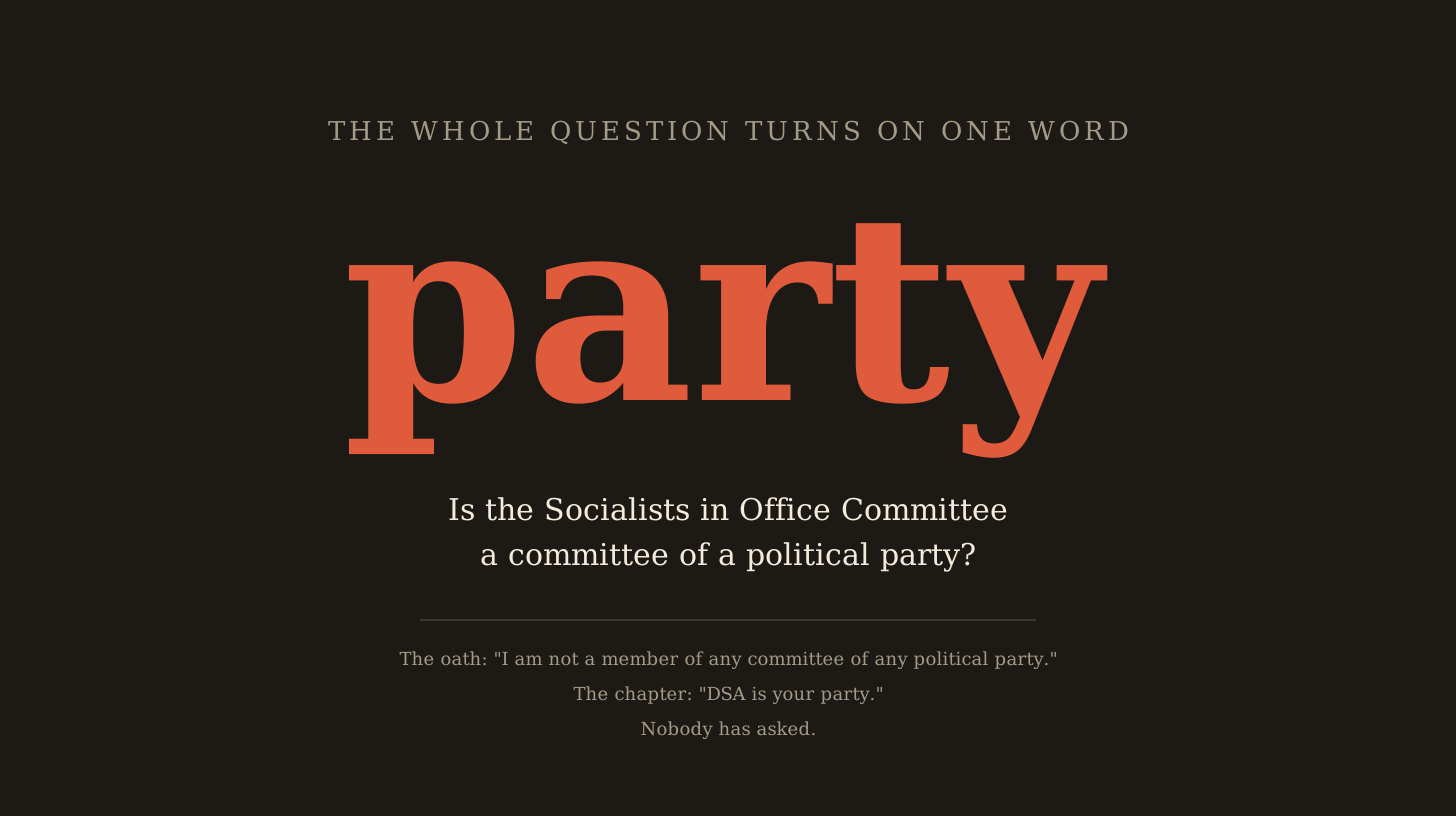
So, the whole question turns on one word. Is the Socialists in Office Committee a committee of a political party?
The chapter says DSA is your party. The state says DSA is not a registered party. The Oregon Government Ethics Commission has looked at the arrangement twice and twice found no law that reaches it. The city's ethics code, as we have seen, is advisory. Nobody has asked the question under the charter. I am asking it. I am not answering it, because I do not know, and the people whose job it is to know have not been asked.
Before anyone else draws the line, I will. In 1966, in Bond v. Floyd, the Supreme Court told the Georgia House it could not use an oath to keep Julian Bond out of his seat because of his politics. An oath to uphold the government is not a license to screen beliefs, and neither is this article. A councilor is entitled to be a socialist. A councilor is entitled to agree with the socialists every time the vote comes up. The question is not what they believe. The question is what happens on the day, the chapter's priority and the merits of the issue point in different directions, and whether the councilor who goes with the merits still has a job in two years.
The test of independence is not whether people agree when agreement is easy. It is whether an officeholder is free to disagree when disagreement costs the support that keeps the seat.
A capable candidate should be able to say, "I agree with you about housing. I disagree with you about something else. Here is what I propose to do for this district." That should be a viable political position. In Portland it is a failed membership application.
Why the charter
The city's own ledger does not fix this. Matching payments went to all six incumbents, across the council's divide. That tells you where the money came from. It tells you nothing about which relationships an officeholder believes must be preserved to keep the seat, and the chapter is the only institution in town that put its answer in writing.
Senator Russell Long used to say Louisiana's corruption could be made illegal but never made unpopular. Portland has the reverse. The arrangement is popular, nobody has found a way to make it illegal, and the city's ethics code has volunteered that it does not intend to try.
That leaves the charter. The next four pieces take the three things one at a time, with the certified ballot records when the county releases them, a district map, the mayor's actual powers and what the public's campaign money has actually bought. Single-member districts can elect ideologues. Strong mayors make bad decisions. None of this repeals ambition. What it can do is make responsibility clearer, competition more direct and independence, something a councilor can afford.
At Paramount, my business partner did not tell me the executives were stupid. He told me I had misunderstood the problem they were solving. I do not intend to spend two years telling Portland that the winners are stupid or the voters were fooled. I intend to take the city's own job description, the one it wrote and then marked advisory, and ask what it would take to make it the one that gets you hired.
The objective is to make doing the public's job well the safest way to keep your own.
Robert S. Miller is a Pearl District resident and president of a gaming technology company. He uses AI tools, Claude and ChatGPT, to gather public records, run the numbers and check facts.
Doesn't this local "party" ambiguity parallel national (D)s' leaders' reluctance to embrace their socialist allies after DSA's very recent "blue(r) wave" wins in a number of states and localities? If so, perhaps any Portland resolution would also parallel the national one, which would require an end to demonizing the further "left."