


Contenders for leadership positions in troubled institutions might be expected to have a plan—a diagnosis of past failures, a theory as to how things should work and the critical steps needed to get there.
Multnomah County chair candidate Sharon Meieran has been making plans to reverse the county’s wasteful, ineffective and unpopular approach to homelessness, addiction and chronic mental illness since her first term as a county commissioner 10 years ago. She brought potential partners together, drafted documents and tried to push an evidence-based strategy uphill, all to little effect.
Meieran is running for the county’s top seat based on a conviction that—in a system in which the chair administers all city departments and controls the commission’s agenda—it’s the only way to bring about the necessary structural change.
“My goal is to fix Multnomah County,” she said, “and I need to be chair to do it.”
Of the three vying for the position, only Meieran has produced a plan. Julia Brim-Edwards and Shannon Singleton have touted their abilities and achievements without explaining why county programs have gone awry or outlining the changes needed to fix them.
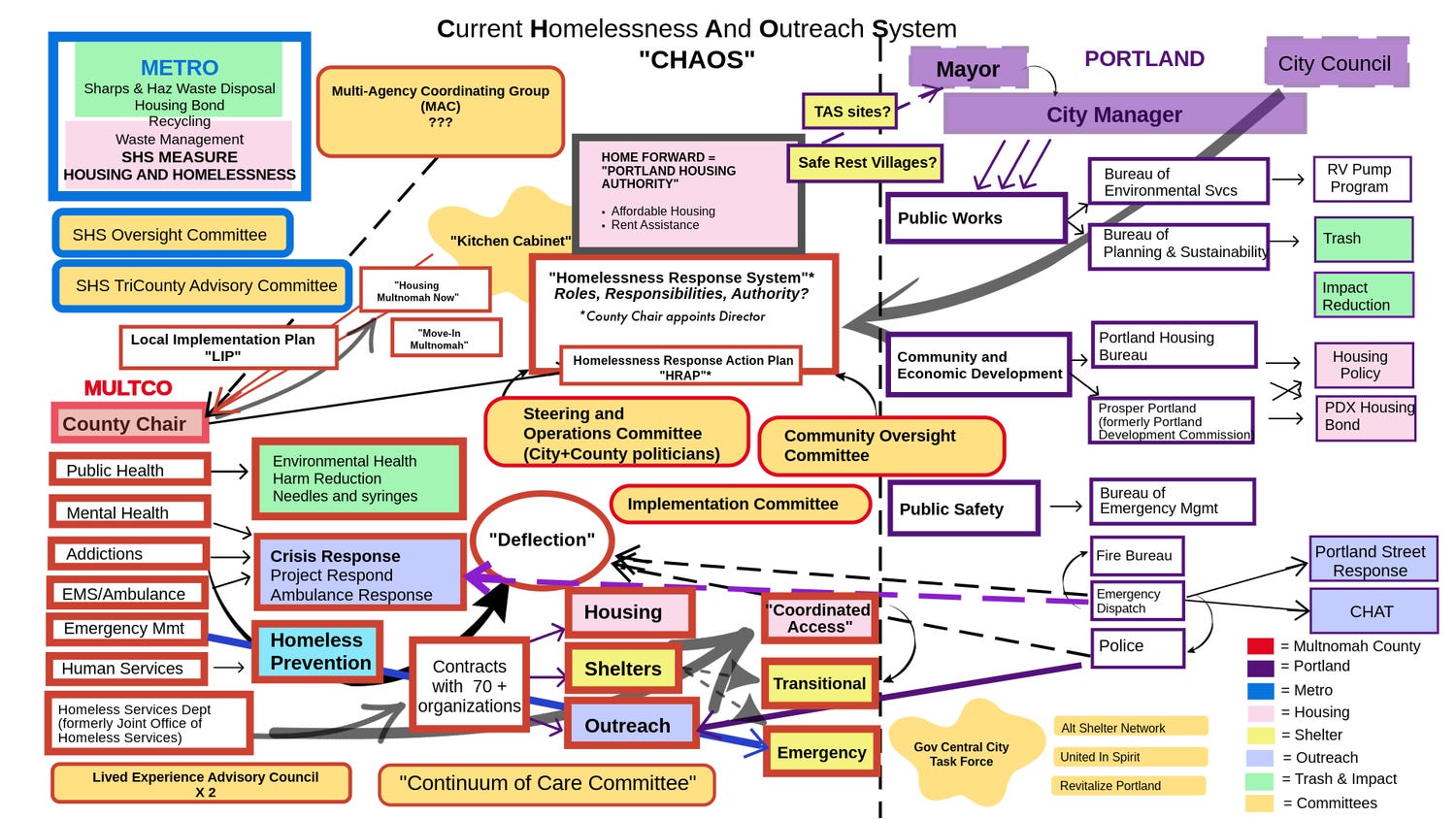
By contrast, Meieran has been disseminating a 23-page plan, including a county organizational chart so labyrinthine that even a novice can see why the county can’t get out of its own way.
“I’m flummoxed. Frankly, I would have preferred not to run for office in the first place, but I knew the county needed a plan,” Meieran said in an exclusive interview with the NW Examiner.
“I used all of my efforts to work on a plan with the experts, created one and put it out there so that there can be public debate as the county is trying to figure out new leadership and its direction.”
Meieran, an emergency room doctor and former attorney, has worked in arenas where the buck stops.
“I thought, apparently naively, that putting out a plan would get some reaction from someone, especially people who are saying they want to be the leaders of the county … and I got nothing.
“And not only did I get nothing, whether it’s critique, whether it’s these things would be great or here’s how I would tweak it. It doesn’t have to be my plan. Like, what is anyone else’s plan? There’s not even an outline of anything. And so I honestly don’t get it,” she said.
In the county that never plans, signs of mismanagement abound. The chaos and garbage on the streets can’t be missed. Numbers back up the images.
“Oregon is ranked 51st in the nation [counting Washington, D.C.] for prevalence of mental illness,” she said. “Oregon is always near the bottom, and it’s led by Multnomah County, which is supposed to be the local mental health authority for the region, providing the full complement of mental health services.
“So, we are the worst in mental illness and addiction. We have the worst overdose rates, worst addiction rates, worst deaths, especially of youth. Worst youth suicide rate.”
The slide didn’t begin yesterday.
“Ten years ago, we were in a crisis around homelessness and mental illness. That’s why I ran to be at the county in the first place,” she said.
Most county social services are provided indirectly through nonprofit organizations. Meieran said the contracts are renewed year after year without accountability or measurement of results.
“They don’t hold any of the nonprofits they contract with to account,” she said. “The county contracts with hundreds of nonprofits, and what I found out as I worked at the county—one of my biggest frustrations—I could never get just a list or itemized description of what they do. What are the goals? How do they tie into the bigger picture?”
The only reliable thing is the steady flow of funding.
“They would just roll over the county’s budget, fund these organizations, maybe tweak a little bit depending on how much money they had or didn’t have,” she said. “And that was how they did business.”
Took a whistleblower
That loosey-goosey approach led to the scandalous collapse of Sunstone Way, a major shelter provider that misspent about $3.6 million in public funds, much of it on extravagant trips and personal expenses. A criminal investigation is underway.
“It’s only because someone blew the whistle that that came out,” Meieran said. “But it is the tip of the iceberg. If anyone did an actual audit or review of all of the county’s nonprofits … they would be finding this everywhere. The amount of money wasted in that context is unimaginable, and it’s unconscionable.
“The county should not have to rely on the courage and strength of one whistleblower to come up with the reason for all of these things happening, or for telling us they happen.”
That individual was Kate Fulton, the former finance manager for Sunstone. Fulton also made headlines last year as a whistleblower while she was a member of the Food Front Cooperative Grocery board.
Many others inside the system chose not to speak.
“Regularly, I would hear from people who would tell me the truth about what was happening at the county—failing in their contracts, how badly the county was operating,” Meieran said.
“They were all validating each other, and validating what I would see. Then I would say, ‘We need to tell the story.’”
The replies were predictable: “Oh no, I can’t. I can’t come out and say it, because it’ll threaten our funding.”
As a result, Meieran said, the county has received more money per capita for homeless services than any place in the country while “unsheltered homelessness has at least tripled.”
Managers of county programs are fleeing in droves.
“The turnover at the county has been mind-boggling,” Meieran said. “There have been seven health department directors in eight years, seven homeless services directors, six mental health directors, five community justice directors and a revolving door of other senior leaders. That kind of churn is devastating for an organization. No one can move forward with that.”
Budget last straw
Meieran had hoped that Brim-Edwards would carry the reform torch while she enjoyed retirement from public office. That changed when Brim-Edwards supported the county’s 2027 budget, which she saw as a continuation of piecemeal measures in defiance of fundamental change.
Meieran refused to support the budget in her last year on council, explaining: “We have tons of money. We literally couldn’t spend it all. What we lack is a plan and a system that actually accounts for where our money is going.”
She sees Brim-Edwards’ pivotal vote for hiring Nathaniel VerGow as homeless services director as just propping up the status quo.
“[VerGow] spent the past decade in senior leadership in Los Angeles’ homeless services system, a system now being dismantled after a federal lawsuit and independent review uncovered profound failures in oversight, accountability and financial management,” Meieran wrote on her website.
“Los Angeles has one of the worst records in the country,” she told the Examiner. “It was the subject of a federal lawsuit and a scathing independent review that found it had wasted billions of dollars.
“But that’s the person the county brought in, that the chair selected and that three commissioners voted for.”
In an Oregonian interview, “VerGow repeated the county’s usual explanation for homelessness: high rents, not enough money,” she continued. “Addiction? Substance use disorder? Serious mental illness? Not one of those words appeared in his answers. That omission is glaring and defining.
“If the person running the county’s Homeless Services Department doesn’t name addiction and mental illness as central to the county’s unsheltered homelessness crisis, then there’s no reason to listen to anything else.
“Throughout the interview, Mr. VerGow reached for buzzwords like collaboration, efficiency, prevention, relationships, funding and better data for elected officials. While those words matter, they do not add up to a vision.”
After VerGow’s first three months on the job, “We are seeing nothing” in terms of progress or a plan, Meieran said.
What others say
Brim-Edwards, who served with Meieran on the county council for 18 months, often on the same side of issues, gave The Oregonian a stinging assessment of her former colleague:
“Sharon Meieran was a county commissioner for eight years and was ineffective at driving change or improvement,” Brim-Edwards wrote. “This place is less affordable, less safe and the problems bigger because of Meieran’s time on the commission.”
Meieran has not disguised her ineffectiveness as a commissioner—she has in fact emphasized it, basing her campaign on a belief that only the chair can bring about the wholesale change needed. And if commissioners share equal blame for the body’s failures, a dose of it would fall on Brim-Edwards for her three-plus years at the table.
Others see Meieran as the one candidate with a plan that makes sense.
Richard Perkins, a former addict and adviser on recovery programs, trusts Meieran.
“Hopefully, Dr. Sharon Meieran, who has worked consistently over the last six years I have known her on a plan to address our behavioral health crisis,” Perkins said, “will finally get an opportunity to implement that plan, and we will have to put up with the status quo no longer.
“Unlike the other two candidates, she has been vocal about the problem and worked with experts on a plan to address these issues. Is it perfect? Surely not. But it is light years ahead of any alternative. We are starting to see new drugs on the streets more dangerous than fentanyl. It is time to abandon the libertarian goals of letting people experiment with dangerous drugs and help those addicted escape their control and rejoin society.”
Examiner subscriber Marc Green claims no expertise in the recovery field but shares Perkins’ enthusiasm for Meieran.
“I read Sharon’s plan and admittedly did not fully understand it,” Green wrote. “The point for me is that she is a professional, she cares and she is ready to act on day one. I endorse her, and our county needs new blood, decision-makers who are results oriented.”

A few observations. One, Sharon has the guts to put out a plan and state “critique me, add to it etc.”. Two, her willingness to take on the non profits/NGOs who have operated without any accountability should be enough to convince anyone to vote for her. We have spent billions on a problem that has gotten worse, with little to no accountability. And finally, as a result of Sharon’s willingness to examine the nonprofits, the unions have endorsed her opponents. Of course they have, they want the status quo and the grift to continue. For me, the results of this race will reflect if Portland will ever change. Donate to her campaign and volunteer.
The mismanagement of money is mind-blowing alongside the crumbling of the city of Portland.
Portland has been derailed long enough...let's get Portland back on track! Enough is enough!
You've got this Sharon Meieran!