


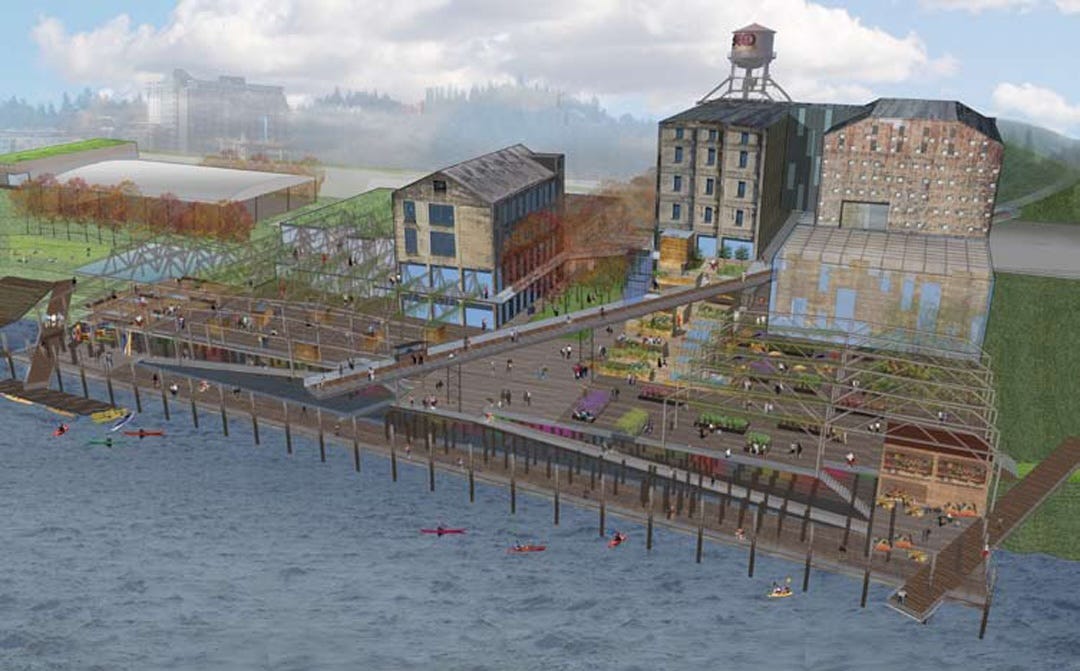
The many failed attempts to redevelop Centennial Mills are often brushed off as mere pipe dreams, each reinforcing the infeasibility of the whole mission. The last fleeting dream now lies in ashes after an Aug. 2 fire doomed the eight-story flour mill tower.
But one venture stood above the rest in 2008, only to be cut down by Prosper Portland, the city’s development agency, then known as the Portland Development Commission.
Developer Shaheen Sadeghi of Cosa Mesa, Calif.-based Lab Holding won a national design competition with a proposal he called SEED. It would have repurposed existing mill structures into public spaces centered around local food, culinary culture and small vendor spaces.
Before and after his Portland reversal, Sadeghi has built several similar projects in California, including The Camp in Costa Mesa and Anaheim Packing District, an Orange County food hall.
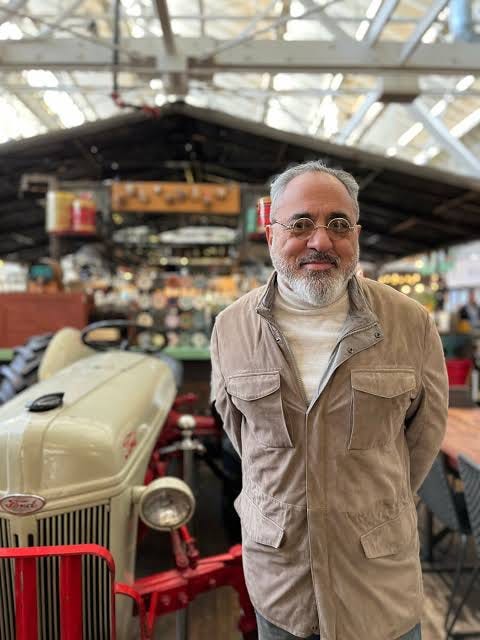
In 2012, the NW Examiner described his altogether different experience in the Rose City:
PDC chair kills one riverfront food project, builds another,
spurned developer charges conflict of interest
By Allan Classen
August 2012
From the start, cancellation of redevelopment plans for Centennial Mills made no sense.
The developer for the 5-acre riverfront site was chosen in 2008 after one of the most thorough public involvement processes in modern Portland Development Commission history. Community backing was broad and enthusiastic for the food-oriented scheme conceived by Shaheen Sadeghi and his LAB Holding company.
Then, without warning or a trace of public engagement—and on the verge of a final agreement to trigger construction—PDC officials drastically changed the scope of the project this spring and spurned Sadeghi’s offer to try somehow to meet the new standards.
The official explanation? A change in direction at the redevelopment agency to emphasize job creation in certain industries not including food. In 2009, PDC developed the Portland Economic Development Strategy (EDS) to target jobs in five regional industries.
But the new policy was in place for two years while both LAB Holding and PDC were moving single-mindedly toward completion of the original scheme, called Project SEED. Sadeghi traveled the globe visiting outstanding public markets. He hired nine independent contractors to assess the condition of the aging mill structures and address requirements of public bodies all the way up to the federal government.
He hadn’t started with a blank slate. The project had to incorporate a yet-to-be-built pedestrian bridge from the envisioned Fields Park, protect the health of endangered fish in the river, connect to a pedestrian/bike path along the river—all while upholding his commitment to save the existing mill structures.
Meanwhile, PDC was also hiring contractors to assess the decaying wharf and live up to its end of a memorandum of understanding.
In November 2010, the PDC commission and staff reaffirmed that the project, though falling behind its original timetable—along with virtually all other local development in the slumping economy—was still on course, aiming for a final development agreement in early 2011.
But in April 2011, newly appointed PDC Executive Director Patrick Quinton advised Sadeghi that due to “significant changes at PDC,” he now had to meet new wholesale requirements never before mentioned.
Suddenly, a two-year-old policy resolution trumped all, although no other development agreements were cancelled in deference to this policy.
The Southern California developer, who launched his career with a youth-oriented “anti-mall” in 1993, was taken off guard by the new ground rules.
“Then, boom, I got a call to turn the project into an office building,” said Sadeghi. “I said, ‘You’re kidding me, right?’”
The California-based developer was indignant. By his calculations, he had already invested about $2 million in preparations for construction, and he was being asked to scrap it all to put up an office building, something he had never done and knew little about.
The deadline for coming to terms on a new plan was less than three months away.
He asked for more time to meet the new standards, but Quinton turned him down.
“When he said no to that, I knew for a fact they weren’t sincere,” said Sadeghi. “I walked out of the meeting.”
He was particularly galled when Quinton told him “culinary is a veneer industry” and not of importance to economic development in Portland. “Those words really got to me.”
In the developer’s mind, food is at the heart of Portland culture and creative drive.
“This town is about food,” he said, referring to its interest in sustainable and local foods, the booming food cart phenomenon and the unique restaurants that excite New York Times reviewers.
Sadeghi wasn’t the only one who was shocked by PDC’s U-turn.
Patricia Gardner, co-chair of the River District Urban Renewal Area, in which Centennial Mills is located, and vice president of the Pearl District Neighborhood Association, said it was “a shame” to cancel the project “because it was close to a DDA (disposition and development agreement).
“We had an expensive public process, so for it to die behind closed doors is exceptionally challenging,” she said.
But Quinton said the kind of businesses he wanted at Centennial Mills were in “software, activewear and outdoor gear, clean tech and sustainable industries, or advanced manufacturing or other traded sector firms with demonstrated high growth potential.”
One can argue the economic potential of the local food versus footwear industries, but clearly Project SEED was chosen to do the former, and suddenly that wasn’t good enough.
The most obvious source of PDC’s about-face would be Scott Andrews, who was elected chair of the commission’s board of directors in June 2009, and Quinton, whom he hired to run the agency in February 2011. They were the ones quoted by the media in defending the decision to bury Project SEED.
They blamed Sadeghi for not having signed tenants or gotten financing lined up, but he called that a red herring because he couldn’t begin to outline his costs or timetable until an engineering report on the wharf’s condition was completed, and that work was commissioned and controlled by PDC.
While dreams of one attraction focused on local, healthy food were evaporating, another local, healthy food project a mile upriver was taking root. This one, by Melvin Mark Companies, also had the blessing of PDC, which for a time considered including it in a new urban renewal area. This one also had a direct connection to PDC chair Andrews, who is president of Melvin Mark Properties, a division of MMC.
In May 2011, Multnomah County agreed to sell three blocks at the western end of the Morrison Bridge to Melvin Mark Cos. Two blocks of the proposed development will be devoted to the James Beard Public Market, a year-round indoor/outdoor facility selling local produce and locally manufactured foods.
That Andrews would have a hand in killing one riverfront food attraction while financially tied to a similar project nearby struck some as more than coincidence.
“Why is it that the chairman of the organization [PDC] goes in and shuts down our project and then goes to do one of his own?” Sadeghi asked. “That doesn’t sit right.”
The developer is officially claiming Project SEED was the victim of what amounts to a conflict of interest in an amended suit filed in Multnomah County Circuit Court in March. A more limited suit charging breach of contract was dismissed earlier this year by the same court.
“It became clear to Project SEED that the plan change was to kill the momentum of negotiations, avoid a final DDA and prevent competition with the Morrison Bridgehead project.”
Sadeghi said the simultaneous creation of two food-related attractions in Portland would have brought confusion, making it difficult for the public market to raise the $25 million in capital donations needed to meet its goal of opening debt free.
“The SEED project was all about food,” he said. “What they’re going to do now is very similar.
“This whole thing is very fishy.”
The original park idea was resisted by the Pearl District Neighborhood Association, which called for a grander public attraction worthy of the site's historic significance. That was an era when people asked, "Why not the best?" A lot of pieces had to come together to make such a vision possible, and since 2008, the city has not been up to the task. At times, just culpable.
It will always be the Portland Development Commission to me.