

By Robert S. Miller
Every Portland councilor swears the oath in City Code 3.74.020 before taking office. It ends with two promises worth rereading this election season: “I will faithfully, honestly and ethically perform my duties,” and “I am not a member of any committee of any political party.”
I have taken a few oaths and administered a few. An oath is a commitment to a bigger thing, and you do not understand it until you have to fulfill it. It is the thing you strive to be, and then it becomes your most prized possession, the words that define you.
On Dec. 19, 2024, at the Newmark Theatre, 12 incoming councilors swore those words, and took office on New Year’s Day. Four of them had already broken the oath years before they raised their hands. Not in the lawyer’s sense. In the older sense: They arrived with their loyalties already ranked, and the city was not ranked first.
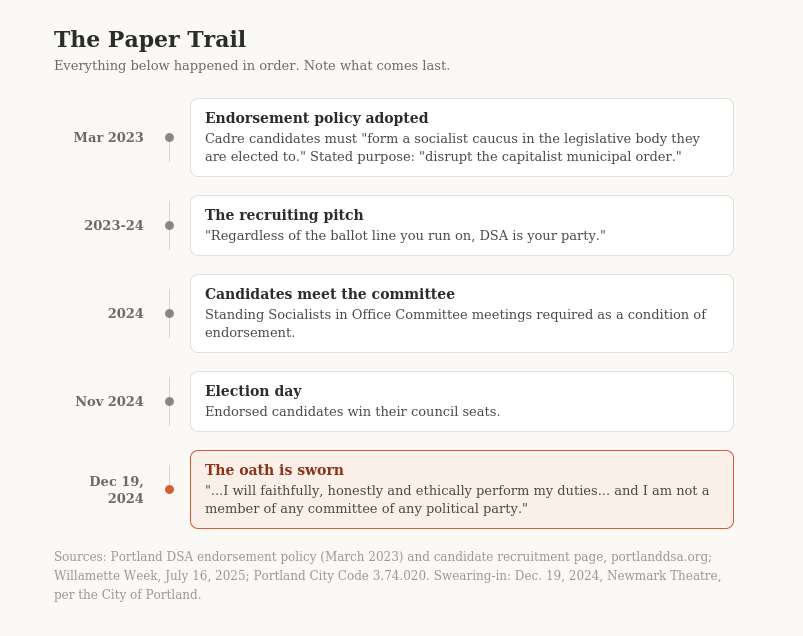
“The Paper Trail” timeline, image attached. Caption: Sources: Portland DSA endorsement policy, March 2023, and candidate recruitment page, portlanddsa.org; Willamette Week, July 16, 2025; Portland City Code 3.74.020.]
The dates above are not my characterization. They are the public record, most of it published by the Portland chapter of the Democratic Socialists of America itself. In March 2023, 20 months before the election, the chapter adopted an endorsement policy requiring its top tier “cadre” candidates to meet with the chapter twice monthly, brand themselves as democratic socialists and form a socialist caucus in the body they are elected to. The stated purpose, in the chapter’s own announcement: to “disrupt the capitalist municipal order.” Its recruiting page tells prospective candidates, “Regardless of the ballot line you run on, DSA is your party.”
The candidates won. The caucus followed. Per Willamette Week, the four DSA councilors keep a standing monthly meeting with the chapter’s Socialists in Office Committee, the only outside political group with a scheduled meeting with a third of our council. Chapter co-chair Olivia Katbi described the arrangement plainly: “Our councilors are DSA. So what they are doing is DSA until further notice, unless we say it’s not.”
You know the rest from this paper and others. Hundreds of text messages, obtained by public records request, showing coordination from the dais during the 2025 budget hearings. A five-hour private retreat at City Hall that drew a unanimous vote by the state ethics commission to investigate.
This spring the commission closed the matter and dismissed every complaint, finding no violation of state law. In January, Councilor Dunphy left the Peacock caucus, and Green said he no longer attends its meetings. No record shows any of the four DSA councilors leaving the Socialists in Office Committee or the organization. The caucus could fray. The structure did not. And this year, the chapter campaigns to re-elect three of them, citing as credentials that its councilors “consistently participated” in the committee and “frequently vote as a bloc.”
Every official carries loyalties into the chamber: faith, family, a union card. The oath does not erase them; it ranks them. Influence asks in the open, wins some, loses some. Control is different, and control leaves marks.
The four marks:
The commitment comes before the oath.
The relationship is a standing structure, not an open door.
It has teeth.
It never appears on a campaign mailer.
Your union’s endorsement carries none of those marks. A statehouse party caucus carries none; it is printed on the ballot line. The arrangement described above carries all four. That is the whole case. And notice what is missing from the four: any question of whether the ideas are good. The offense is never the idea. It is the method.
A fair reader will ask how none of this violates the rules, and the honest answer is that it slips every seam we have. Oregon’s ethics law polices money, and there is no dollar here. The meetings law counts quorums, and when the state commission examined the five-hour retreat, it dismissed every complaint: no violation found. And the oath’s final clause names committees of political parties. While DSA is not a registered political party under Oregon law; it is a nonprofit advocacy organization whose own recruiting page tells candidates: “DSA is your party.”
Three rulebooks, three seams. The dismissals are not the vindication they sound like. The law is not saying this is fine. The law is saying nobody imagined it. My industry, casino gaming—the most regulated business in America—had the same gap once, until hidden owners taught it that every interest in a licensed enterprise must be disclosed. Portland just got the same lesson.
The councilors deny taking direction, and they do govern. This council passed the largest street-funding measure in decades. Nothing here claims their goals are illegitimate or their voters foolish. But I ran Louisiana’s pardon board, and I never met an inmate who did not have a great reason for breaking the law.
A great reason is the most common thing in the world. What I remember from that seat is the other side of the ledger: the victims, the mommas, the children, the communities, the people who were never in the room where the great reason won. When public business is settled in rooms the public cannot see, the people outside the room pay. That is what this is about. Not socialism. Not housing. The room.
The remedy is not a recall and not a purge. It is the fix my industry learned: disclosure. The council could adopt a simple rule tomorrow: Any standing agreement between a councilor and an outside political organization—its meetings, its pledges, its enforcement—gets filed with the auditor the way lobbying contacts are. It could go one step gentler still and pass a resolution reaffirming the final clause of its own oath, the nonpartisan principle all 12 have already sworn.
Neither motion asks anything of a councilor whose only allegiance is the one in the oath. If the arrangement is as benign as its defenders say, filing it costs nothing, and reaffirming it costs less. And where the state’s code cannot reach, the city’s own can: Write the disclosure duty into Portland’s ethics code, where a violation is subject to the same sanctions as any other.
When college football’s most innovative coach kept finding seams in the recruiting rules, the NCAA did not sue him or shrug. It added a sentence to the rulebook. Portland can add a sentence. As of publication, the DSA chapter has not responded to a written inquiry asking which endorsement terms applied to its council endorsees.
Three of the four are on your ballot Nov. 3. You were never in their room. You are, finally, in yours.
Thank you Robert Miller for providing this insightful presentation along with a SOLUTION. As I read your piece I was struck by the morality factor, as in, these DSA advocates do not demonstrate a scintilla of conscience. They are about power and control.
It's hard to believe that the Charter Commission--one of its members a DSA member, another a sympathizer--didn't know what they were doing when they said the council/mayoral elections would continue to be "non-partisan." This is just one of the many little gotchas in the document, engineered, explicitly, to supercharge "minorities," including political parties. You voted for it; you got it.
No one in legacy media is remotely interested in the fallout from the radical charter; they ignored it when it was being cooked by the City Club, Coalition of Communities of Color, and their plant, Julia Meier (aka, She Who Must Never Be Mentioned). They cut off any intelligent debate of the weird aspects of the charter; they endorsed it and allowed the bureaucrats to trundle out the vote. They're ignoring it now.
But there's good news: in a mere nine years the charter will be reconsidered.