


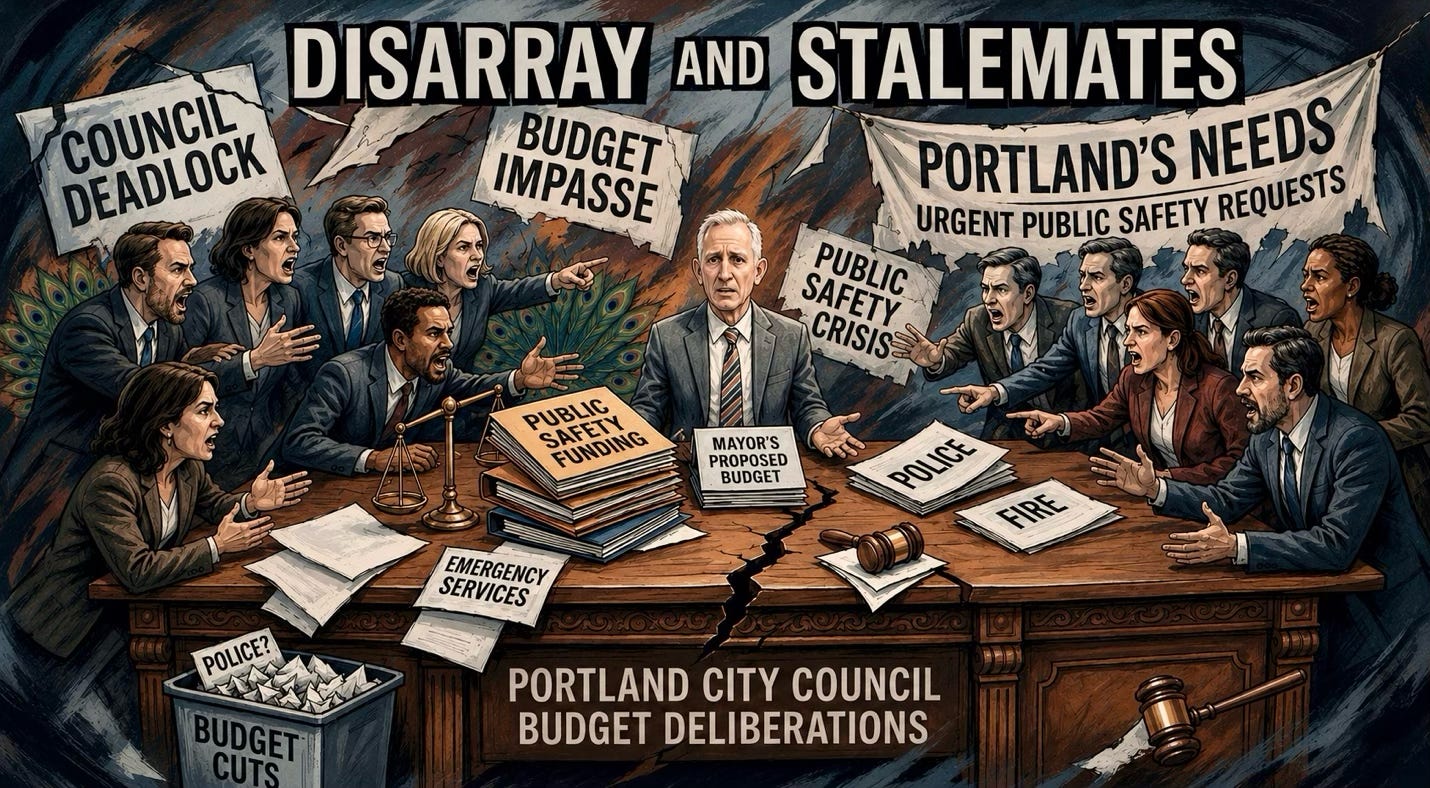
Portland’s recent budget stalemate exposed more than political division. It raised a fundamental question about whether the city is following the charter voters approved.
According to The Oregonian/OregonLive , the city’s 12 councilors spent three days grinding through nearly 40 amendments to Mayor Keith Wilson’s $8.5 billion budget amid a record $160 million deficit. When the dust settled, only 15 relatively modest amendments survived. More consequential proposals involving police and fire staffing, shelters, parks and housing repeatedly died in 6-6 votes.
The spectacle reinforced what many critics feared about a 12-member council: An even-numbered body can easily deadlock.
Under the charter, seven votes are required to pass a non‑emergency ordinance, resolution or budget amendment. A 6‑6 vote is not compromise. It is paralysis.
Meanwhile, Portlanders watching public safety positions and shelter beds disappear are asking the only question that matters: Why isn’t the mayor breaking the tie?
And that leads to the real issue: Is the mayor legally required to break a tie vote?
Charter language meant to be broad
The Portland Charter answers that question clearly.
Section 2-401 lists the Mayor’s responsibilities under “Duties”:
“The Mayor has the following responsibilities:
(e) Vote on matters before the Council in case of a tie, when the Mayor casts the deciding vote.”
Notice the phrasing: Not “some” matters—not “non-emergency ordinances.” The charter explicitly states “matters before the council.” That phrase, unqualified, means what it says: Any matter on which a tie occurs. This language was not an accident or an afterthought. It was deliberately crafted to be broad.
What reformers actually said
The history of the Charter Commission process provides the legislative intent of the broad tiebreaker language.
By 2022, one public concern surfaced repeatedly: a 12‑member council could deadlock. Reporting by Rose City Reform documented numerous warnings that an even‑numbered council would produce exactly the gridlock Portland is now experiencing.
Former Mayor Ted Wheeler urged the Charter Commission to include a mayoral tie-breaking authority specifically to avoid governmental paralysis.
Commissioner Carmen Rubio stated the rationale directly:
“As much as we’d want a majority to align around any policy agenda or issue that comes before City Council, sometimes that just doesn’t happen.
“The public is already frustrated around city council gridlock. If we don’t have a tool to break through those impasse times, it would just produce a different kind of gridlock and cause more frustration.”
Her comments described the tiebreaker as a general anti-gridlock mechanism, not a narrowly confined power limited to certain categories of legislation.
The commission listened. After what Rose City Reform described as “a deluge of warnings about a deadlock,” commissioners—including current councilor Candace Avalos—unanimously added the tiebreaker. The explicit purpose, as co-chair Melanie Billings-Yun put it, was to respond to Portlanders’ strong demand for a tiebreaker mechanism to prevent stalemate.
The public discussion consistently treated the tiebreaker as broad authority. One commissioner compared it directly to the vice president’s role in the U.S. Senate:
“{The}tie-breaker power decisive action is similar to what a vice president does with the U.S. Senate. They come in to break a tie, but they are not a member of the senate.”
The analogy matters because the vice president breaks ties not only on final passage, but also on amendments and procedural motions.
Other commissioners added that the tiebreaker would “incentivize council to not hit a tie” and encourage dealmaking when councilors wanted to avoid mayoral involvement.
Likewise, the League of Women Voters of Portland put it plainly in its endorsement materials:
“The mayor breaks tie votes of the council. This tie-breaking vote prevents gridlock.”
Nothing in the public record suggests a narrow power. The intent was broad. The language is broad. The purpose was broad.
January 2025 city attorney memo
On Jan. 2, 2025, the new council deadlocked 6‑6 on electing a council president. A motion was made to let the mayor break the tie. City Attorney Robert Taylor advised against it, arguing that officer elections are internal matters governed by Section 2‑110.
For that specific question, the reasoning is defensible. But Taylor went further—much further.
He cited ballot title language his office had drafted (“vote to break ties on non‑emergency ordinances”) for the 2022 voters’ pamphlet to argue that the mayor’s authority is limited to that single category.
A majority accepted the memo. Three councilors dissented. Consequently, a memo written for a narrow question became the basis for a sweeping limitation on mayoral authority.
Charter, not ballot title, controls
That creates a serious legal question: Can a post-election legal memo narrow powers that the charter itself, in plain text, grants in broad and unconditional language?
If the drafters intended to limit the tiebreaker to non‑emergency ordinances, they could have written that restriction into the charter. They did not.
Legal analysis begins—and often ends—with the plain meaning of enacted text.
The charter is unequivocal:
“Vote on matters before the Council in case of a tie.”
Budget amendments unquestionably fit within that category.
While the ballot title in a voter pamphlet summary used narrower language, subsidiary materials cannot rewrite enacted law. The charter itself uses the phrase “non‑emergency ordinances” elsewhere (Section 2‑117), proving the drafters knew how to limit the scope when they intended to. They chose not to here.
The contrast is stark. The charter uses broad language; the ballot title uses narrow language. Under basic principles of legal interpretation, the enacted text controls.
I served 12 years as mayor of Ketchikan, Alaska, under a charter that stated: “The mayor shall not have a vote except in the case of a tie.’ There, the council set its own rules, but the mayor still voted on every tie, including amendments to ordinances and budgets. Portland’s charter uses the exact same structure. The council sets its operating rules, but the mayor must break ties.
Why this matters now
Currently, the council’s operating rules, shaped by the city attorney’s interpretation, prohibit the mayor from breaking ties on budget amendments. If that interpretation is wrong, Portland is operating under procedures that directly conflict with its own foundational law.
This is not merely procedural trivia. Portland’s new government structure depends on the ability to function despite ideological fragmentation within a 12-member council. The repeated 6-6 votes during the budget process are exactly the scenario reformers anticipated when they added the tiebreaker provision.
What must happen now
If the mayor cannot break ties on major legislative and budget matters, Portland has a government with a built‑in paralysis mechanism.
This demands an independent legal review—not from the city attorney’s office, which authored the limiting memo, but from an outside constitutional lawyer with no institutional stake in the outcome.
The core question is simple:
Does Section 2-401(e)’s reference to “matters before the Council” mean what it says?
A stronger step would be for those councilors who believe the charter means what it says to jointly fund a request for judicial clarification. Public officials share standing to seek judicial enforcement of charter requirements tied to their official duties, especially where voting authority is allegedly diluted or disregarded.
If tied motions are treated as failures when the charter requires a mayoral tiebreaker, councilors could argue that the constitutional process was not followed. An incorrect interpretation, they can contend, effectively altered the governing charter structure approved by voters.
They may not only have the authority to challenge the interpretation but may have an obligation to do so. Because, if the charter means what it plainly says, Portland may have spent the week operating under the wrong rule.
Portland deserves a government capable of governing. The charter’s framers tried to provide one. Whether their work is being faithfully interpreted is a question that demands a straight answer before the next 6‑6 tie buries another decision.

Thank you, Bob Weinstein, for clearly making the case for the Mayor’s tie-breaking authority. These 6-6 votes are gridlock and frustrating. A tie vote prevented my common sense public safety budget amendment from passing last week.
Absolutely. Do it now. Do it quickly. Save us from ourselves. Make democracy work.