


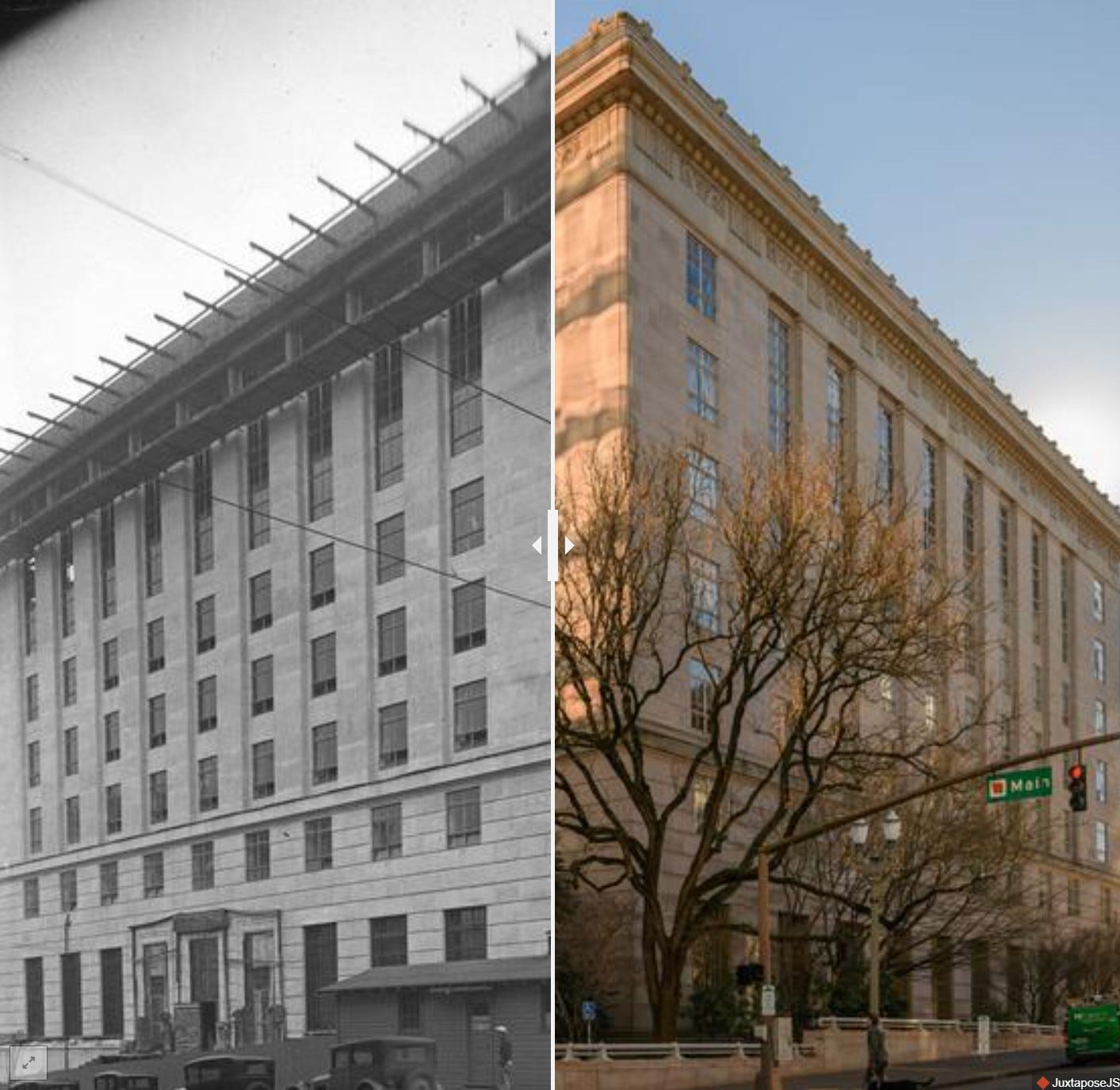
Buildings perched on two downtown Portland square blocks—both drenched with decades of legal history as well as architectural significance—sit empty these days with no new uses in sight.
Portlanders for decades swept into the courthouses to engage in civil and criminal trials, visit local and federal government offices and attend public hearings. But with state and federal courts having moved to high high-rise buildings, the Multnomah County Courthouse that dates to 1914 and the Gus J. Solomon U.S. Courthouse, finished in 1933, sit silent with doors and windows boarded over.
A Portland-based housing and real estate development firm headed by NBP Capital bought the old county building in 2018 and announced plans to convert it to office use. That plan evidently died with the COVID pandemic and the ensuing collapse of the downtown office market.
SKB, another local real estate firm, bought the old U.S. Courthouse late last year, and plans to move its own office into the building. The firm said it plans to retain much of the elegant marble-laden interior spaces, but what other uses might occur will take time to figure out.
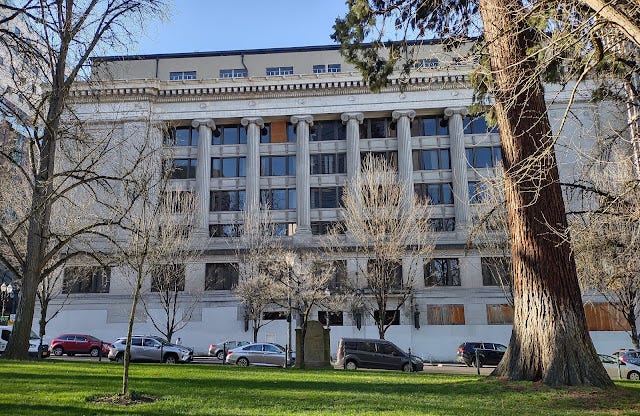
Both buildings are listed on the National Register of Historic Places. The Multnomah County building, facing 1021 Southwest Fourth Avenue, was built in two L-shaped phases while an earlier courthouse dating to the late 1860s was gradually demolished. The courthouse was one of the final buildings designed by the firm of Whidden & Lewis, the city’s most important architectural firm from the late 19th century and into the 20th.
The county courthouse suffered numerous makeovers over the decades, but the grand hallways and main staircase remain on floors one through six. The two upper floors contain a holding jail and small offices.
The former U.S. Courthouse design is an interesting blend of Neo-Classical elements with Art Deco flourishes, as it was created at a time when architectural tastes were moving away from historical elements to modern forms. “Stylistic definition of the Courthouse is difficult. It is typical of many General Services Administration properties in its eclecticism,” states the National Register listing.
The design firm was headed by Morris Whitehouse, whose long career in Portland included work for high-end clients including the University Club, the Waverly Country Club and the Eastmoreland Golf Clubhouse.
The building’s name was changed to the Gus J. Solomon U.S. Courthouse in honor of the judge who spent 37 years on the bench. Known as a stickler for accuracy and rough treatment for ill-prepared lawyers, Solomon also had a sense of humor. Watching a case in his court, your correspondent once heard him explain why he often ruled quickly from the bench. “I do what I think God would do, and when I get reversed by the Court of Appeals, I know where they are coming from.”
Both these buildings deserve brighter futures, as does the neighborhood they share in downtown Portland. Great minds need to get to work to find answers.
Join Building on History’s mailing list by writing “add me” to faroverpar463@gmail.com

I worked as a trial court clerk for Judge Robert E Jones in the old County Courthouse back in 1975 and later tried many cases there as a lawyer. I remember well the newspaper/candy stall, run by a proprietor who was blind, yet unerringly reached for the requested product. The small lunchroom was pretty poor and the top floor jail was cramped, dirty and way overcrowded. The main lobby was always full of Sheriffs, police, lawyers, defendants, jurors and citizens with County business. Many smoking cigarettes and cigars. It was a center of civic activity. And yes, the staircases were grand, very grand.
I loved going to the Mult Co. courthouse with my Dad, Phil Lowthian. Getting through the metal detectors was always the exciting first step into this world. He showed me where to pay a parking ticket (not that I ever got one); and what floor people were heading to for restraining orders; and where the public terminals were to look cases up. Here you could get the facts on just about anything or anyone.