

By Fred Leeson
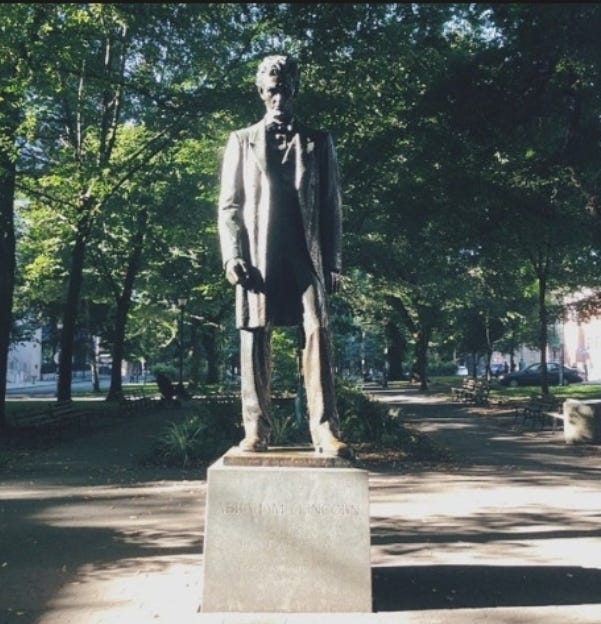
By acting in near-secrecy, planners charged with restoring the Abraham Lincoln statue in the South Parks have created an unexpected ruckus by deciding—several months ago—that Lincoln should be displaced from the original plinth and set at ground level.
The Portland Office of Arts and Culture and the Regional Arts & Culture Council made their decision last Dec. 18 and never announced it publicly. It also appears that the decision was made without any opportunity for public testimony of the fate of the historic statue.
“The plan is to place the statue on the ground, sited in front of its pedestal, and to its left as you face the pedestal from the north,” according to minutes of the Dec. 18 meeting. The minutes also assert that the statue, toppled by protesters in 2020, is supposed to be reinstalled this spring.
The proposed change for the statue’s future only became apparent recently when a preservation advocate made a request for public records. In general, objections to lowering Lincoln to the ground stem from the apparent effort to minimize his importance as a historical figure and a belief that sincere “preservation” requires the work to be restored to its original status.
“The toppling of Lincoln in October 2020 was an initial act of disrespect and lawlessness, and the permanent removal of Lincoln from his plinth is also a transparent act of disrespect,” says William J. Hawkins III, a leading Portland preservation expert who closely follows conditions surrounding Portland’s public artworks. He said the new plan was never mentioned in meetings with the planners in the intervening months. “We now see that they knew this plan would be met with rightful objections,” he added.
Letters are being sent to Mayor Keith Wilson and to Portland city councilors raising objections to the process. The Portland Historic Landmarks Commission on June 1 said it had not been notified of the plan and called for an explanation. The landmarks commission has no jurisdiction over the statue because it was toppled before the South Parks Blocks was admitted to the National Register of Historic Places. However, the statue, if returned to its original placement, could be added to the National Register district as a contributing element.
Ironically, a proposal from a landscape architecture firm consulting on placement of the statue said it believed that the decision was “informed by an extensive community engagement process that has already occurred.” Where and when that engagement process occurred is an interesting question, and likely will be probed by the landmarks commission.
Wherever Lincoln ultimately lands, he is to be joined by a sign “contextualizing information on Lincoln’s legacy and impact on Oregon,” according to minutes of the Dec. 18 meeting of the Regional Arts & Culture Council. While the council stated its belief that placing Lincoln at ground level would make him more accessible to viewers, the council apparently did not address the greater potential of intentional or accidental damage at ground level.
You can join NW Examiner contributing author Fred Leeson's Building on History email list by writing “add me” to faroverpar463@gmail.com.
The people who attacked the statue of Abe Lincoln during their demented rampage around Columbus Day 2020 were not “protesters.”
They were vandals, some of whom very likely had clear ideological viewpoints consistent with the thinking that would humiliate one of this nation’s greatest presidents by taking him off his well earned pedestal.
The City's decision to lower the base of the Lincoln statue appears to have been made with an alarming lack of transparency and public engagement. Following the decision to restore several of Portland's historic statues, the City's arts office had discussions with a variety of interested individuals like Bill & Kit Hawkins, community groups, including Concerned Citizens, and others. At no point during these conversations was there any indication that the City was contemplating relocating the Lincoln statue onto a dramatically lower base.
This omission matters. Public engagement is not simply a box to be checked after decisions have effectively been made behind closed doors. It is intended to provide residents with meaningful opportunities to understand proposals, offer input, and influence outcomes before decisions are finalized.
The City currently employs 37 community engagement personnel across its four service areas. With such substantial resources dedicated to public outreach, there is no reasonable excuse for failing to ensure that a significant proposed change- a change that the decision makers knew would be of great public interest and concern- to one of Portland's most prominent historic monuments was widely communicated and openly discussed. The fact that neither the possibility of lowering the statue's pedestal nor the ultimate decision itself was disclosed during these discussions raises troubling questions about the City's commitment to transparency and public accountability.
Government earns public trust by dealing fairly and honestly with the people it serves. Residents have a right to expect that important decisions affecting shared civic assets will be openly discussed before they are made, not revealed afterward as a fait accompli. When information is withheld from stakeholders who have been participating in a public process, it undermines confidence that the process was genuine.
The Lincoln statue is more than a piece of public art. It is a significant civic and historical landmark whose presentation conveys meaning about how Portland understands and honors its past and that of our nation. Changes to such a monument should be approached with care and openness.
Good government requires more than technical compliance with procedural requirements. It requires candor, transparency, and respect for the public. Portland residents deserve a clear explanation of when this proposal was first considered, who participated in the decision-making process, why it was not disclosed during prior public engagement efforts, and what steps will be taken to ensure that future decisions involving significant public monuments are conducted in the open.
Trust is earned through transparency and lost through secrecy. Whatever one thinks of the merits of lowering the Lincoln statue's base, the process that produced this decision falls short of the standards Portland residents should expect from their government.
p.s. On a practical note, the city to date has failed to demonstrate how a Lincoln statue on the ground to make it more "accessible" can be better protected from individuals who wish to disrespect or harm it- as well as from dogs using it as a scent post or marking spot- than keeping it on its original raised base.