


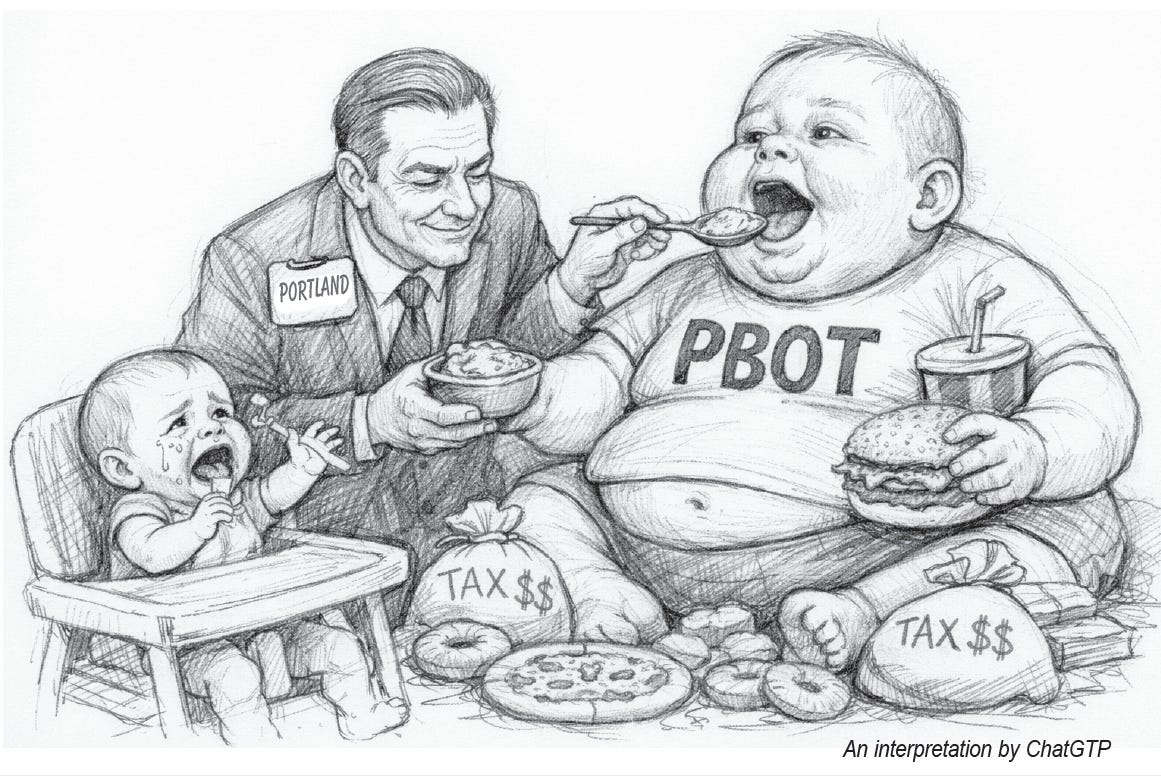
The Portland Bureau of Transportation is in a financial hole—through circumstances beyond its control, it would have us believe—and it needs big money fast. Reserves of $63 million have drained to nearly zero, and 66 staff positions have been cut as the bureau braces for budget deficits predicted to reach $27 million over the next two years.
Above it all, a maintenance backlog of $6.6 billion continues to rise.
The entire bureau has geared up, preparing charts and figures for public presentations around the city. They want to know what new taxes and fees might be tolerated.
The search for clever funding strategies is boundless. PBOT fees could be added to utility bills to collect up to $47 million a year. This idea has the “advantage” (depending on one’s point of view) of being relatively invisible to consumers, who might not notice why their utility bills go up.
Another new revenue stream could come from charging city bureaus and companies that cut through paved streets to work on underground infrastructure. That could produce up to $22 million a year. The Water Bureau or electric company paying the fees would pass it on to their customers, however, so it’s mostly a matter of switching dollars from one pocket to another.
Home deliveries by companies like Amazon or Grubhub could also be taxed. Most find the double-parked vans an annoyance. Taxes paid by other people or unpopular activities go down easier, which seems to be the sweet spot for these funding innovations.
The Biden administration was particularly generous with grants to Portland, but that train has stopped. The state of Oregon cannot be counted on to make up the difference. A $385 million transportation package failed at the Legislature, and PBOT officials doubt the package can pass via referendum.
That leaves the city itself and the willingness of the Portland City Council to enact a PBOT bailout. But who is looking under the hood to see how the bureau is spending what it has? PBOT has boosted staffing levels with short-term federal grants, adding the equivalent of about 100 full-time workers in 2018. The bureau now has more than 900 employees. How many does it need? Don’t expect to get an answer at the PBOT workshops.
My window into the soul of PBOT is the Northwest Parking Stakeholders Advisory Committee, which meets monthly to guide spending of parking meter revenues in the Northwest District. The meetings are chaired by a DEI consultant who condescendingly leads participants through deep-breathing exercises and a recitation of behavioral norms at every session.
About five staff members attend each meeting, justifying taking their hourly compensation from the pool of money designated for neighborhood-recommended projects. Most of the neighborhood’s share has been spent subsidizing transit passes, BikeShare and scooters, with inadequate information to know whether the subsidies are producing results.
Thirteen years since the committee was created, the process has yet to produce a visible project initiated by neighborhood representatives. Instead, it continually steers funds toward projects PBOT wanted to do anyway. Amid universal clamor to fix the rutted northern half of Northwest 23rd Avenue, PBOT says not until the street rebuild associated with the Portland Streetcar extension moves forward—a project neighborhood representatives have consistently opposed.
Meanwhile, PBOT spends freely for unpopular lane closures, traffic diverters and excessive bike infrastructure—that most neighbors consider worse than doing nothing—because they meet an ideological criteria that thrives on thin air.
These are issues that more PBOT funding will not resolve.
PBOT has proven itself hostile to neighborhood concerns while creating a labyrinth of programs and processes that waste money and do things people don’t want. Could some of the “ideological missionaries” be trimmed from the budget so we have enough resources to fix the potholes? Let’s re-envision the bureau from the ground up.
Instead, we are asked for patch-in funds that would forestall such a reckoning. It’s akin to filling potholes when a street rebuild is needed, a metaphor even PBOT people might comprehend.
This article is exactly accurate. Pbot and other bureaus kick the costs of maintenance and crucial infrastructure down the road while spending on what they believe are necessary like bike lanes, diverted roads and expensive street cars they get federal funds to pay to build but cost portland to maintain. Zero accountability for a crumbling infrastructure because they'll be making 6 figures and an early retirement before those deferred maintenance issues start showing their ugly head.
It’s important to remember that these are the same folks pushing to spend $60-$150 million - depending upon federal match- on a streetcar extension to an abandoned development at Montgomery Park area.
Money that could fix the damn potholes, and improve street and sidewalk safety throughout Portland.
See my piece “Streetcar to Nowhere.”
https://nwexaminer.substack.com/p/streetcar-to-nowhere?selection=ce6d90d2-c26a-4cc2-b848-d4ce403de781&r=1ldykh&utm_medium=ios