


Mayoral candidate Keith Wilson’s promised solution to Portland’s homelessness problem was keyed on creating 1,500 more overnight shelter beds by Dec. 1, 2025. By his count, he reached the goal by pushing hard against local resistance to siting those shelters in the Pearl District and other residential areas.
Strictly speaking, the city did not add 1,500 new shelter spaces, but it got close enough so that any person seeking shelter on a given night could be accommodated. Wilson declared victory. Despite boosting the bed count, he did not get homeless people off the streets. Those numbers have only increased, particularly in areas around the new shelters.
Although Wilson promised a virtual elimination of outdoor sleeping in the vicinity of the shelters, in fact, camping, drug activity, crime, trash and physical assaults actually mushroomed around them, as documented by official statistics and systematic daily observations by neighborhood volunteers. The city hired special security and cleanup crews to mitigate the mess, but they could not keep up with the load.
The problem wasn’t a shortage of overnight beds. The 200-bed Northrup Street Shelter never had more than 155 overnight occupants, and average occupancy was about 100.
What appeared to Wilson and most voters as a measurable and useful target turned out to be a false summit. Well before reaching the 1,500 number, it was evident that any preconceived number had little to do with factors making unsheltered homelessness such an inscrutable problem. Shelters inevitably embedded a community of addicts and those with mental illness, who clustered around them even if not going inside. A subculture that included drug dealers and predators mixed in with benign individuals just seeking solace in the company others.
The Northrup shelter closed within a year. Unsheltered homelessness rose during that period, and the harm caused to neighbors of the shelter may be felt for years. Businesses closed and property values plummeted, tightening the doom loop around city and even state politics.
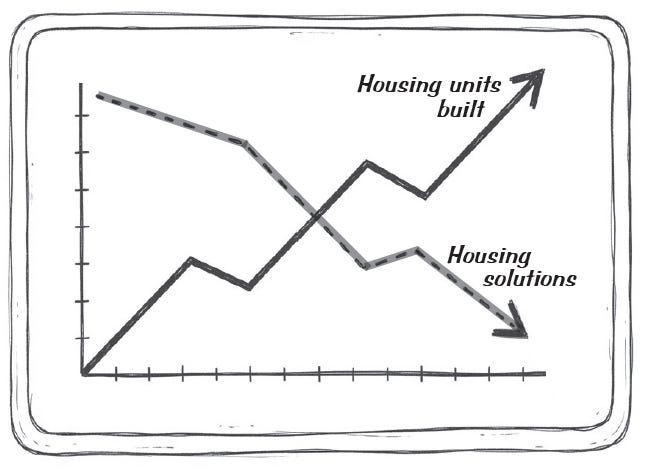
Building at all costs is the watchword in all situations. The whole state is committed to building more housing units at all price levels as the corrective to increasingly unaffordable housing. Gov. Tina Kotek set a goal of 36,000 new homes per year, almost double the actual rate of growth. The city of Portland aims for about 3,000 new units per year, even as actual construction is in a deep dive.
Most housing construction going on in the city now is government-subsidized for low- and moderate-income households. As this month’s cover story explains, the resulting homes are far more expensive to build than market-rate housing, and the “affordable” apartments created are not even attracting the tenants assumed to be waiting in line for a roof over their heads. About 2,000 such units in the city are vacant as many limited-income tenants find they can get a better deal from a private landlord. Still, nonprofit agencies, policy makers and government authorities think building more of the same is getting us out of our predicament. They use numbers to back their projections.
From shelters to affordable housing to market rate housing, we are trying to dig our way out of a pit. Could it be that we are simultaneously tilting the housing market with huge subsidies? Or by rejiggering the zoning code to increase development rights, we are thereby increasing land values, the bedrock on which all developers begin their feasibility calculations? Are such questions even being posed as we push full speed ahead in the same rut?
As Paul Simon wrote, “The nearer your destination, the more you’re slip slidin’ away.”
And so we are.
Complex social problems do not yield to simple solutions. Their breadth cannot be described by counting a single factor. As remedies are applied, the dynamics evolve, and unforeseen challenges arise. Those who march blindly toward the original goal—never adjusting to new evidence and changing circumstances—tend to defend their intentions rather than admit flaws in their imagination.
Thank you for this thoughtful editorial revealing the complexity of our social problems. There isn’t one easy answer. My goal is to address one piece: the acuity level of the on-street behavioral health problems that leave people vulnerable and can threaten the safety of the rest of us.
Do you know why this problem doesn't exist in other cities around the country and also in Lake Oswego? They don't offer any services.