


Reprinted with permission from Stadiumhood.substack.com
Mar 27, 2026
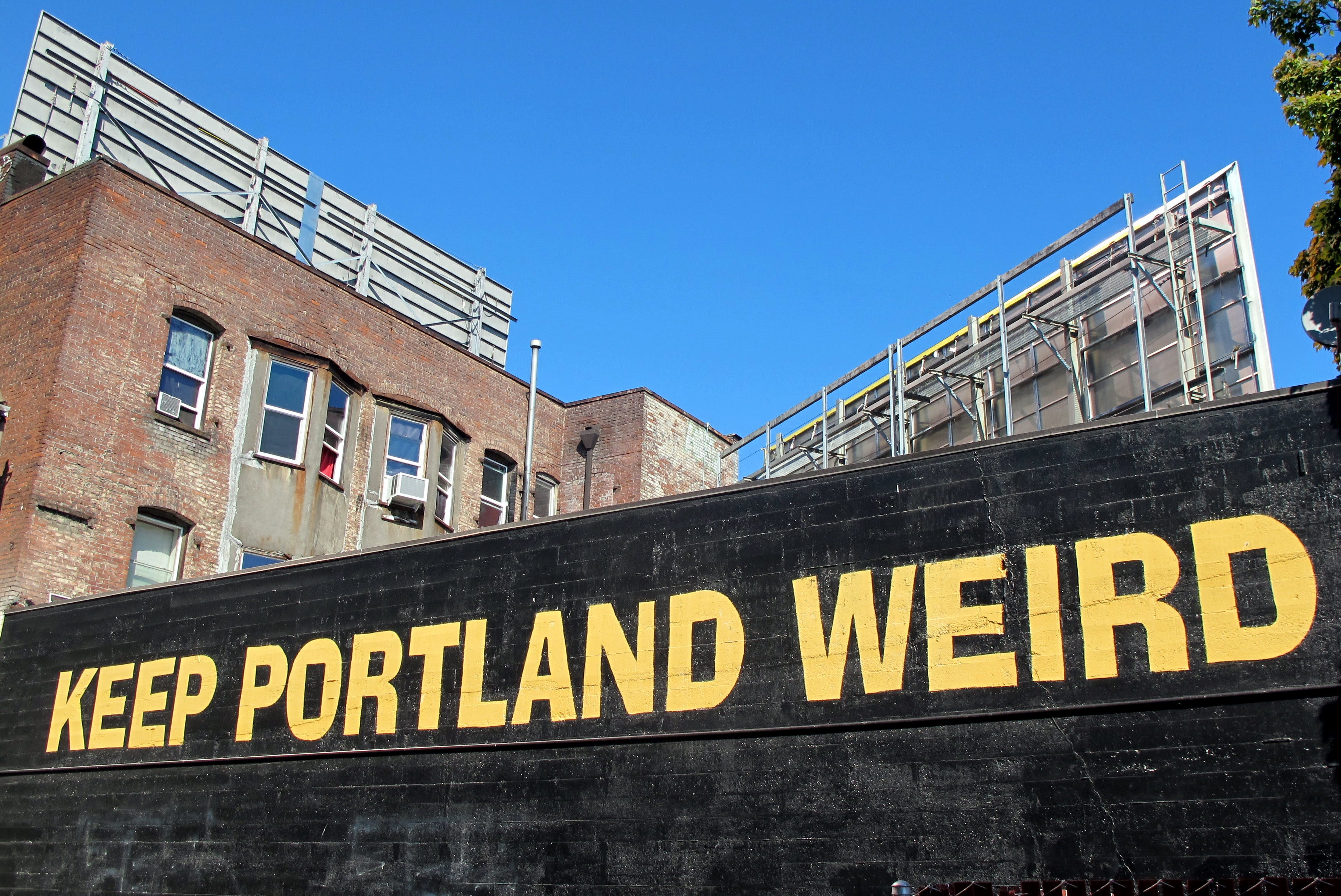
Keep Portland Weird was always half joke, half call to action. We meant the food carts and the fixie bikes and the avant-garde theater in a converted warehouse. We didn’t mean the state of where we are today in some ways. But here it is anyway… the other weird, the kind no one asked for, turning up in the empty storefronts and the slow hollowing-out of something we used to take for granted. For a while, the good kind was winning. Lately, I’m not so sure.
“Portland’s ability to deliver even the most basic transportation services is at risk.”— Portland Bureau of Transportation Director, 2023
I started pulling on one thread and couldn’t stop. From government reports to city audits, to public records. What they show, collectively, is a pattern that Portland and Multnomah County have been missing their own targets for years. I’m sharing what I found because you paid for it, and you deserve to see it, and I’ve just come back from engaging with the short legislative session with new hope.
This research project set out to answer one question: What is Portland’s decline all about?
The evidence I’ve uncovered points overwhelmingly toward a pattern of decisions that are not producing the outcomes residents were promised.1 As we’ve seen in Stadiumhood, sometimes the best intentioned outcomes do not distribute evenly. They concentrate in specific corridors, neighborhoods, and blocks, as neighbors in the Pearl can attest. One breakdown compounds another.
What the Data Shows
1. You Are Paying More and Getting Less By a Wide Margin
Portland residents now carry the second-highest combined tax burden of any city in the United States, behind only New York City. Since 2009, local leaders and voters have approved at least 20 major new taxes and levies. In that same period, businesses saw their total tax bill surge 82%. And what did residents get in return?
Police take nearly 20 minutes on average to respond to a high-priority emergency which is nearly double the national standard. Portland Fire & Rescue meets its own adopted response time goal less than half the time. Streets are crumbling under a $6 billion maintenance backlog.
The city’s own auditor just found that Portland’s arts tax passed by voters in 2012, still has no goals, no metrics, and no way to measure whether it’s working. The report came ten years after a previous audit said the exact same thing.
The permit system was broken for two decades. Mental health services are so dysfunctional that a sitting county commissioner — herself an emergency room doctor — declared in writing that the system had failed and asked the governor to intervene. And in Oregon’s public schools, only 43% of students are proficient in English and just 31.5% in math. These numbers sit below pre-pandemic levels, and well behind neighboring Washington state.
Portland and Multnomah County collectively spend hundreds of billions of dollars, and in some categories, more than double the national average. The metropolitan area is in a management, accountability, and priority crisis. And it is costing every single resident, every single day. Across multiple systems, money is consistently collected at scale, but not translated into measurable, sustained outcomes.
2. Portland is Losing People, Jobs, and Businesses, and the Trend Is Accelerating
Portland is shrinking. Multnomah County has lost population every year since the pandemic. Businesses are closing faster than they are opening. The region lost more jobs in 2024 than any other major metro area in the country — while the rest of the nation was growing. Losses were concentrated in manufacturing, professional services, and financial services which comprise some of the high-paying jobs that sustain a middle class.
The most telling number of all may be this one: people moving to Clark County, Washington — just across the river — earn an average of $105,800 per year. People moving into Multnomah County earn an average of $73,540. Higher earners are voting with their feet, and they are choosing the Washington side of the border: the predictable result of a tax and services environment that has become increasingly hostile to the people and businesses that fund the city’s future.
Portland Public Schools lost 6,000 students since 2018 (the equivalent of three high schools) and enrollment is projected to decline for 14 more years. Families with children are not staying, and the data tells us that Oregon ranked last in the nation for chronic absenteeism in 2022-23, the district has cut $75 million from its budget over three years with $50 million more planned, and up to 10 schools may close by 2027. The school system is part of the same story.
Portland’s downtown economy is moving in the opposite direction of the rest of the country. Office vacancy has climbed to around 37%—among the highest in the nation—while demand has sharply declined, with leasing activity falling to near-record lows. Retail vacancy is also elevated, outpacing most peer cities. At the same time, property values are dropping significantly, highlighted by the sale of the city’s largest office tower for about 88% less than its value a decade ago. While many U.S. cities are beginning to recover, Portland continues to see rising vacancies, falling demand, and declining asset values.
3. We are Not Holding Them Accountable
Perhaps the most important finding in this entire body of research is not any single statistic. It is a pattern. Over and over again, across every issue examined — homelessness, mental health, permitting, fire response, street maintenance, taxes, education — the same story repeats itself: programs are approved with big promises, money is collected, and results do not follow. And no one is held responsible.
Multnomah County spent over $500 million annually on homelessness — more than $53,000 per homeless person — and the homeless population grew. The Preschool for All program collected hundreds of millions of dollars more than it budgeted, left $485 million sitting unspent at the end of fiscal year 2024, and delivered fewer than 3,800 of the 11,000 seats promised to voters by 2030. The homeless services department violated its own budget rules by funding permanent programs with one-time money — then declared a crisis when that money ran out. The building permit system failed its own timeliness standards every single year for over two decades before anyone was held accountable. Portland Public Schools test scores flatlined and families are left with no plan that has reversed either trend.
This is what a lack of accountability looks like at scale.
And the people who pay for it, through taxes, through deteriorating services, through a school system under sustained stress, and through a city that is harder and harder to live and work in — are ordinary Portlanders looking for some common sense for the common folk.
What This Means for the Elections
The data in this research project was drawn almost entirely from the government’s own records, audits, its own budget documents, and its own performance reports. This is Portland’s story, told in Portland’s own numbers.
The question for voters this cycle is going to be whether the people asking for your vote have a plan and experience to do something different, or whether they intend to continue a pattern that has been failing this city for years.
I still believe in the good weird. The Portland that takes chances, takes care of people, and takes pride in being something other cities aren’t. But weird needs a foundation. And right now, ours needs a different approach.
This article draws from a larger body of research compiled for community education. You can read the fully sourced document including every statistic and citation at: Four Undisputable Proof Points: What Is Not Working in Portland. It is a living document being updated as new information becomes available.

Michelle Milla's data tells us what went wrong in Portland, but to understand why it is so hard to fix, we need to look at how the 2022 charter reform was designed and by whom.
The charter reform that restructured Portland's city council — expanding it to 12 members elected by ranked-choice voting from four multi-member districts — was not primarily designed to solve the accountability and performance failures Milla documents. It was designed to change who gets elected.
The blueprint came largely from two reports produced in 2019 and 2020 by the City Club of Portland, a members-only civic organization that operates largely out of public view, whose work fed directly into the Charter Review Commission process.¹
The City Club reports are candid about their priorities. The research committee's charge was explicitly to assess "whether the City of Portland's current method of electing City representatives provides equitable representation for all residents."² The entire evaluative framework was built around an "equity lens" consisting of five questions, none of which asked whether the resulting government would deliver better services, spend money more effectively, or hold officials accountable for results.³ Competence, performance, and fiscal accountability do not appear in the criteria at all.
This was not an oversight. It reflected a deliberate choice about what the reform was for. The 2020 report is explicit that multi-member districts combined with ranked-choice voting would benefit organized voting blocs — precisely the nonprofit, activist, and public-sector coalition that has dominated Portland politics for years.⁴ What the report framed as increasing equity was also, in practice, a structural advantage for the political infrastructure already in place.
The reform was sold to voters as modernization and inclusion. What it actually delivered was consolidation. The same coalition that produced the accountability failures Milla documents — the missed targets, the unspent hundreds of millions, the homelessness spending that grew the homeless population, the permit system that failed its own standards for two decades — is now more durably entrenched in a system specifically engineered to favor organized, ideologically coherent blocs over diffuse voters who simply want functioning streets and honest government.
The City Club reports do acknowledge, briefly, that "a system should rely on structures that result in better representation, rather than relying on the benevolence of individual elected officials."⁵ That is exactly right. But the structures they designed optimize for the identity of elected officials, not their accountability to the people they serve. Those are not the same thing, and Portland is now paying the price for confusing them.
Until reform candidates emerge who are willing to run on performance and accountability — and until Portland's political culture treats those as legitimate governing values rather than code for opposition to equity — the electoral machinery now in place will continue to produce the same coalition, the same priorities, and the same results.
---
Footnotes
¹ City Club of Portland, *New Government for Today's Portland: Rethinking 100 Years of the Commission System* (February 2019); City Club of Portland, *New Government for Today's Portland, Part II: Rethinking How We Vote* (August 2020). The City Club of Portland is a private membership organization. Its research reports are produced by volunteer committees of members and are adopted by member vote before being released as policy recommendations.
² City Club of Portland, *Rethinking How We Vote*, p. 1.
³ City Club of Portland, *Rethinking 100 Years of the Commission System*, pp. 4–5. The five equity lens criteria ask whether the process leads to diverse candidates, whether policy outcomes are equitable, whether the process encourages participation, whether it is responsive, and whether it maintains equity long-term.
⁴ City Club of Portland, *Rethinking How We Vote*, pp. 12–14. The report notes that ranked-choice voting with multi-member districts benefits candidates who can appeal to organized voting blocs, and explicitly recommends this system as producing more candidates from "historically marginalized communities" — communities that in Portland are substantially organized through the nonprofit and activist sectors.
⁵ City Club of Portland, *Rethinking 100 Years of the Commission System*, p. 19.
THANK YOU for summerizing what I've been sadly observing. Idealism untethered from common sense economics or basic management skills is sinking our beautiful city.
PLEASE email this to every city and county commissioner.