


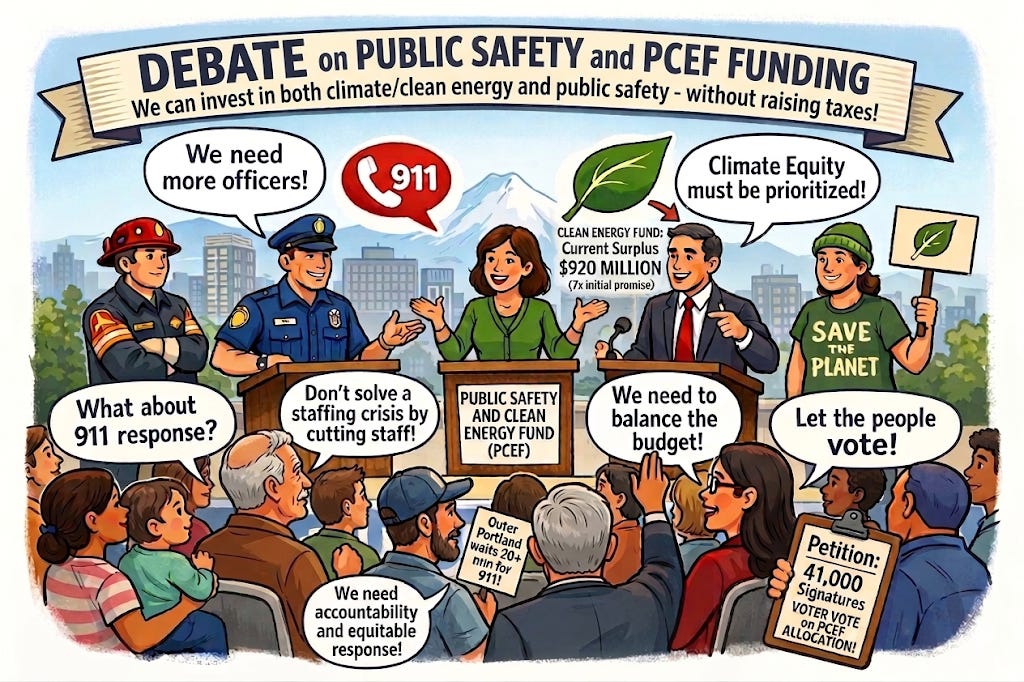
There is a principle deeper than politics at work in Portland’s public safety crisis: A city owes its people the reasonable assurance that when they call 911, someone will come.
Right now, Portland isn’t meeting that obligation.
The situation, plainly stated
Portland fields roughly 800 sworn officers to serve a city of more than 650,000 residents, or about 1.2 per 1,000 residents, the lowest staffing level in roughly 35 years, despite the city adding 175,000 residents during that time. That places us 47th out of the 50 largest U.S. cities, far below the national average of 2.4 per 1,000 residents.
The consequences aren’t abstract: Average response times for high-priority 911 calls have more than doubled since 2019, reaching 20 minutes citywide and even longer in outer neighborhoods. Homicides remain more than twice their pre-2020 levels.
And now, facing a $160 million budget gap, the city proposes to cut $21.7 million more from the Police Bureau, including 34 of 40 unarmed civilian support specialists who handle lower-priority calls that sworn officers never reach. As Police Chief Bob Day warned plainly, you don’t solve a staffing crisis by cutting staff.
The money is already there
Here is where the situation crosses from difficult into indefensible.
When Portland voters approved the Clean Energy Community Benefits Fund in 2018, its proponents told them the measure would “bring in $30 million every single year to clean-energy projects.” Today the fund pulls in roughly $200 million annually, nearly seven times what voters were promised, and has accumulated a surplus of approximately $920 million, hundreds of millions of it unallocated. Portlanders didn’t vote for a slush fund. They voted for a climate program. What they got was both, and no one asked them which other city priorities should benefit.
This fund has already been quietly redirected to the transportation bureau, city employees and the general fund. The mayor has suggested tapping it for MODA Center renovations. A May 2026 poll found 64% of Portland voters support using the surplus for core services like police, fire and parks.
The money isn’t missing. The rules are.
What the initiative would do
The Enhanced Community Safety Initiative would establish a city policy of 2.0 officers per 1,000 residents. While still below the national average, this would stabilize emergency response and restore community policing capacity. It would fund this by dedicating 25% of existing PCEF revenue, or roughly $50 million annually, to hiring and training police officers. The remaining 75% remains available for climate work. No new taxes. No either/or.
It also pairs funding with real accountability: benchmarks for response times, crime trends and public confidence. This is a proposal with measurable outcomes, not a blank check.
Who bears cost of inaction?
Lengthy emergency-response times are not merely performance metrics. They have real-world consequences for residents, businesses and neighborhoods. The human cost of under-policing falls hardest on the people with the least ability to insulate themselves from crime—those who can’t afford to move to safer zip codes, hire private security or absorb a burglary without financial devastation.
Outer Portland neighborhoods already endure the longest response times. They are disproportionately home to working-class families and communities of color. If a fund created in the name of climate equity is generating almost seven times the revenue voters were told, resulting in a huge surplus while public safety is being cut, something has gone wrong—not just financially but morally.
There’s also a quieter loss worth naming. The freedom to walk your neighborhood at night, to run a small business without daily property crime or to let your kids use the park. These are everyday liberties that have eroded so gradually that many Portlanders have simply stopped expecting them. Safe streets are the infrastructure of ordinary life. When that infrastructure crumbles, it’s not felt equally.
Question of democratic legitimacy
Supporters and opponents disagree about how PCEF revenues should be used, what staffing levels Portland needs and how public safety should be funded.
What should be less controversial is the value of allowing those disagreements to be resolved through democratic processes. Oregon’s initiative system exists so citizens can place major policy questions before voters. If supporters gather enough signatures, Portland residents will have the opportunity to decide this issue directly.
The PCEF is already being redirected—to PBOT and other general fund services—incrementally, without voter authorization. Putting a structured, accountable reallocation on the November ballot isn’t a threat to the fund’s mission. It’s how democratic legitimacy gets restored rather than further eroded.
Need not be certain to sign
Portlanders want safe neighborhoods, environmental progress, accountable government and emergency responders who actually arrive. The challenge isn’t choosing which of those values matters. It’s deciding how to balance them when resources are limited and priorities compete.
That’s what this initiative debate is about, and that debate belongs to voters, not to the City Council alone.
The campaign needs 41,000 signatures by July 2. That window is closing fast. Sign now and help collect signatures from your neighbors.
If you’re not sure, signing the petition doesn’t commit you to a yes vote. It commits you to the principle that this question is worth a public debate, and that Portlanders, not City Hall, should have the final word.
Whatever one’s position on the initiative itself, the underlying questions about public safety, fiscal priorities and democratic accountability are significant enough to warrant serious public discussion.
If this makes sense to you, sign the petition at https://www.saferportland.com.

Excellent essay, Bob! “Safe streets are the infrastructure of ordinary life.” Amen. I’ve been pointing out our lengthy response times and lack of safety since I was elected and tried to restore cuts to the public safety budget which failed 6-6. Sign the petition!
I agree wholeheartedly. I am signing the petition to start the debate. This from someone who believes, just as wholeheartedly, that human caused climate change is the greatest existential threat that not just humanity but every living species in the planet faces. It is about the path we need to follow while we change our global value system to allow for the kinds of changes we need to make in how we live to make a meaningful difference. That is generational, and it can't be a straight line. Let's start the debate. Our City Council is deadlocked and ineffective and seem to favor performative priorities over the most serious that face us in our immediate local future. The initiative system is is best choice. to start the debate.