

Submitted by Pearl District Neighborhood Association
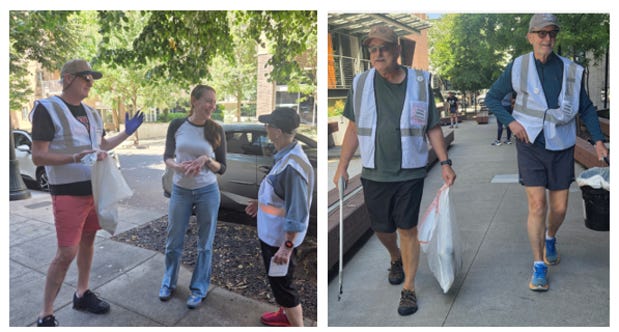
When the Pearl Patrol launched just a month ago, a NW Examiner reader suggested the group share its early observations. Program manager Linda Witt offers these reflections from the group after the first month of operation, during which more than 50 patrollers completed over 60 one‑hour group walks with 3-5 people on each. Volunteers report that they enjoy the camaraderie, and they appreciate knowing their efforts make a tangible difference. They choose one‑hour walking shifts — morning, afternoon or evening — alongside fellow participants from a wide range of backgrounds: IT, medicine, retail, finance and banking, construction, art, engineering and education, to name a few. What unites them is a shared commitment to improving livability and safety in the district. Many volunteers also help keep the neighborhood clean by picking up trash (optional), and they enjoy chatting with residents and business owners about what’s working and what’s not.
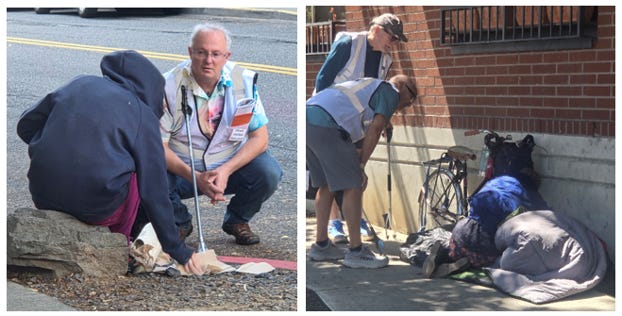
Participants immediately report issues they encounter — whether trespassing, graffiti, tents, drug use or dealing, trash or abandoned vehicles to the appropriate authorities. Some volunteers are also comfortable conducting homeless outreach. As a result, the team has successfully connected individuals with Oasis Day Shelter and other homeless services. The participants have helped people access short‑term housing through close coordination with police, Northwest Community Conservancy, Echelon security services, etc.
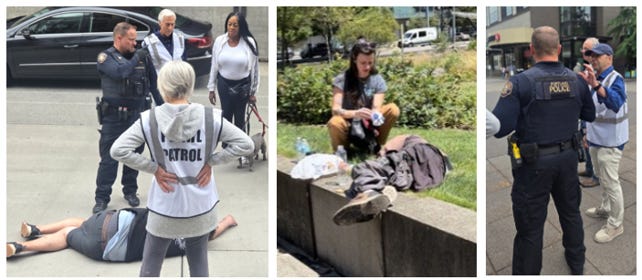
Are we making a difference? In at least two cases, our volunteers were able to summon emergency resources that resulted in ambulance transport — these were situations where others had been unable to get a response. In those moments, we believe lives may have been saved.
After a month of walking, observing and comparing notes, here are the key insights we believe the public — and our city and county leadership — should know:
1. Many of the homeless individuals we engage with are recent arrivals to Oregon, coming from states such as South Dakota, Idaho, Indiana and Louisiana.
2. Most of the homeless individuals we meet do not wish to pursue services. We encourage them when appropriate, but the vast majority are simply not yet at a point in their sobriety journey where they are ready to commit to lifestyle changes.
3. The most challenging situations involve individuals in acute mental crisis and drug-induced altered levels of consciousness. Patrollers do not engage directly in those situations — only trained professionals can safely intervene. We call county and city resources, but response times are slow, leaving acutely ill individuals (or people simply passed out) to continue churning on the streets, and/or in a state where they are vulnerable to theft or further harm.
4. Our volunteers frequently witness open smoking of fentanyl and drug dealings on sidewalks and in parks. Our timely reports have contributed to a couple of recent arrests by the police, but law enforcement resources fall far short of the need. Targeted police missions are underway, and we appreciate seeing more officers in cars and on bikes — but much more remains to be done. It appears that the Pearl’s parks — especially Jamison Park — are functioning as waiting areas for Northrup Shelter guests in the early evening and as a day shelter during daytime hours. Our hope is that the Parks Department can restore full use of these spaces to the public once the shelter ceases operation in mid-September.
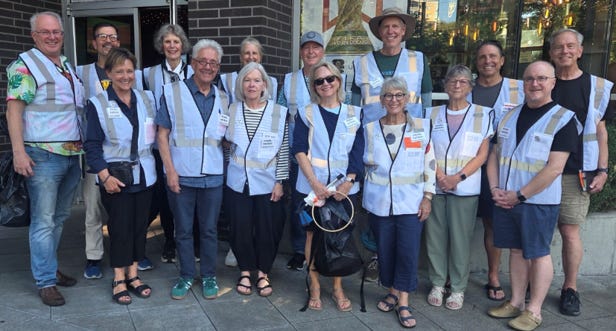
New volunteers are welcome to join, whether they can do one walk per month or several walks per week. To learn more, email Linda Witt at pearlpatrolpdx@gmail.com.
I’d like the city council/mayor/county reps to respond to the fact that most of the homeless in The Pearl have recently come here from other places. I’d like them to tell us whether they think buildings being burned down in our neighborhood and the need for out of pocket private security and citizen foot patrols (while they remove police budget) to maintain even a semblance of normality is reasonable.
This is a result of our permissive to the point of masochistic policies around camping, drug use, and other crime. Cities around the US are getting cleaned up and we are getting dumped on, and this is backed up in the statistics. This should be priority number one for our feckless “leaders” but they’re too busy on their flavor of the week ideologically driven “issues” and shouting into the void how much they hate Trump.
The Pearl Patrol deserves credit for getting involved, reporting problems, attempting to help connect people with services, and in some cases even getting emergency help to people who needed it. But at the citywide level, this is still a whack-a-mole problem. If increased patrols move people out of the Pearl, they often just turn up in the South Park Blocks or another neighborhood.
Without a broader city and county strategy, we are effectively treating these people as a negative externality, passing them from neighborhood to neighborhood like last week’s garbage. We say we care about them, but too often the practical response is simply to move them somewhere else.
There is also a risk that successful neighborhood patrols reduce the urgency for city and public health officials to develop a real solution. The problems described here—severe addiction, mental illness, medical crises, and chronic homelessness—are simply beyond the capabilities of well-meaning volunteers. No offense to the volunteers, but if Portland Police were unable to investigate murders, we wouldn’t expect a neighborhood patrol to step in and solve homicide cases. The same principle applies here. Neighborhood involvement is valuable, but it cannot substitute for functioning public institutions.
At the end of the day, until we hold the City, County, and State accountable, this problem will not improve—especially if their policies have helped turn Portland into a destination for people looking for a place where street drug use is tolerated with relatively few consequences.