

by Robert S. Miller
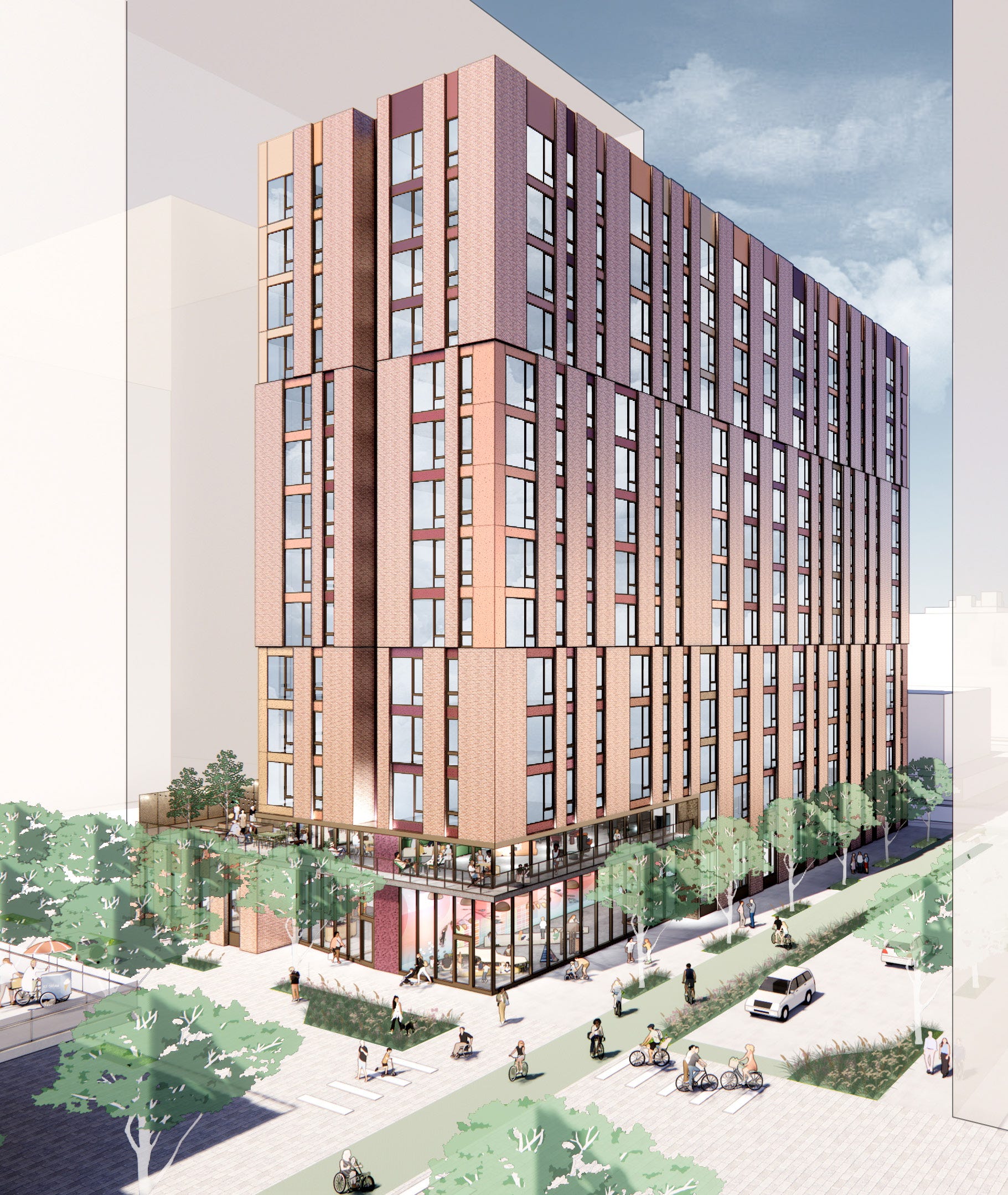
Parcel 4A is the city's name for half a block on the old main post office site at Northwest Ninth and Johnson. Home Forward and the Urban League plan a 14-story tower there with about 225 apartments for lower-income renters (Next Portland). It would be the first building on the 14-acre site.
It costs about $168 million. It is holding about $44.2 million in state construction and supportive housing money. The state's anticipated closing date, Oct. 19, has passed, and the deal has not closed.
What the test requires
I don't buy green bananas. At 78, I want to see what ripens within five years. That is the idea behind the Green Banana Test, a screen I built for judging a public capital project on its own terms: its sponsor, its money, its operator and its schedule. Before anything is scored, the project has to answer seven yes-or-no questions:
Is the building clearly defined?
Does the sponsor have the authority and the land?
Is someone accountable for delivering it?
Is there a credible path to all of the money?
Is someone responsible for running it?
Is the schedule tied to documented steps?
Has demand been checked against a reasonable alternative?
A failed gate blocks an unconditional yes, however well the rest of the scores. Then come four published scores from 0 to 100: can it be delivered, can it pay its way, what does the public gain that it would not get otherwise, and what are the risks and the cost of passing up the alternatives? Weighted together, they make one number. The last step is the five-year check: what the public will actually have five years after the decision. The full method is on The Center Held.
How it measures up
In October, I scored Parcel 4A at about 40, with two failed gates (Financing Not Closed). Here it is again, on the public record as of Nov. 24.
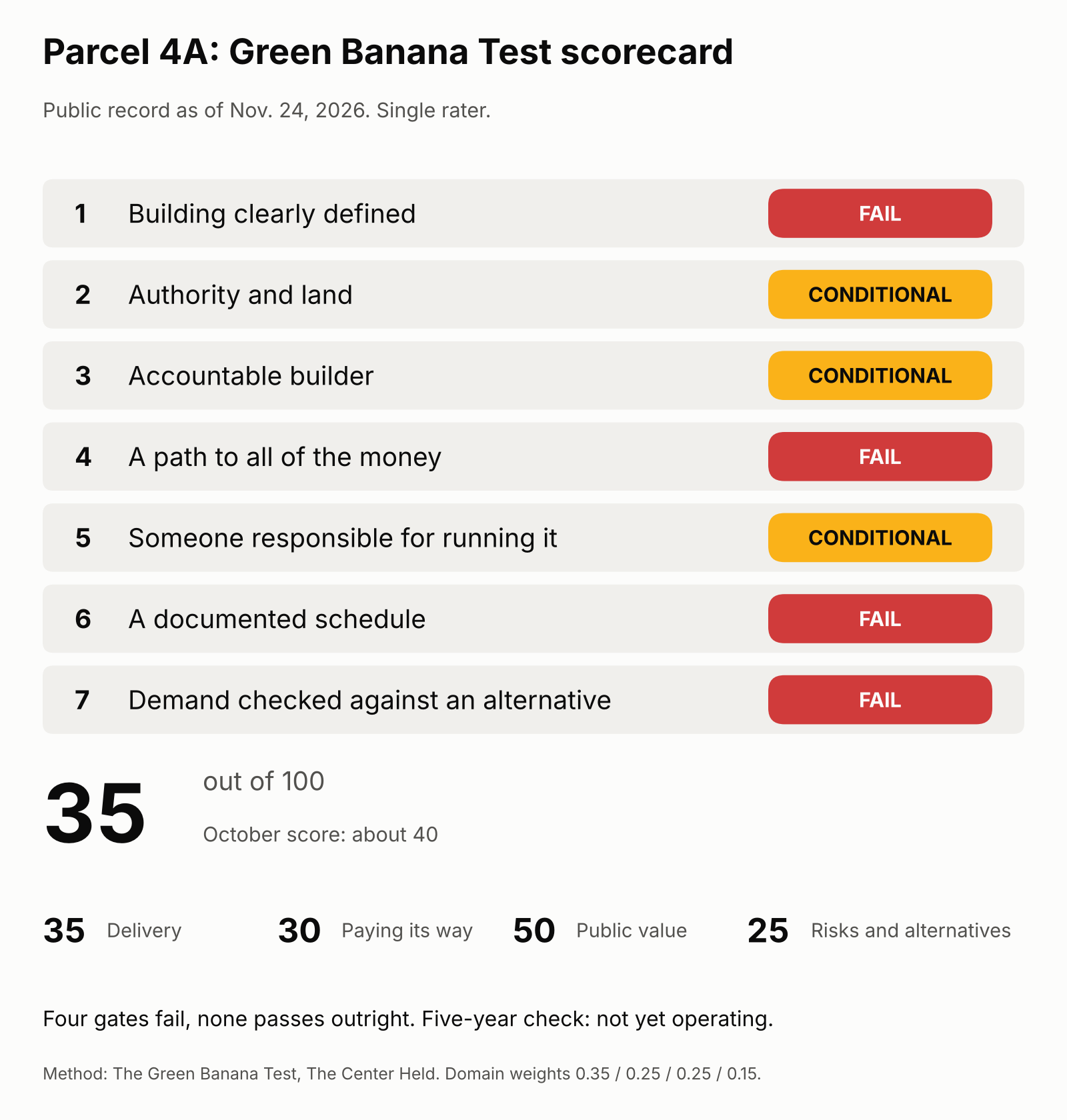
1. Clearly defined: Fail. Public sources give 219, 229 and 230 apartments. The state change request that defines the current building has not been published.
2. Authority and land: Conditional. Home Forward has the legal authority, and the land belongs to the city. The terms for handing the land to the project are not public.
3. Accountable builder: Conditional. The team is named: Home Forward, the Urban League, Holst Architecture and Colas Construction. The sponsor is carrying a $38 million deficit.
4. All of the money: Fail. The state money is reserved, not closed. The closing date passed, there is no construction price, and the state's programs are fully subscribed until a spring 2027 bond sale.
5. Someone to run it: Conditional. Home Forward is named as owner and operator. The neighborhood association voted unanimously to pause due to how Home Forward runs its existing Pearl buildings.
6. A documented schedule: Fail. No new closing date, no construction price and no bond vote on any agenda.
7. Demand against an alternative: Fail. 157 of 229 apartments are studios and one bedrooms at 60% of median income, rents state staff say many eligible renters can no longer afford. No market study has been published. Buying existing buildings costs about a third as much per home.
Score: 35 out of 100. Four gates fail and none passes outright. Delivery 35, paying its way 30, public value 50, risks and alternatives 25. Five-year check: On today's record, nobody can say when tenants move in, so the project stays where it was in October, not yet operating.
The verdict is not "no housing here." The neighborhood association isn't saying that either. Rather, not this building, not on this schedule and not without a date someone is accountable for. None of this needs a new tax or a new agency. It needs someone with the authority to set a date and keep it.
The evidence
The money (gates 4 and 7)
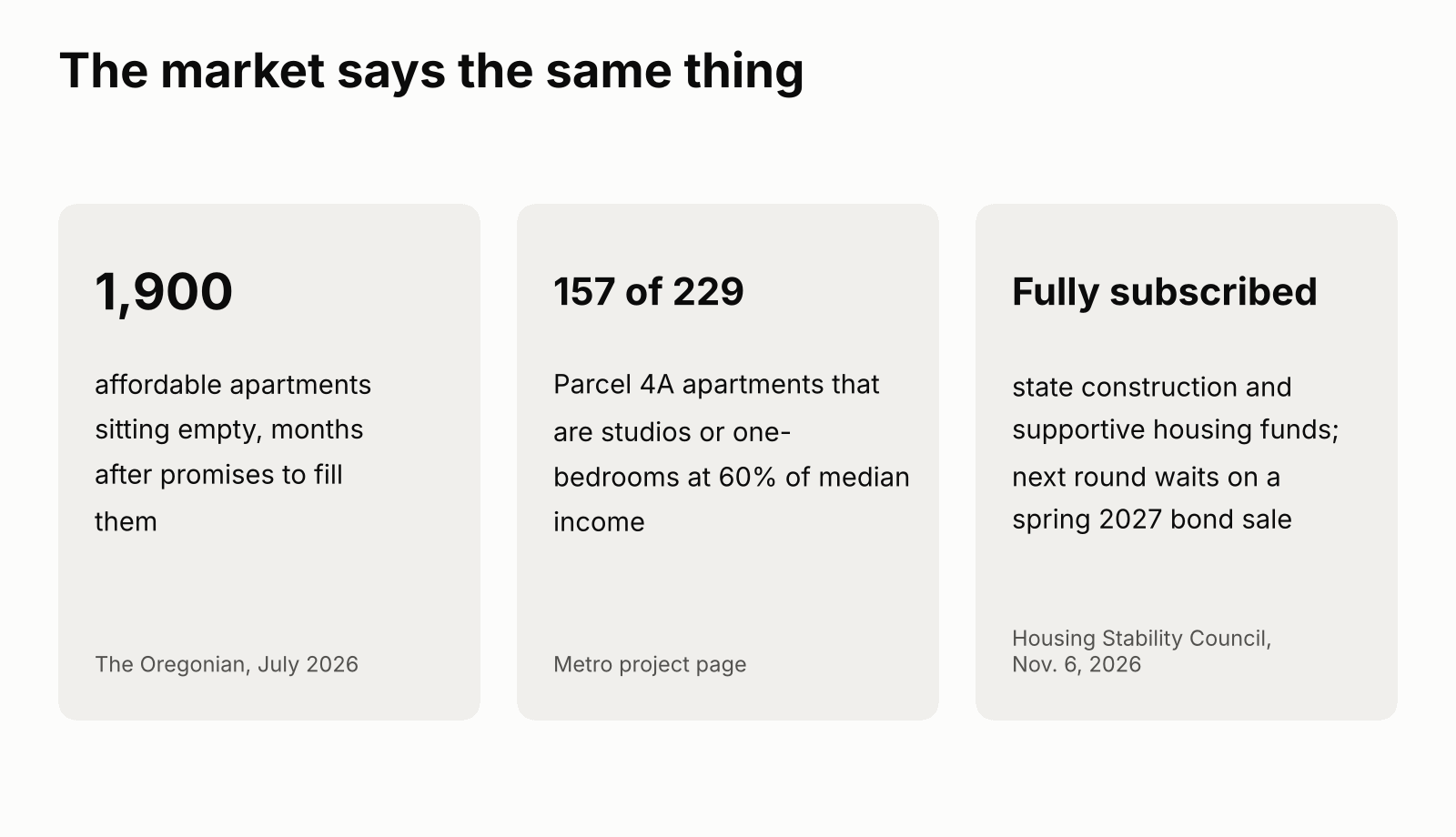
It's the state's money, and the pot is empty. The tower is holding about $44.2 million in state construction and supportive housing funds. The state's November packet says both programs are "fully subscribed," and the next round waits on a spring 2027 bond sale (HSC packet, Nov. 6, 2026). Every month that money sits on an unfinished Portland deal, it isn't building anything in Bend, Medford or Salem.
The state's own staff questions this kind of building. In that packet, staff wrote that for many income-eligible households, "60% AMI rents are no longer affordable." Nearly all the top Metro-region applications are heavy on studios at 60% of median income, and "this is not the case in any other region." Staff asked whether Metro projects should have to show a market study before getting funded. Parcel 4A fits the description: 157 of its 229 planned apartments are studios and one-bedrooms at 60% (Metro).
When a subsidized apartment rents for about $137 less than a market one, the renter trades a long application for very little savings. Some are choosing the market unit. This is mostly a Portland-area problem, and the state memo says so.
My inference: Salem has started asking whether new Portland projects can prove they will fill. If that question doesn't apply to Parcel 4A, which already holds the money, Salem is protecting its next dollar but not the $44 million sitting on the riskiest version of the model.
The operator (Gates 3 and 5)
In October, the Pearl District Neighborhood Association voted unanimously to ask for a pause, questioning whether Home Forward has managed its existing Pearl buildings well enough to take on another, as this paper reported (NW Examiner, Oct. 23). The month before, Home Forward’s managers heard the association’s president describe their Pearl Court building in words this paper printed and I won’t (NW Examiner, Sept. 28).
The association's letter says it supports affordable housing on the site. The question is whether this building, run by this operator, is ready. The record says no. The state's anticipated closing date was Oct. 19. There is still no construction price and no bond vote on any agenda, and Home Forward's board has authorized at least $4 million in spending that is repaid only if the deal closes (Home Forward, Feb. 2026 packet). Nobody with authority has set a deadline, because nobody wants to be the one who says no.
The cost (gate 7)
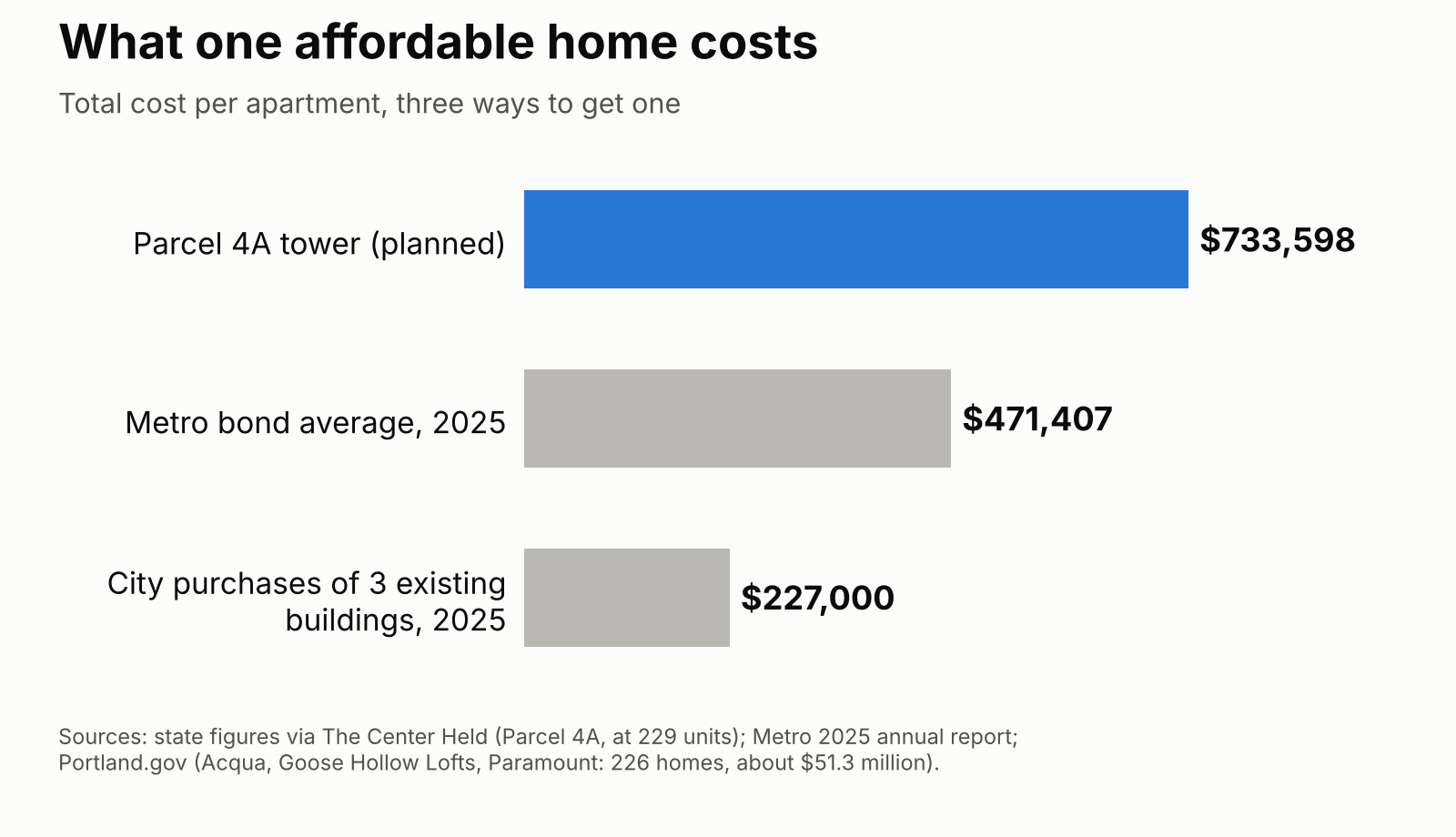
My answer is not this building. At about $168 million for 229 apartments, Parcel 4A costs $733,598 a home. The Metro housing bond average last year was $471,407 (Metro 2025 annual report). In 2025 the Housing Bureau helped buy three existing buildings, the Acqua, Goose Hollow Lofts and the Paramount, and turned 226 market-rate apartments affordable for about $51.3 million (Portland.gov). Nearly the same number of homes, a third of the price, no crane.
Buying doesn't add supply, and older buildings need repairs (Oregon DLCD). But Portland's most pressing affordable-housing problem today isn't a shortage of this kind of apartment. It's the roughly 1,900 already built and sitting empty. Height costs money too: the city's own consultant put a Portland high-rise at about $493,000 a home, against $423,000 for a mid-rise (BAE for Portland.gov). Parcel 4A is 14 stories.
The case for building is real: city land, a dead block, money already awarded, the Urban League and 25 rent vouchers. Those are reasons to build something here. They aren't reasons to build this.
What we recommend
What the neighborhood and the council should ask for
1. Publish the paperwork by Dec. 10: the state change request and response, spending to date and the city's loan balance.
2. Require a market study and a price check against existing buildings before the bond vote.
3. Set the trigger: no state approval and no construction price by Feb. 28, and the deal goes to BRIDGE or another qualified team.
4. Judge the operator by results: occupancy, days to fill a unit and rent collection at its existing Pearl buildings.
If it gets built, redesign it Free advice, worth what you pay for it:
1. Build for families. Trade most of the studios for two- and three-bedrooms, the kind state staff say still lease.
2. Get off 60%. Tie the cheapest units to rent vouchers and price the rest from 50 to 120% of median income, as Parcel 6 across the street is planned (Daily Journal of Commerce).
3. Price a shorter building next to the 14-story one before any bond vote.
4. Don't open it under the 2022 rules until the agency shows they work. That year Home Forward loosened its screening and gave up one of its tools against drug dealing and violence in its buildings (Willamette Week).
Who builds it
Home Forward can keep the deal on terms it doesn't set: redesign, publish the state paperwork, put a health clinic on the ground floor and close by a fixed date. Or it hands the deal to a stronger owner and gets its costs back at closing. In 2024 the city judged four teams qualified for this parcel, Home Forward among them (Portland.gov). Here are the other three.
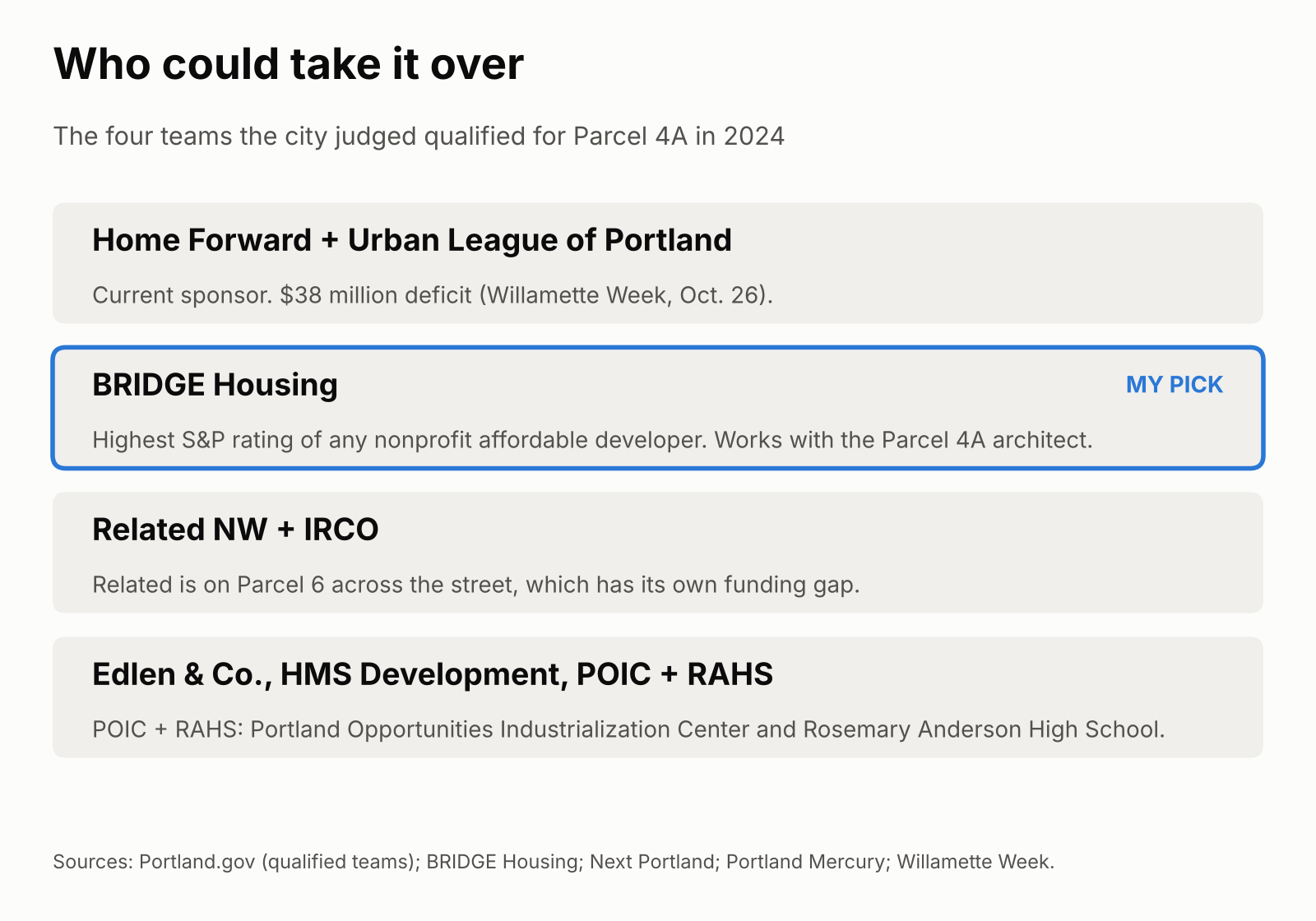
My pick is BRIDGE. A redesign fixes the building, not the sponsor's balance sheet. Home Forward has a $38 million hole (Willamette Week, Oct. 26). BRIDGE holds the highest rating S&P has given any nonprofit housing provider, already works in Portland with the Parcel 4A architect, and isn't carrying the block across the street. If Home Forward hasn't closed the gaps by Feb. 28, the deal should go to BRIDGE. If nothing pencils, the land goes back into the anchor plan I argued for in Oregon Roundup.
Better choices for the money
And if the money has to be spent now, here is where I would put it:
Fill the empty ones first. Metro is already using bond interest to cut rents on hard-tolease apartments (Metro).
Buy, don't build. A city study found buying needs about $108,000 a home in public money, against $283,000 to build new (Portland.gov). By my arithmetic, at 2025 prices Parcel 4A's budget would buy roughly 740 homes, if the buildings are for sale.
Convert the empty offices. Prosper Portland offers $45,000 a home for conversions to middle-income apartments (Prosper Portland).
Make the test the rule
Parcel 4A is one project. The problem it shows is general: Portland commits land and money to capital projects one at a time, on each sponsor's own promises, and the gaps show up after the money is reserved. That is my reading of this record, and of the other projects I have scored.
My proposal: before the council commits land, tax-increment money or bond money to any capital project, the project answers the seven questions in public, and the City Budget Office runs the test. It checks the answers, scores the project and publishes the result with the council item, along with the evidence that would change it. A failed question means no unconditional approval. Five years later, the same office reports whether the project is open and doing what it promised.
Until someone sets that date, the people paying for the delay are the tenants in Home Forward's existing buildings.
Robert S. Miller is a Pearl District resident and president of a gaming technology company. He writes The Center Held on Substack.
Sources
Oregon Housing and Community Services, Housing Stability Council packet, Nov. 6, 2026: https://www.oregon.gov/ohcs/hsc/Documents/meetings/2026-NOV-06-HSC-MeetingPacket.pdf
Metro, Broadway Corridor project page: https://www.oregonmetro.gov/what-metrodoes/housing-and-homelessness/affordable-housing-bond/affordable-homes/broadwaycorridor
Home Forward Board packet, Feb. 2026: https://www.homeforward.org/wp-content/uploads/2026/02/2026_02_Board_Packet.pdf
Willamette Week, "A 2022 Policy Change Eliminated One of Home Forward's Tools for Controlling Bad Behavior," April 1, 2026: https://www.wweek.com/news/2026/04/01/a-2022-policy-change-eliminated-one-of-homeforwards-tools-for-controlling-bad-behavior/
Willamette Week, Home Forward deficit, Oct. 26, 2026: https://www.wweek.com/news/city/2026/10/26/home-forward-says-38-million-budgetdeficit-is-worse-than-we-understood-it-to-be/
The Oregonian/OregonLive, empty affordable apartments, July 2026: https://www.oregonlive.com/business/2026/07/months-after-promises-to-fill-1900-emptyaffordable-apartments-numbers-havent-budged.html
In the Portland area today, a green banana test for public housing would be incomplete without an additional question:
Can the project be marketed, leased and run as described without creating fair housing exposure?
Compliance
The City of Portland's project page for the Broadway Corridor Parcel 4a building says outreach and services "will target young families and chronically homeless families, including community members who are Black, indigenous, or people of color." Taken at its word, the plan creates Fair Housing Act risk once it is carried out. The risk falls on Home Forward and the Urban League, the sponsors and developers who will run the outreach and deliver the services. It also falls on the Portland Housing Bureau, which is funding the building and published the plan.
Outreach. HUD's regulation under the Act's advertising provision lists, as a prohibited practice, "selecting media or locations for advertising the sale or rental of dwellings which deny particular segments" "of the housing market information about housing opportunities because of race." Outreach targeted by race does this. It decides who hears about 219 new affordable units based on the race of the audience. Calling it "outreach" rather than "advertising" changes nothing, because marketing aimed by race is exactly the conduct the regulation describes.
Services. The Act also bars different terms, conditions or privileges of tenancy because of race. HUD's examples include "limiting the use of privileges, services or facilities associated with a dwelling" on that basis. Fifteen units come with wrap-around Permanent Supportive Housing (PSH) services, the building will have on-site service offices, and the Urban League is the designated service partner. If services are directed to residents by race, as the page says they will be, tenants of different races will receive different benefits of the same tenancy. That is unequal treatment, not marketing.
Selection. HUD has already shown how targeted services spill into who gets housed. In October it announced a compliance agreement over Multnomah County's screening tool, which awarded points for "interest in culturally specific services" and for speaking English as a second language. HUD found the county was prioritizing homelessness services by race, color, and national origin, and that the two point categories appeared to be proxies for race and national origin. A plan that names races outright, for the same population of chronically homeless families receiving supportive services, invites the same finding as soon as it touches intake. If the PSH units are filled through the county's coordinated access system, the agreement already governs them.
Age. "Young families" creates a second problem under local law. Portland City Code makes it unlawful to discriminate in renting real property on the basis of age if the individual is 18 years of age or older. Outreach and services implemented as described would favor younger parents over grandparents raising grandchildren or parents in their late forties.
Why the risk is live now. HUD has spent 2026 pursuing exactly this kind of race-conscious housing policy. According to the Poverty & Race Research Action Council, which disputes HUD's position, HUD's December 2025 letter to Boston characterized as Fair Housing Act violations the city's stated plan to aim homeownership outreach at Black and Latine neighborhoods. Home Forward is the region's public housing authority, controls lease-up and depends on federal money, so it is the most exposed of the three.
The other side. HUD's own affirmative fair housing marketing regulations require outreach to groups "least likely to apply," and those rules remain in effect despite a proposed rescission. In South-Suburban Housing Center v. Greater South Suburban Board of Realtors (7th Cir. 1991), the court upheld a race-conscious affirmative marketing program against a Fair Housing Act challenge. On that reasoning, outreach that widens the applicant pool is lawful as long as selection and services stay neutral. That defense covers outreach at most. It likely does not cover services the page says will be targeted the same way, and it is out of step with how the enforcing agency now reads the Act.
Thanks for the excellent analysis. It's difficult to have any confidence in Home Forward. I would add operational and tenant turnover costs as well.