


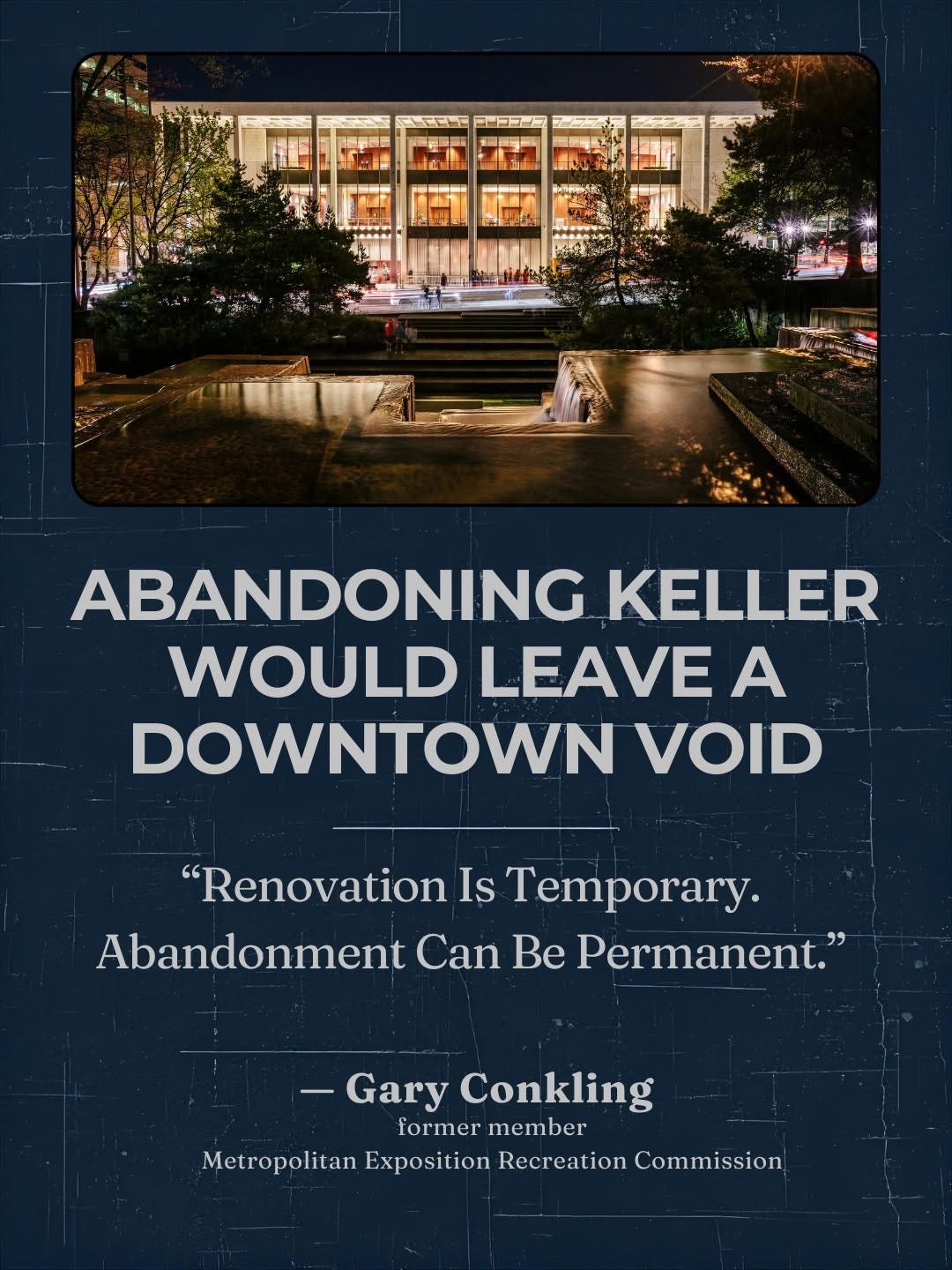
Save the Keller forces are raising the voice of a former member of the Metropolitan Exposition Recreation Commission, which has operated the Keller Auditorium and other Portland venues since 1990.
"As wonderful as all-new facilities are, they cannot address what happens to the venues being abandoned,” said Gary Conkling. “They are plus-one, minus-one bargains. If downtown Portland was in a better place, maybe that bargain would be more appealing. At the moment, have a hulking vacant building with no foreseeable purpose is untenable.
“Shiny new things can be dazzling. Remodeling a cultural fixture can be rewarding. Figuring out what to do with an abandoned building can be mind-numbing.
“Renovation is temporary. Abandonment can be permanent,” Conkling said.
Karen Whitman, executive director of Halprin Landscape Conservancy, which is leading the campaign to Save the Keller, presented a broader overview recently:
Portland has spent the last few years having difficult conversations about priorities.
We’ve debated cuts to parks, public safety, homeless services and transportation. Every budget season, city leaders tell us the same thing: There isn’t enough money.
So why are we suddenly entertaining a proposal that could commit taxpayers to nearly a billion dollars for performing arts facilities?
This latest recommended plan for Broadway exceeds the $600 million dollar debate of the Moda Center and Blazers – yet has received far less public discourse.
It’s time to start paying attention, because this billion-dollar Broadway bet is now the latest financial question before the Portland City Council.
Recently, the Mayor’s advisory committee recommended building a new Broadway-capable theater at Portland State University before eventually downsizing and fully renovating Keller Auditorium. On paper, it sounds like an ambitious vision for Portland’s arts future.
In reality, it asks taxpayers to make an extraordinary financial commitment without answering the most basic question first: Who’s paying for it, and how?
When the costs of the proposed PSU theater complex are combined with renovating the Keller afterward, the total approaches $1 billion. Yet no financing plan has been presented. No public discussion has explained how the city, county, state or taxpayers would absorb a project of that magnitude while Portland struggles to maintain the infrastructure and services it already has.
This is no longer a debate about Keller versus PSU. It’s a debate about fiscal responsibility.
Supporters frame this as an investment in the arts. We support investing in the arts, too. But responsible investment starts by asking whether a project is necessary, affordable and supported by evidence. On all three counts, this proposal falls short.
First, there is no crisis requiring immediate replacement of the Keller.
The building is aging, but it remains functional, heavily used and profitable. Broadway Across America recently signed a new seven-year agreement that keeps productions at the Keller through 2033. If the building were truly incapable of supporting Broadway, that contract would not exist.
Second, the city has never studied the very scenario now being recommended.
The consultants hired by Portland concluded there was insufficient market demand for two Broadway-capable venues operating simultaneously. Yet the recommendation now before City Council creates precisely the kind of two-venue system that has never been analyzed for market demand, operating costs or long-term financial sustainability.
Finally, the proposal creates enormous uncertainty for the Keller itself.
Broadway would move to PSU first. Only afterward would the city attempt to renovate and shrink the Keller. But there is no cost estimate for that renovation. No funding source. No schedule. No guarantee it ever happens. The most likely outcome is inaction and years of uncertainty surrounding one of Portland’s most important civic assets.
The Keller is often called a cash cow, because it not only pays for itself but also helps subsidize other Portland’5 Centers for the Arts venues. Because the city owns the Keller, Portland needs a real plan to protect both the venue and the broader arts ecosystem.
There is a better path.
Instead of making a billion-dollar commitment the city cannot currently afford, Portland should make a modest investment of $10 million to $15 million over the next several years to address deferred maintenance, keeping the Keller operational and economically successful for the next decade.
This “Affordable Fix” is not about lowering our ambitions. It’s about matching our ambitions with reality.
It allows Broadway to remain downtown, preserves the Keller’s role in supporting Portland’s performing arts system, avoids years of disruption, and gives the city time to answer the questions that remain unanswered today.
Just as importantly, it allows Portland to see how new private entertainment venues coming online next year affect demand before committing hundreds of millions of additional public dollars.
Great cities don’t become great by chasing every ambitious idea. They become great by making disciplined decisions. Portland has no shortage of worthy projects competing for scarce public dollars. Roads need repair. Parks need investment. Public safety remains underfunded. Basic city services continue to face painful reductions.
Against that backdrop, asking taxpayers to support a billion-dollar performing arts expansion without a funding plan is simply not responsible governance.
City leaders don’t have to choose between supporting the arts and protecting taxpayers. They can do both. Reject the billion-dollar gamble: Preserve the Keller. Invest in the Affordable Fix.
And make the next decision only after Portland has the facts, the financing and the confidence that our city can truly afford it.
To help, sign up to testify:
Once Friday’s council agenda is posted, you can register to provide oral or written testimony HERE.
If you testify, keep it to 60 seconds.
Great advice. Will anyone listen? It becomes a contest to testify for the various camps, hoing to sway the vote with the completely unrepresentative support and objection, with various stakeholders edging for advantage, as if two or three minutes of open persuasion will make a difference. I am hoping to forward this piece to the City Council members and Mayor, in the hope that their staff will actually read the article or the comments and pass that along to their boss and that the boss will read it.
We are in the midst of this decision, a similar one about the MODA Center and another about highways and schools and health care and behavioral health and the State Hospital. Governments are good at exciting folks about new shiny objects, but notoriously bad at maintaining what they have. We broke the mold when we created a tax to accumulate to address climate change and it produced way more than initially expected, so here we are arguing about using it for the MODA Center and sidewalks. Portland is very good at chasing shiny objects. But the Portland Five are losing money and have lots of deferred maintenance. It is really the Keller keeping all five from sinking. Metro has punted the problem to Portland.
We are losing population, especially in Multnomah County and Portland, but so is Oregon generally. Much of the population we are losing is that part that pays the taxes that fund the government that builds and maintains the infrastructure and provides educational and health services. Fix the basics.
We need to consolidate around the basics of good government; public safety, public health, public education and water and start building on that. Losing the Blazers will be a shame, but unless the business community rallies around funding the needed improvements and we demonstrate a plan to maintain it, it is leaving along with the businesses that should be its sponsor. We may eventually lose the Keller, but we don't need to compound the problem with a new bill for the PSU theater. We need all the local stakeholders to get on the same page and coelease around a plan to save Portland from itself. We need to decide what we are and adopt a realistic vision for ourselves.
"the Mayor's advisory council"...hmmm..those people pushing this plan seem to be sneaky and likely self-serving. How else does one square the absence of a formal study replete with trustworthy data and forecasts? The desires of this group should not dictate the economics of those who must pay. Politics is a dirty business and we can see the consequences. The idea of a second Broadway complex did not grow from demand, it grew from inconvenience. Need we remind ourselves that Portland business is dying? Fully one-third of office space is vacant. Porltand needs to tighten its belt and resurrect profitable enterprises who are willing to come because the business climate is welcoming. We needa full review of the city's budget so that we can lower taxes, spend for more police staffing. Every dollar is precious, particularly when the revenue pie shrinks.