


Portland already has machine politics. The mayor now has to organize the rest of us without becoming what he is trying to defeat. At the end of the previous article in this series, I promised there was a plan. Here it is: Keith Wilson is doing something important, and he needs to finish it.
Nobody voted for this. Our city offices have been nonpartisan for nearly a century: No party affiliation may appear on a candidate’s ballot, filing or voters’ pamphlet. In 2022, we added ranked-choice voting and multimember districts because they sounded like more of the same protection. Then we handed the new system to 98 council candidates, several hundred thousand voters and every political organization in town. One side read the whole book. The rest of us admired the packaging.
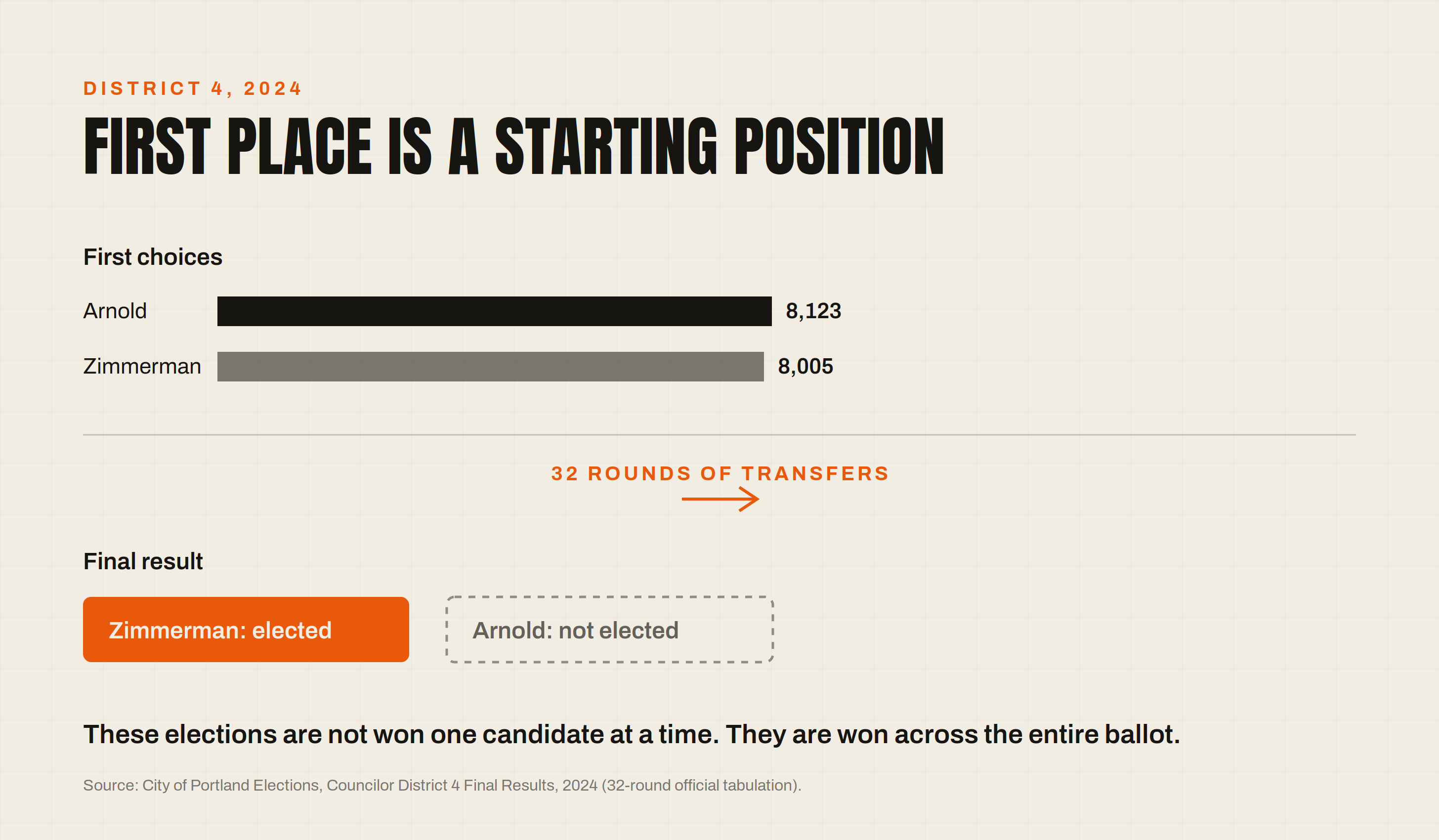
The organization I have been describing looks formidable only because it understands something its opponents have not yet absorbed: Portland's ranked-choice elections are not won one candidate at a time. They are won by organizing the entire ballot. Three councilors are elected from each district. A candidate is guaranteed a seat at 25% of the vote plus one ballot, although the last seats need not reach that threshold. That makes second, third and later choices consequential. In District 4 in 2024, Eli Arnold began ahead of Eric Zimmerman, 8,123 first-choice votes to 8,005. Zimmerman nevertheless won after transfers; Arnold did not. First place was merely the starting position. The official count took 32 rounds.
The DSA understands the resulting organizational problem. Its candidates do not enter the election as isolated individuals. The organization recruits candidates, raises small contributions, communicates preferred candidates to its supporters and remains active between elections. Everyone else largely campaigns for one candidate at a time. I call that machine politics not because it is illegal, but because it is permanent, coordinated and designed to deliver votes across an entire ballot.
I am not approaching this as a newcomer. Fifty years ago, I was a pollster working against the political machines of New Orleans. The technology has changed. The operating principle has not: A full-time organization ordinarily defeats a collection of part-time campaigns.
That is the problem Mayor Wilson now has an opportunity to solve. A game that rewards organization stops being a scandal when everyone organizes. The question is who can organize the other three-quarters, and what rules will keep the answer from becoming another political owner.
The mayor discovers politics
Wilson has begun to answer the first question. He backed Kellie Torres in District 3 and has aligned himself with incumbents Steve Novick, Olivia Clark and Eric Zimmerman. The shape is visible, but it is not yet a slate. The candidates do not all endorse one another. They do not appear on one card. They have not given voters a common ladder for the second and third choices that actually decide these elections. At present, the mayor has several candidates standing near one another and hoping the public notices the resemblance.
Still, the movement matters because it reaches beyond endorsements. Wilson has supported restoring Abraham Lincoln to his original pedestal after his statue was toppled in 2020. He has defended police staffing and proposed additional investigators. He has bet his office on a homelessness pledge made in public and counted in beds, opening more than 1,500 overnight shelter beds against it. Those decisions do not amount to a complete platform, but they announce a disposition: Repair what was damaged, protect the basic institutions of civic order and stop allowing every municipal decision to become a subsidiary battlefield in the national culture war.
Wilson is also the only elected official positioned to assemble a citywide answer. Councilors represent districts. Unions represent their members. The DSA represents a political program. Business organizations represent businesses. Among them, only the mayor is elected by all of Portland. He controls the executive branch, proposes the budget and will be blamed when the city cannot govern. The new charter gave the mayor responsibility without a guaranteed council majority. That arrangement does not permit him to remain a neutral spectator. If he does not organize a governing coalition, the best-organized faction on the council will organize one for him. The assignment has four parts: Convene the coalition, write its principles, build a serious candidate-selection process and publish a common ballot. One rule governs all four: The coalition helps elect its candidates and never owns them.
Nobody wanted a machine
Nobody has to like this. I do not particularly like it. But look at the money already assembled, the crowded candidate fields and the permanent organizations working between elections. The argument over whether Portland should have organized political teams has been settled by events. We have them. The only remaining question is whether one ideological formation will enjoy a permanent monopoly on competence.
That does not mean copying the Democratic Socialists of America’s arrangement and changing the label. The distinction is not between a left-wing machine and a centrist machine. It is between electoral organization and political ownership. Portland needs the first and should prohibit the second.
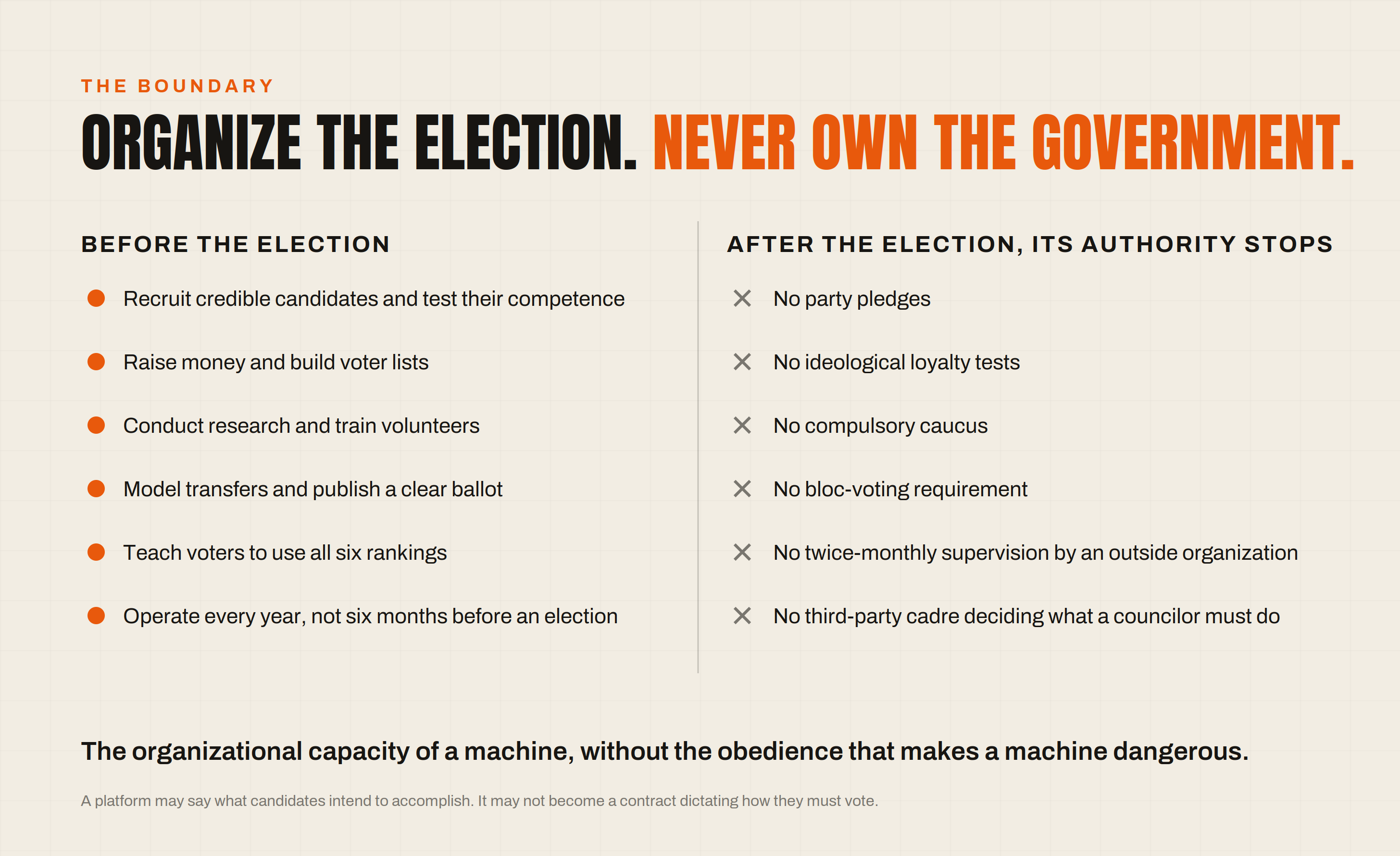
Before an election, the organization must do everything the system rewards. It must recruit credible candidates, test their competence, raise money, build voter lists, conduct research, train volunteers, model transfers and publish a clear ballot. It must explain which candidates it recommends and why. It must tell voters how to use all six available rankings to keep their ballots alive rather than allowing acceptable candidates to disappear when early preferences are eliminated. It must operate every year, not materialize six months before an election and vanish the morning after.
After the election, its authority must stop. No party pledges. No ideological loyalty tests. No exclusion because a candidate refuses a position on a national issue. No compulsory caucus. No bloc-voting requirement. No twice-monthly supervision by an outside organization. No third-party cadre deciding what an elected councilor must do. A platform may say what candidates intend to accomplish. It may not become a contract dictating how they must vote.
That boundary is the whole undertaking. We need the organizational capacity of a machine without the obedience that makes a machine dangerous.
A Portland coalition
The model is not ideological conversion. It is coalition building around a limited mission. President George H. W. Bush did not assemble the coalition that liberated Kuwait by persuading Saudi Arabia, Egypt, Syria, the European governments and the United States to adopt a common view of history. They disagreed about nearly everything beyond the invasion in front of them. Bush defined the issue, held the coalition together and stopped the mission where the agreement stopped.
Portland needs that kind of construction. Business leaders, traditional liberals, independents, neighborhood advocates, public-safety constituencies, practical progressives and labor members who want city government to remain city government do not need to agree about the world. They need to agree about Portland.
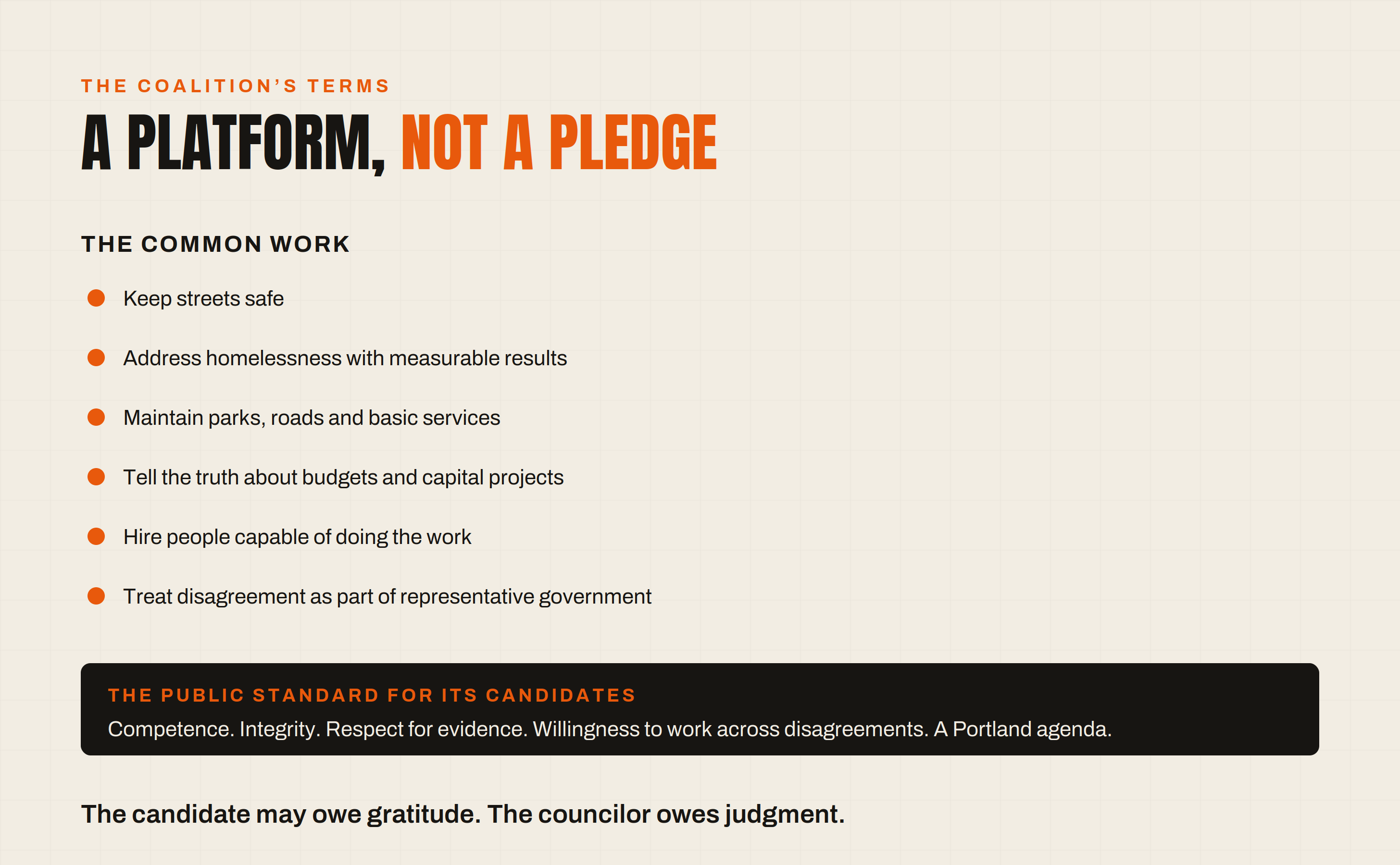
The common work is not mysterious. Keep streets safe. Address homelessness with measurable results. Maintain parks, roads and basic services. Tell the truth about budgets and capital projects. Hire people capable of doing the work. Treat disagreement as part of representative government rather than evidence of moral contamination. Keep foreign policy and national ideological campaigns from consuming institutions that have no competence to conduct either.
Issues kill. Principles ennoble. The immediate issue is the organizational monopoly. The principle is representative government in which elected officials exercise judgment for the entire city.
The ballot has to mean something
A Wilson endorsement list will not be enough. The organization needs an authentic public voice, a recognizable ballot and a method for deciding who belongs on it. It cannot simply collect everyone who dislikes the DSA. Opposition is not a governing philosophy, and resentment is not candidate qualification.
Its candidates should meet a public standard: demonstrated competence, personal integrity, respect for evidence, willingness to work across disagreements and commitment to a Portland agenda. They need not offer identical answers. In fact, if they agree on every question, we should suspect that the independence clause was written in disappearing ink.
The selection process also must be more serious than the present festival of self-nomination. Ranked-choice voting lowered the cost of entering a race and encouraged crowded ballots. That may widen participation, but it also asks voters to distinguish serious prospective councilors from people enjoying their allotted minutes of public attention. A useful organization performs that screening openly. It does not appoint councilors. It tells voters whom it has examined, what standards it applied and why those candidates deserve consideration.
The ballot should then say something simple and verifiable: these candidates accept the same governing principles, consider one another fit to serve and remain free to disagree after election. Rank them in the order you prefer. That is coordination without surrender.
Nobody's representative but yours
I learned the line in Louisiana, where political organizations rarely bothered pretending they were philosophy seminars. Every candidate should be able to look at the voters and say: I am nobody's representative but yours.
That does not mean the candidate arrived without allies, money or endorsements. Nobody does. It means no organization retains title after the voters confer office. The candidate may owe gratitude. The councilor owes judgment.
This is where the proposed coalition must differ from the structure documented earlier in this series. The DSA terms govern the relationship after victory: meetings, caucus and program. The new organization should govern only the conditions under which it lends its name and machinery before an election. Once voters decide, its candidates become public officials, not deployed assets.
The safeguard should be written before the organization wins anything. Political restraints invented after victory have the approximate tensile strength of cotton candy. The principles must be public, specific and enforceable through the only sanction the organization should possess: the right to withhold its endorsement next time.
The ball is in Wilson's hands
Wilson has started, but starting is not the same as building. His thoughtful consultation with stakeholder groups is the necessary first step. Before asking candidates and constituencies to stand together, he needs to know what they share, what they will tolerate and where agreement ends. A coalition this broad cannot be announced into existence. It has to be assembled.
The consultations cannot become a substitute for the decision. At some point they end and the four tasks begin, the last of which is asking whether the participants are prepared to appear together on one ballot. If the answer is yes, the organization will need the donor list, research capacity, field operation, transfer strategy and institutional memory that the other side already possesses.
This will be politically risky. Wilson will be accused of importing partisanship into a nonpartisan system by people who already benefit from disciplined political organization. Candidates accustomed to running alone may resist identifying one another as acceptable choices. Those same constituencies will agree about Portland more readily than they agree about one another.
Bush did not begin with natural allies. He began with a consequence none of them could accept. Portland's consequence is less dramatic but mathematically just as clear. On this divided council, six votes has meant failure. Seven governs. One side has built the organization capable of finding the seventh. Unless a citywide counterpart is assembled, Portland's nominally nonpartisan system will be governed by the only people willing to act like a party.
Only the mayor can decide whether to undertake this. He has the citywide mandate, the executive responsibility and the convening authority. The coalition should not belong to him after its candidates take office, but it may never exist unless he is willing to bring it together before they run.
The analysis is finished. The machinery is visible. The arithmetic is not waiting: all six District 3 and District 4 council seats are decided on Nov. 3. The ball is in Wilson's hands.
Robert Miller is a Pearl District resident who has spent five decades in the gaming industry. He holds a Ph.D. in operations research from Louisiana State University, writes The Center Held on Substack.
Sources

I just checked in the mirror . . . I'm not a machine. But I do have some advice for District 4 voters who basically support the mayor's agenda: Only rank candidates whose first name begins with a vowel -- Eric, Eli, Olivia. That's three. You don't need to rank six, and don't rank anyone you don't want representing you on council.
And there is a corollary, "Ditch Mitch."
Dynamite piece. Only a few Big Questions: Is Wilson the person to assemble the Sane Government coalition, given the propensity of (a) the mayor's waffling personality and (b) Portland's middle-roaders (yes, they exist) to tune out the evident social and political decay on the well-founded belief that nothing they do or think counts for bupkus (c) the laziness and arrogance of our dominant legacy media outlets (aka: If Portland's future is being described by Sophie Peel, god help us).
That's not a lot for even a political genius to work with, and anyone who fits the bill will probably look at the effort to move the needle a millimeter with trepidation.
Cities rise and fall (just ask anyone left in Gary, Indiana); Oregon is a poor state; the American economy is ruthless in sorting winners and the DOA. Might be a lost cause, but maybe--just maybe--Portland can pull itself together. Miller has told us part of what it'll take.