


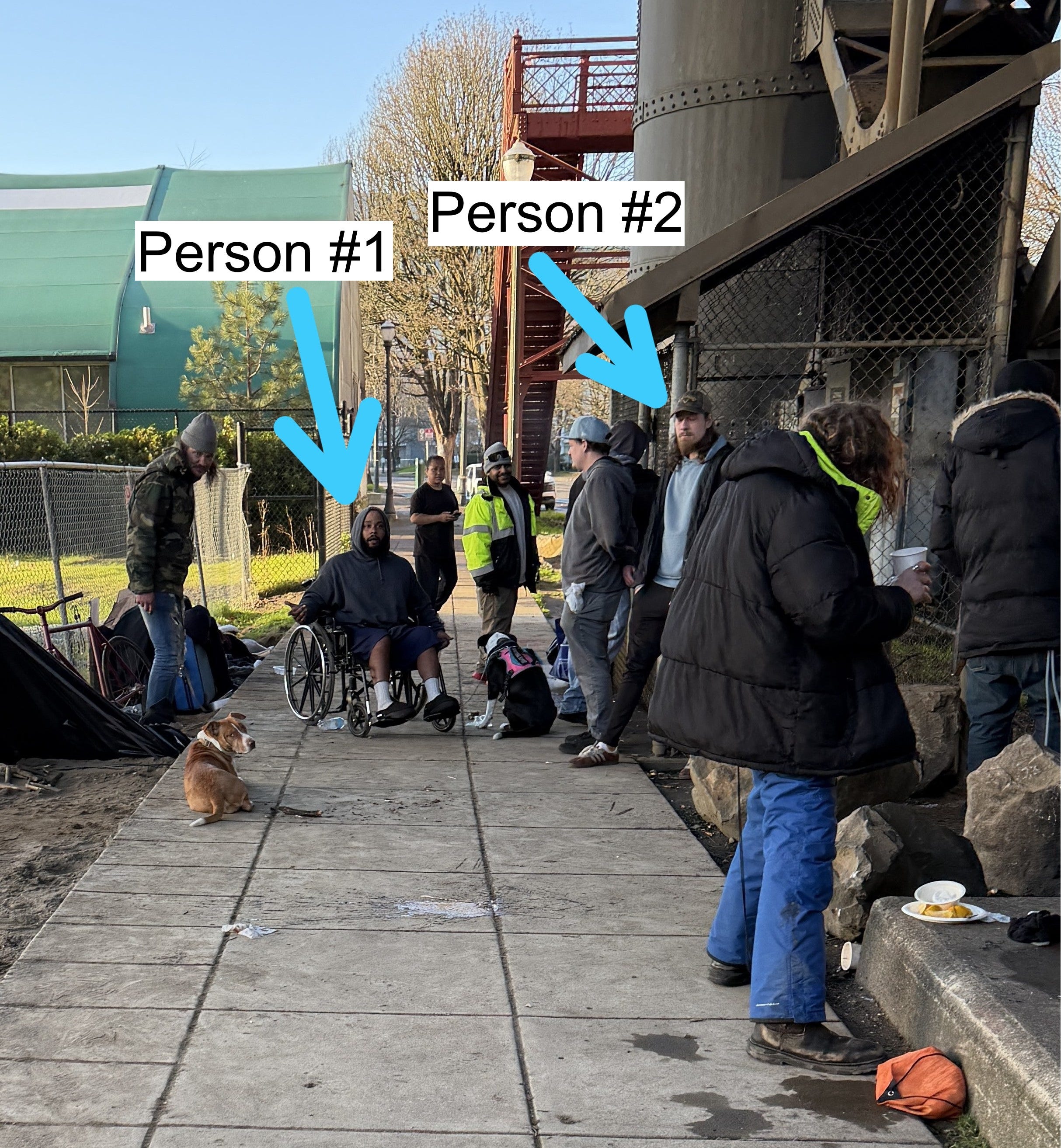
Brian Harvey and his neighbors at The Yards, a HomeForward apartment building along Northwest Naito Parkway, have formed a tenants union to prod management to do a better job of keeping the area safe and livable.
That struggle has been complicated by mismanagement of the place next door, the River District Navigation Center, where about 90 residents receive support and assistance to move toward more permanent housing.
Transition Projects Inc., which manages the center under a contract with Multnomah County, sometimes excludes residents for violation of rules, rules that include not congregating outside the facility.
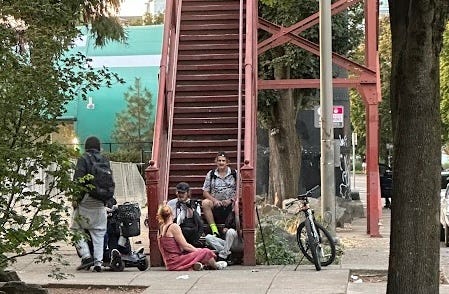
Harvey said groups hang out at the base of the stairs to the Broadway Bridge, often blocking passage.
“That’s been going on for months” he said. “It causes a lot of problems, a lot of intimidation. Every pedestrian I see walks off the sidewalk, down to the street. I avoid this area.
“These people really feel like they own this area, and they’re there every day, so it’s an effective no-go zone.”
In some instances, Harvey said, the problem has gone to extremes, such as armed threats of violence against neighbors.
He has asked center staff to intervene, without success.
“Part of the problem with addressing this is that Transition Projects will claim that HIPAA prohibits them from identifying anybody as being a participant as the shelter. They’re saying HIPAA says we can’t actually confirm [anyone’s identity].”
The NW Examiner asked TPI if that guidance is given to center staff, but has not received a reply.
We asked Thomas Dodson, a retired local psychiatrist, if this interpretation of the Health Insurance Portability and Accountability Act could be correct.
“Typically, health care providers would not release information they had about the identify of patients to the police,” Dodson wrote. “There is no HIPAA regulation that stops them from calling the police when there are troublemakers outside their facility. … Like any person, they should do so.”
Glen Ujifusa, a Multnomah County deputy district attorney, attended the Pearl District Neighborhood Association meeting at which the concerns above were discussed.
“I am in direct contact with the mayor’s office regarding shelters,” Ujifusa said, “and if you would like me to discuss this shelter and the questions you have about individuals hanging out and they’re not supposed to, I’m happy to be another voice to support your group in doing that.
He also promised to speak to the sergeant leading the Central Precinct Neighborhood Response Team about the situation by the Navigation Center.
The River District Navigation Center has failed its neighbors from the day it went in - endless camping, drug dealing, prostitution and squalor on its steps. It's just another example of how it's NOT possible to mitigate the effects of putting low-barrier homeless shelters in high-density residential neighborhoods. There is not one single success story in our city, or anywhere, where this works. The Moore Center in North Portland has traumatized its residential neighbors, people near the MSRV are selling their homes, and Pearl District owners are selling their condos for staggering losses - just to get out of the neighborhood beset with drugs and squalor. The mayor needs to reset his strategy and follow in the steps of San Francisco, where consequences and "tough love" are now the policy, to clean up neighborhoods and truly help the acutely addicted people and mentally ill -- rather than just warehousing them, without supportive services.
HAHAHAHA...talk to the mayor???? A mayor who doesn't give a RIP about the neighborhoods he is destroying.