

By Bob Weinstein
Portland Mayor Keith Wilson’s request that Washington and Clackamas counties contribute $6 million and $4 million respectively to Portland’s shelter system has drawn predictable resistance. Washington County leaders are weighing a token $1 million; Clackamas County officials say they must “carefully consider the financial impact.”
But the political friction obscures a deeper truth: Wilson is right to ask, more right than his own argument makes clear. Wilson has not framed his request around the distribution formula at all. His stated rationale is simply that Portland shelters serve residents from across the region. That is true, but an understatement.
The real problem is not Portland’s $15 million shelter shortfall. It is a structural flaw in Metro’s Supportive Housing Services (SHS) formula, which distributes money by population rather than by where homelessness is actually concentrated.
Money follows population, not need
Metro collects hundreds of millions annually for homelessness services. Yet 95% of SHS dollars are allocated based on each county’s share of the region’s population, not its share of the homeless population. That mismatch has enormous consequences.
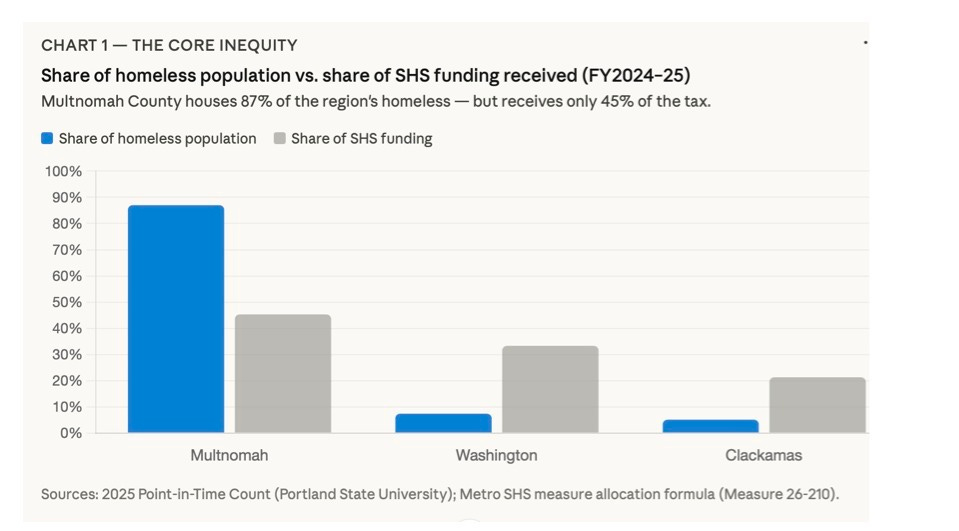
Chart 1 illustrates the fact that Multnomah County has 87% of the regions homeless population, yet receives only 45.3% of SHS revenue. Washington and Clackamas counties—home to far fewer homeless residents—receive dramatically more funding per homeless person. This is a structural misalignment between where the crisis is and where the resources flow.
Homelessness in the region is heavily concentrated in Multnomah County—particularly in Portland—where service demand, system strain and public visibility are greatest.
Clearly, the distribution formula is not fair and needs to be changed. A fairer distribution formula might provide each county with 25% of its allocation based upon total population and 75% based upon the county’s homeless population.
Cost per homeless person
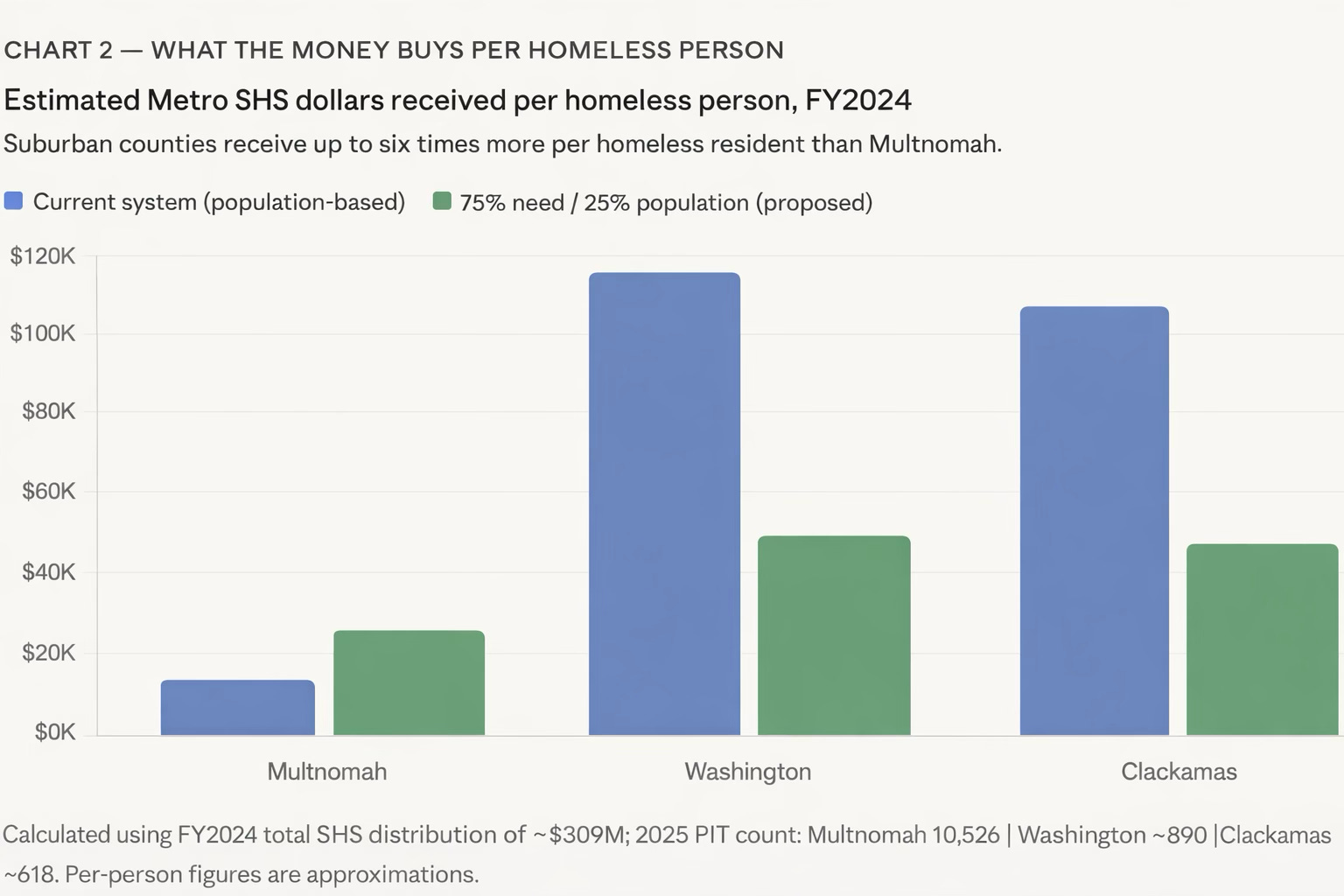
Chart 2 makes the inequity unmistakable. Under the current formula, Washington and Clackamas counties receive over $100,000 per homeless person, while Multnomah receives roughly $13,000. Even under the 75/25 formula, Multnomah would receive only about $20,000 per homeless person, while Washington and Clackamas would still receive around $40,000 per person.
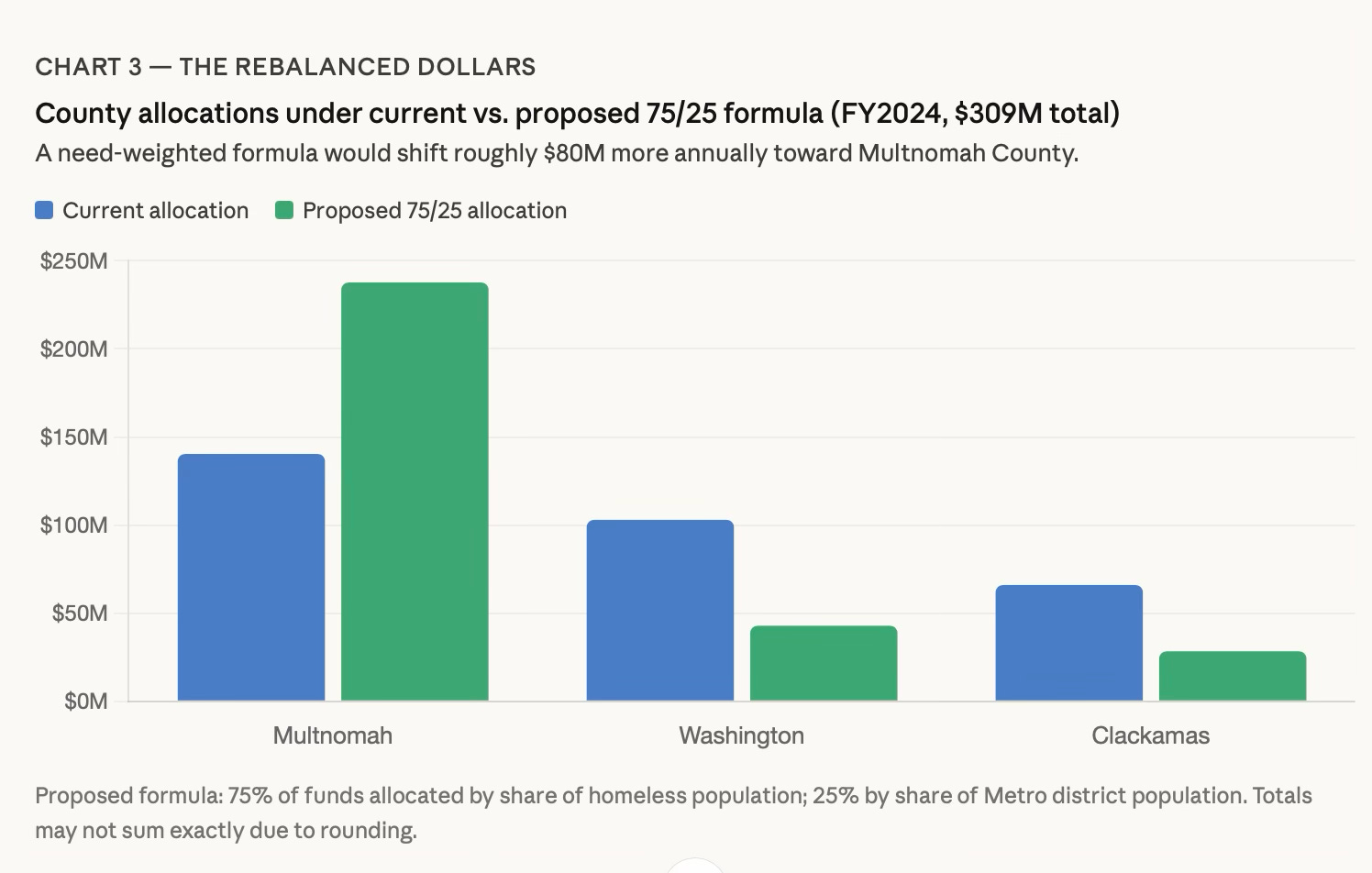
This is not a radical proposal. It simply reflects the principle that resources meant to address a problem should be concentrated where the problem is concentrated.
A formula that spends six times as much per homeless person in Beaverton as in Portland is not equitable by any reasonable standard regardless of how equity is defined.
Suburban response in context
Washington County leaders argue that shifting money “doesn’t solve the problem.” Clackamas County officials question Portland’s performance.
Those concerns may resonate politically, but they do not address the underlying math: suburban counties benefit from a formula that allocates them far more per homeless person than to Multnomah County.
Multnomah County faces a $68 million shortfall in its Homeless Services Department and may close multiple shelters—-facilities that serve residents from across the region. In practice, Portland’s shelters function as the region’s emergency system.
Against that backdrop, Wilson’s $10 million request is not a bailout. It is a temporary patch over a flawed formula.
I typically agree with your take on Portland’s afflictions, but not in this case. The homeless are concentrated in Multnomah County/Portland because of county/city policies related to camping, open air drug use, lax law enforcement, etc. Portland shouldn’t be rewarded with additional funding to address social dysfunction its policies enable. The Mayor and Council need to live within their means. They have plenty of money, what they lack is prioritization/focus, pragmatism and effectiveness. Funneling more money to these people is throwing good money after bad.
Bob: Your usual good sense has left you. The more money you throw at so-called homelessness the more homelessness there will be. Who can forget that in the 1980's when you know who had to get homeless voters for a certain county in Central Oregon a nationwide casting call was required. Jurisdictions like Portland have subsidized the homeless lifestyle since then and made it an attractive alternative for a portion of our population. The way to cut homelessness is to cut the subsidies not ask counties that are less committed to subsidizing the problem to throw money at ones that can't seem to get it.