



“What does it mean to have survived oppression only to become part of an oppressive system?”
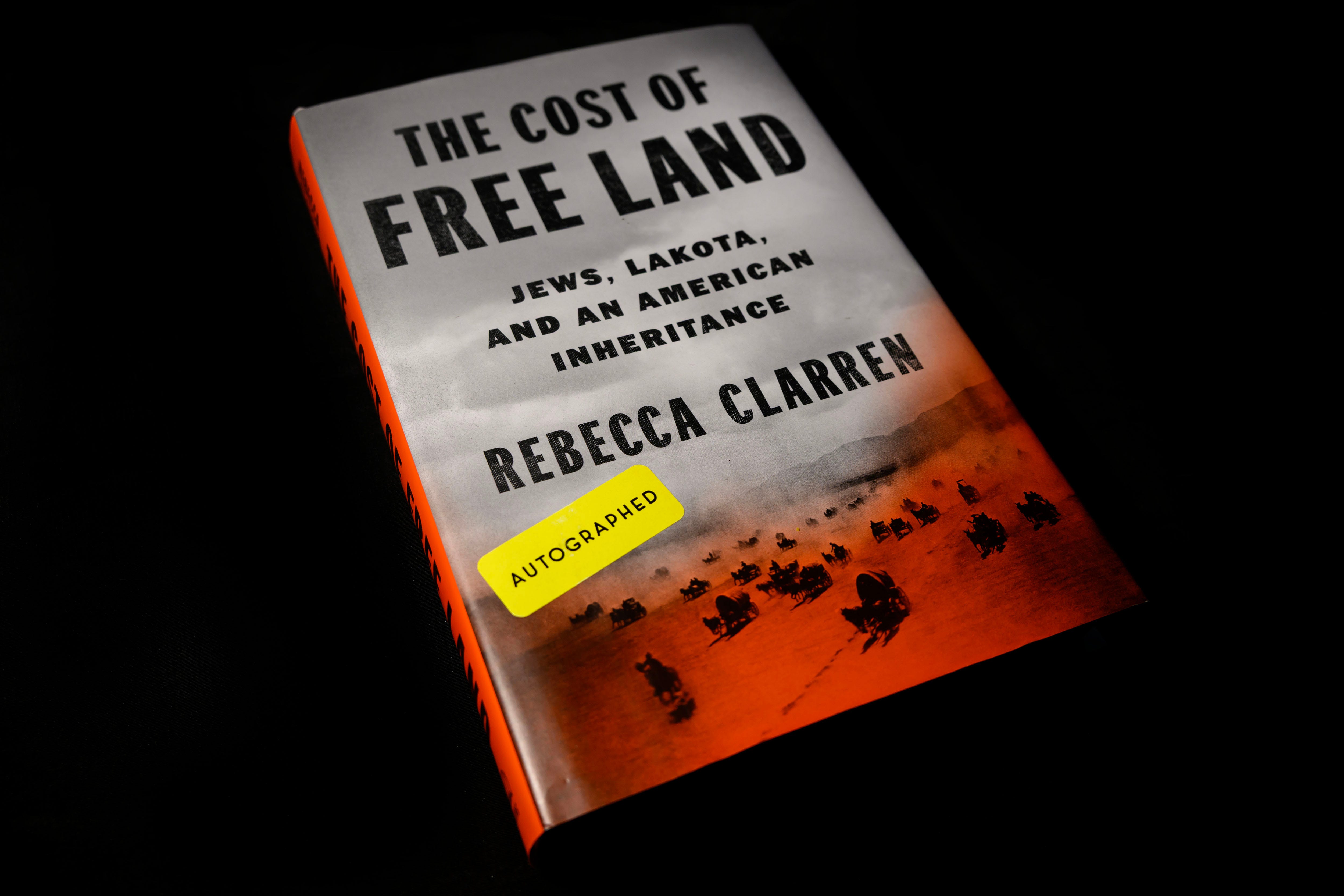
It’s a vexing and ambitious question. Portland award-winning author and journalist Rebecca Clarren challenges herself by scrutinizing her own family history, in a book she spent years researching, “The Cost of Free Land: Jews, Lakota, and an American Inheritance.”
To tell the story, Clarren pored through family documents and consulted with native elders and members of her own Jewish faith. There is a lot to unpack here and Clarren does it in an incredibly thoughtful way.
For more than two decades, Clarren has been writing about the American West and Native Americans. It never felt personal. But in 2017 she was writing articles for “Indian Country Today” about the effect of federal policy on Native Nations.
“While I was working on that series I just had this kind of slow dawning realization that, oh, this is my story too,” she said, “because policies that hurt Native people were meant to help immigrant families like my own. And it was that realization that led me to want to write this book.”
Clarren knew that her immigrant ancestors had once farmed in South Dakota, but she hadn’t known much more until she learned that the land that first established her family in the United States was cruelly taken from the Lakota Nation.
“I started doing tons of legal research, figuring out the deeds and the mortgages that our family had on those lands and creating big maps, the original plat maps of the land to figure out where and at what time we accrued more land,” she said.
Land tells the story
Through the Homestead Act, the U.S. government gave Clarren’s ancestors — and thousands of other homesteaders across the American West — 60 acres of free land. Clarren’s family land was the wild prairie of western South Dakota.
The Homestead Act was how the West was won. The government — according to Clarren — swindled the Lakota out of their land. Once the government proclaimed Lakota land private property, it handed it over to U.S. citizens and immigrants alike to turn the wild land into taxable farms and ranches. This was economic development. (At the time, the U.S. government welcomed immigrants who would work the land. It is estimated that almost a third of all Americans today are descendants of western U.S. homesteaders.)
Clarren’s ancestors came to the United States in the 1890s, fleeing anti-semitism in Odessa. Not only was anti-semitism legal in the Russian empire, but it was brutally enforced through pogroms. Her own great-great grandfather came within an inch of losing his life during one of these massacres against the Jews.
In about 1905, Clarren’s family applied for and received those free 160 acres near the Black Hills of South Dakota.
While most immigrant Jews went to the cities, some 30,000 American Jews farmed in the early part of the 20th century, 1,000 of them in South Dakota. Through hard years and hard work her family prospered, creating generational wealth and a firm stake in the American Dream.
Still, it was an inconvenient and uncomfortable truth that Clarren wrestled with: Her family’s good fortune and thus her good fortune came at the expense of the Lakota. Troubled, she sought guidance from tribal elders she’d gotten to know through her years of reporting. One of them told her to seek the answers in her own traditions.
Jewish teaching
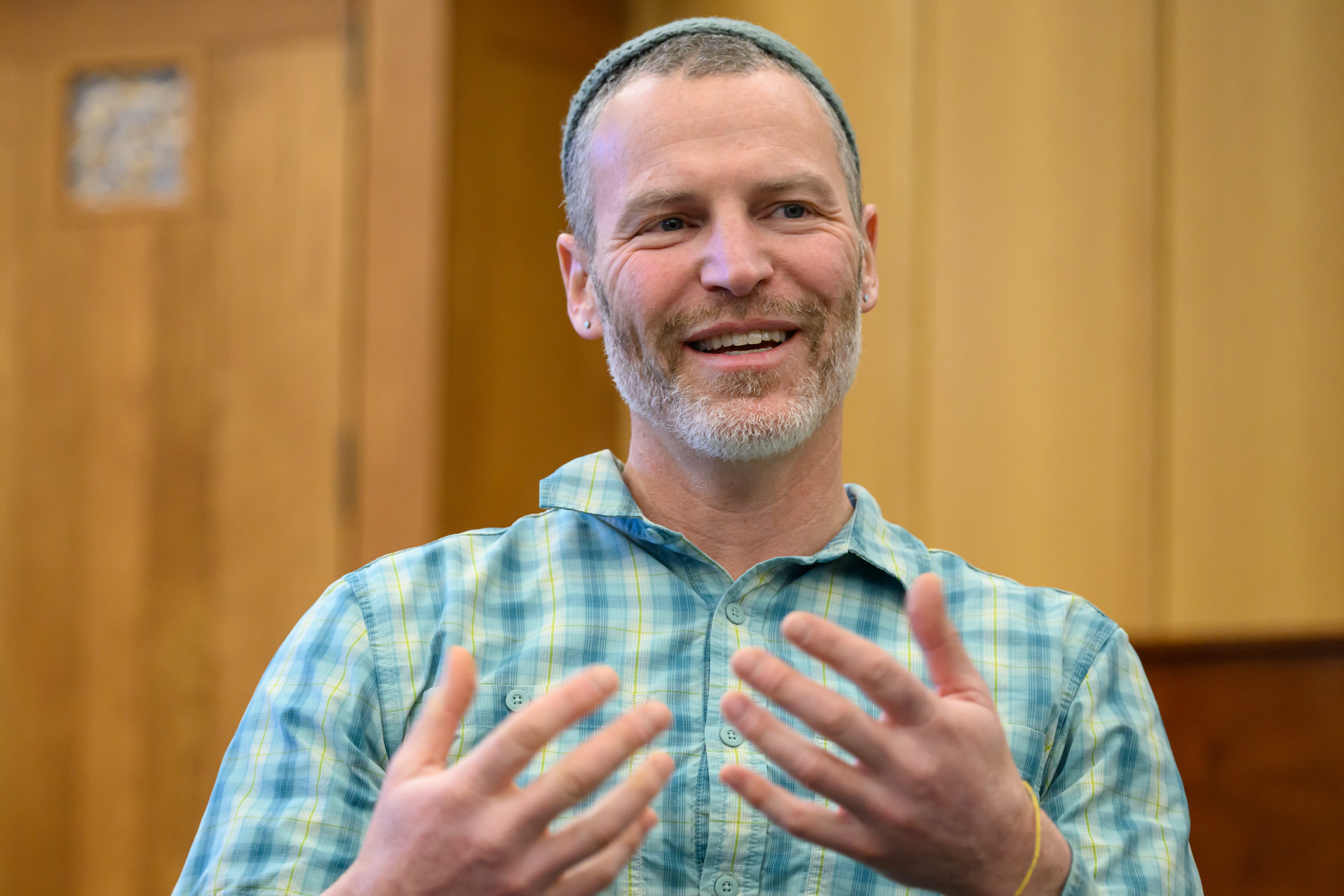
Clarren went to her rabbi, Rabbi Benjamin Barnett of Havurah Shalom in Northwest Portland.
Rabbi Barnett said Clarren asked him two questions: “What does Judaism say about forgiveness? What does Judaism say about collective healing or atonement?”
He could not give her a pat answer, because, as he told us, Judaism invites questioning. It is an “interpretive tradition.” Rabbi Barnett and Clarren met often to discuss how one can “repair a harm.” He is mentioned extensively in her book: “One of the things that I think is really important about the book,” Rabbi Barnett said, “is that it is a process of telling a story and examining where we come from in a way that’s not moralistic, and it’s not hiding from the truth, but it’s not castigating.”
Together, Clarren and Rabbi Barnett searched ancient Jewish texts for answers. A story in the Talmud talks about a stolen beam used to build a new house. Should the “stolen beam” be returned to the rightful owner, as some Jewish scholars conclude, meaning the house would have to be demolished? Or can one somehow “repay” the value of the stolen beam and thus the house can remain standing? Which is what other scholars believe — saying one still has a moral obligation to admit the wrongs and make amens.
Clarren is not sure whether her ancestors knew if their land had been Lakota land. She combed through family letters and documents and found nothing that acknowledges it. But through her research, she found early 20th century articles in local newspapers reporting on the Lakota being upset about losing their land. They could have known.
Another troubling thought: Could her family have done something about it? A native elder told Clarren that she really could not expect people who had run for their lives and come here with nothing to stop to have a conversation about “restorative justice.” That takes time. Generations, maybe. And maybe that time is now.
You cannot rewrite the past, but Clarren writes that many of our cultures — including Native and Jewish — provide blueprints for healing the harm.
It has been several generations since Clarren’s family sold the land in South Dakota, so even if Clarren wanted to, she could not give it back to the Lakota. Instead, she is donating to the Indian Land Tenure Foundation which helps Native Nations recover their historical lands.
Clarren said she needed to come to terms with her American inheritance. While careful not to tell others what they should do, she adds: “It is very clear to me that we need a federal program to really think deeply about this and federal leadership, but we don’t have it. And I don’t think it’s a moral choice to just wait for that leadership, because that’s to delay justice indefinitely.”
Clarren and Rabbi Barnett taught a class at Havurah Shalom, about what they learned. And the congregation is now nurturing more connections with Native Americans in the Northwest. Clarren’s book is available at Powell’s Books.

This is a question we all should be asking ourselves. Since I worked as a therapist in mental health in Montana, some of my clients were Native people and struggling with generational trauma. To do my job I had to research directly with tribal elders and medicine people to learn some of the solutions to this dilemma. For me personally, I came to believe education was a road to personal power and power within the dominant culture, so I contribute as much as I can to higher education of native people. I’m proud to say that a few of my teenage clients were not only the first to graduate high school, but to complete degrees in college as well. These people have learned to live within the system and still maintain and advocate for important values of their ancestors which I believe may be our only salvation for us as humans to coexist with nature. The organization of my choice is the American Indian College Fund,
www.collegefund.org/support.
I think I can safely predict this post won't be popular. I find the contemporay handwringing about "stolen land" emotionally self-indulgent and historically uninformed. Yes European settlers took land from the Lakotas. Similarly the Lakota Empire took land from the Cheyenne, the Kiowa, the Crow and many others. Certainly the Lakota never felt badly about. Quite the contrary. They quite liked their "stolen" land and fiercely defended it. Until Western science formed the basis for material progress unimaginable to earlier humans, one group had taken land and other things from other groups throughout the entire course of human history. Why would it be that European settlers would have some special cross to bear? Yes it's great we've finally reached a point where we are able to organize society so this in an aberration to be condemned (e.g. Ukraine) rather than a constant feature of human existence. However, going back and selecting one particular past human land grab over all the others and "acknowledging it" or "apologizing" for it seems designed (albeit unintentionally) to make those who do the "acknowledging" and "apologizing" feel good about themselves and morally superior. I realize there are good people who do it, but count me out.