

By Meghan Whitten and Scarlett Dempsey
Sirens sounded, followed by announcements to “secure the perimeter” and then “lockdown.” On Feb. 17, what began as a typical day at Lincoln High School quickly shifted into a lockdown. Instead of sitting at their desks, students hid in corners; some trembling, others confused.
Two people, ages 15 and 22, not affiliated with Lincoln, fled the scene of a stabbing near the MAX train at Southwest Main Street and Southwest Broadway, according to Principal Peyton Chapman. The suspects then ran to Lincoln. The secure perimeter was announced at 10:57 a.m. because of police activity outside but was immediately turned into a lockdown when the suspects entered the building at 10:58 a.m.
According to Vice Principal Travis Johnson, the suspects jumped the south fence near Blue Star Donuts at 10:57 a.m. and were then let into the commons at the athletic entrance by a student at 10:58 a.m. Police were in pursuit when the suspects were let into the building. The two individuals were arrested by the Portland Police Department inside Lincoln on the second floor in front of the counseling office at 10:59 a.m.
According to Johnson, once the suspects were apprehended, administrators and campus security went to each classroom, unlocking doors and giving the all-clear over the next 20 minutes. All classes were cleared by 11:30 a.m.
Junior Reed Eldridge was on the sixth floor during the lockdown and felt “pretty safe” knowing he was far from the entrance to the school.
“[I was] kind of confused. I wasn’t very scared, but I didn’t know what was going on,” said Eldridge.
Senior Dylan McCleary was scared, especially knowing her sister was in the building. They were both on the fourth floor.
“I was definitely feeling a lot of fear, just knowing that this is actually happening at our high school,” McCleary said. “I am now having more fear for my sister too because she is a freshman and I’m not going to be able to be around her during school emergencies.”
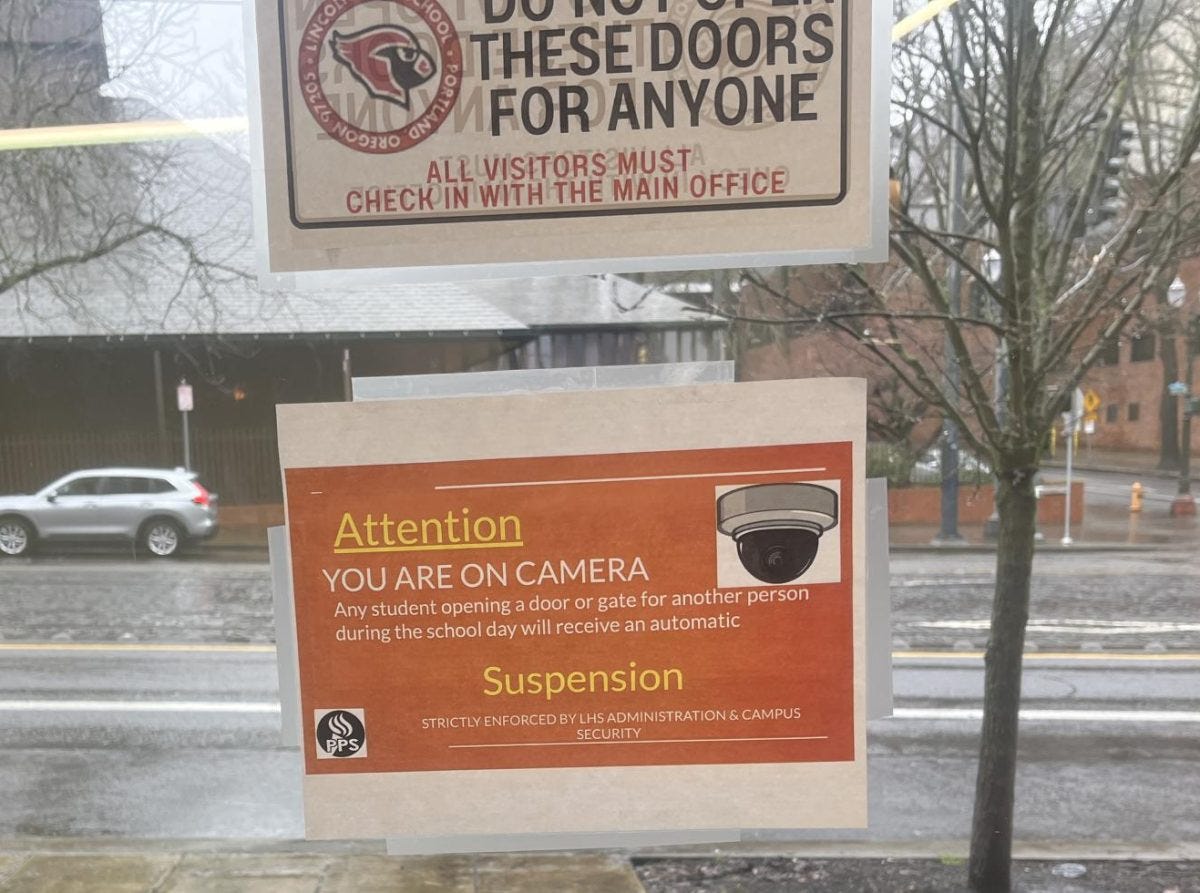
Following the lockdown on Feb. 17, Lincoln’s administration put signs on all school doors indicating that opening a locked door for anyone, including friends and classmates, will result in an automatic suspension and that cameras will be more closely monitored. Vice Principal Johnson explained that it has always been against the rules to let people into the building through locked doors.
“There’s nothing new. We’ve always been saying, ‘Don’t open doors.’ We’re advertising it more. That’s what feels new,” Johnson said. “We have students that had consequences for opening the doors for other people. We’re going to put effort into making sure we’re getting the word out and then using cameras to track it.”
Some students, like freshman Boden Cain, disagree with the new suspension policy.
“I remember them always having [the door] rule, but I feel like a suspension is harsh,” said Cain, who was on the 2nd floor during the incident. “I feel like it was a mistake.”
French teacher Doug Siegel supports the new policy, and believes that education about the risks of opening doors is necessary.
“Because we’re downtown and because of what happens downtown …We need to really underline the point that … there’s just certain things you can’t do,” said Siegel.
During the lockdown, many students including Eldridge were worried because their phones were in their Yondr pouches, making them unable to contact their parents or guardians. Read more about the Yondr pouch policy in the Cardinal Times article by Matthew Klein and Ravi Weinrobe: ‘Off and away!’ Yondr is here to stay.
“[My parents and I have] been kind of annoyed about the Yondr pouch rule because now that there’s an emergency [they couldn’t] contact us and get a hold of us,” said Eldridge.
Johnson understands the worries of parents, as a Lincoln parent himself, but he believes that having cellphones during an emergency can negatively affect the situation and it is the job of the school or district to keep families informed.
“[Students] texting parents is not gonna keep them safe, and it is really hard because we’re used to that [as] parents,” said Johnson. “I feel super strongly [that] it’s our job, [as the] school to communicate as fast as possible what’s going on to help lessen that worry for parents. …The cell phone will not keep anybody safe and in fact, it can impact the situation negatively as far as spreading rumors [and] having a bunch of people come to school, which [then we would] now have to put energy there versus into solving the problem.”
Principal Chapman emphasized that these door policies are designed to benefit the community and ensure everyone’s safety.
“Do not open doors, even if you think you know the people; they need to come through the front doors for all of our safety, sanity and school records,” Chapman said. “We can help change the culture that way. It’s for the betterment of us all and the safety of everybody.
Quote from student in article: “I remember them always having [the door] rule, but I feel like a suspension is harsh,” said Cain, who was on the 2nd floor during the incident. “I feel like it was a mistake.”. My response: I'm not a strict law and order type, but given the number of school shootings, you would think students today would be more aware of the risk of allowing strangers into a school. Being suspended is not the end of the world, allowing a shooter into a school might be the end for someone.
If we had practical, humane and reasonable civil commitment laws in the country to balance the liberty interests of individuals with severe mental illnesses with societal interests for safety, civility and beauty in the public square our schools could be safer.