


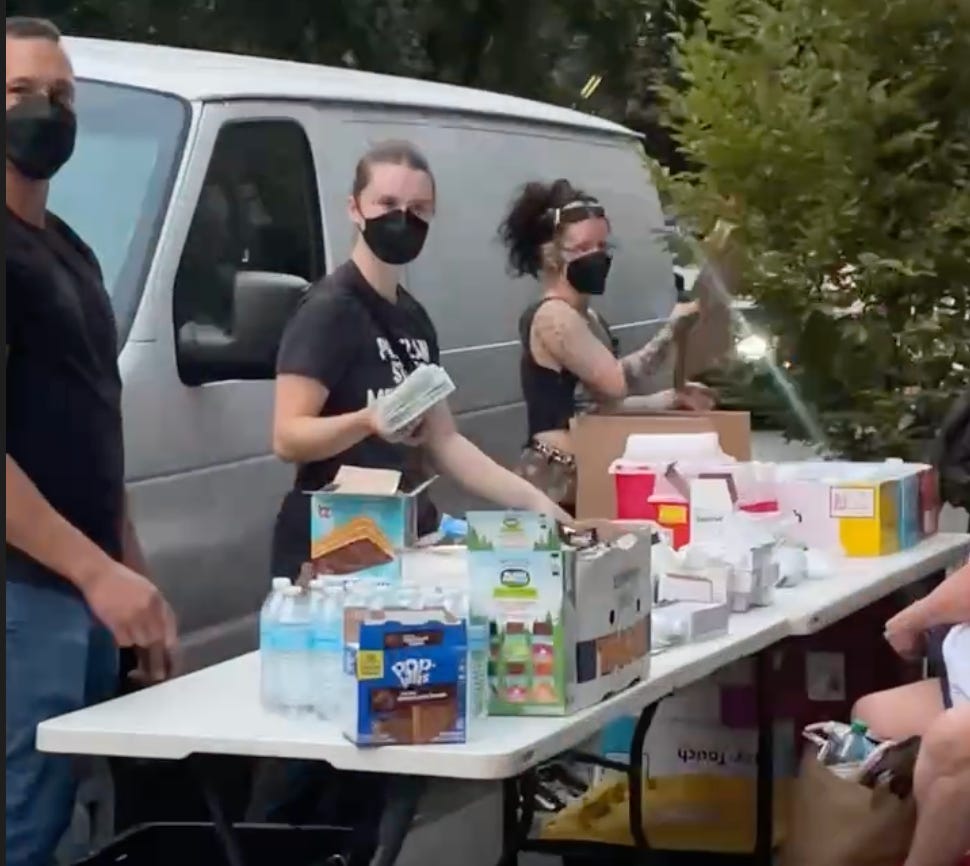
State Sen. Lisa Reynolds spoke to 60 constituents at a Northwest District Association meeting March 25 and told them she was sorry for the way a bill to regulate handouts of needles and drug paraphernalia died in her committee this spring.
“I’m very sorry for how this all went down this session,” Reynolds said. “Don’t get me wrong on that; it did not go how I would have preferred.”
Which is not to say she did anything wrong.
“I also want to be clear: This measure would not have passed out of our committee. … I will tell you that we did not have the votes in our committee to move it. … It wasn’t just Lisa Reynolds unilaterally making this decision,” she said.
Senate Bill 1573 had flaws that could not be rectified, she said, promising to make another effort in 2027 to limit the negative community impacts of irresponsibly run needle handouts on the surrounding community.
The bill banned such activities within 2,000 feet of a school or childcare facility; she wanted it to be 1,000 feet. The bill created a private right to sue violators; she wanted only a registry or licensing of such programs.
“These measures would have done away with harm reduction,” Reynolds said, referring to an approach that provides clean supplies to reduce health risks for street drug users.
“We want to look at a bill that doesn’t reduce harm reduction,” she said.

“I’ve never read one of these harm reduction studies,” resident Joe Springer said, “But unless those harm reduction studies include the harm to the community … I fail to see how any harm reduction study could be taken seriously.”
Several audience members said Reynolds publicly blamed the bill’s defeat on the unwillingness of its proponents to compromise on the sticking points she outlined.
“We’ve been requesting assistance from your office and trying to engage with you for a long time,” said Michele Milla, chair of Stadiumhood Neighbors, the Northwest/Southwest Portland citizens group that asked for legislative help after their neighborhood was plagued by weekly paraphernalia handouts by Portland People’s Outreach Project at Northwest 19th and Burnside streets until 2025.
“It specifically would not have ended harm reduction in the state of Oregon, as you asserted. We were just looking to partner with you on how to make some common sense guardrails.
“I was a part of those negotiations. We absolutely did accept those amendments and can release records to that effect. So, we did not appreciate being thrown under the bus. I just wanted to go on record saying as much,” Milla said.
“It’s terribly unfortunate, Senator Reynolds, that you killed this bill,” said Laura Murray. “Working with members of Stadiumhood and Sen. [Christine] Drazan, we appealed to your office. Senator Drazan generously supported us through this process. She was the champion for this bill, and my recollection is that Senator Drazan came back to us with the idea that we needed to shorten the distance from 2,000 feet to 1,000 feet, and also amend the penalties.
“And as a collective, we agreed to everything that was asked of us to get this bill passed, so I hold the killing of the bill at your feet,” Murray said.
Autumn Sharp, another neighbor who worked for the bill, is running against Reynolds in the May Democratic Party, because she said Reynolds falsely blamed citizens for the bill’s defeat.
SB 1573 “could not be interpreted in any way to end harm reduction in the state,” she added.
At the March 25 forum, Reynolds did not dispute charges that she left citizens out of negotiations.
“I could not come to agreement with the carrier [Drazan] on that, so, in the short time we had in short session, we were not able to move that bill forward. I see folks shaking their heads—go ahead—I’m frustrated too,” Reynolds said.
One participant challenged the efficacy of harm reduction head on. Lance Orton runs a program in Old Town, CityTeam, that provides residential treatment and recovery services for addicts.
“As probably one of the only intravenous heroin addicts on this call—who was addicted to heroin for 10 years in this city—I would strongly suggest that when it comes to harm reduction, particularly needle exchanges, they only work if treatment is connected to the actual distribution of those needles,” Orton said.
“I’m personally not a big fan of the harm reduction model. … I would also suggest that when distributing needles, it’s so much better to have a clinic where the addict has to go to and exchange their needles. The one-for-one is a much better model. It’s in a place that is safe, far away from communities. Treatment is part of the exchange, where you are offered a case manager. You’re offered opportunities to get off the drugs,” he said.
“The PPOP group is an absolute problem,” he continued. “They absolutely need to be taken away from our community, because they are not helping people get sober. They are not helping people get away from these drugs, they’re actually harming the addicts like myself, and it drives me absolutely crazy.”
“That’s a really excellent point, and one that I will definitely take to heart … as we start crafting this bill,” Reynolds said.
She does not support PPOP’s approach either.
“I agree with you all that PPOP is not a good neighbor,” she said. “It is not a good player in this space. I have said that, and I stand by that.”
NWDA President Todd Zarnitz offered a thumbnail summary: “A bill that neighborhood volunteers, desperately trying to improve the safety and livability of their community and who spent many months [in] the legislative process, was slapped down by their own representative.”
Joe Springer said, “But unless those harm reduction studies include the harm to the community … I fail to see how any harm reduction study could be taken seriously.”
This is a great comment and a common theme in our struggles to address local issues. From public drug use, prostitution, and traffic offenses, we often treat the situation as if the offender is the only subject to be factored into equation.
As I resident of NW, I can honestly say that not only do I not feel represented in any way by current elects, they seem like they are diametrically opposed to my physical, mental, and financial well being. They go out of their way to make our lives worse and they need to be removed if we ever want this to get better.