


It’s not hoarding if it’s books, right? There are a few new places people can prowl for their next acquisition.
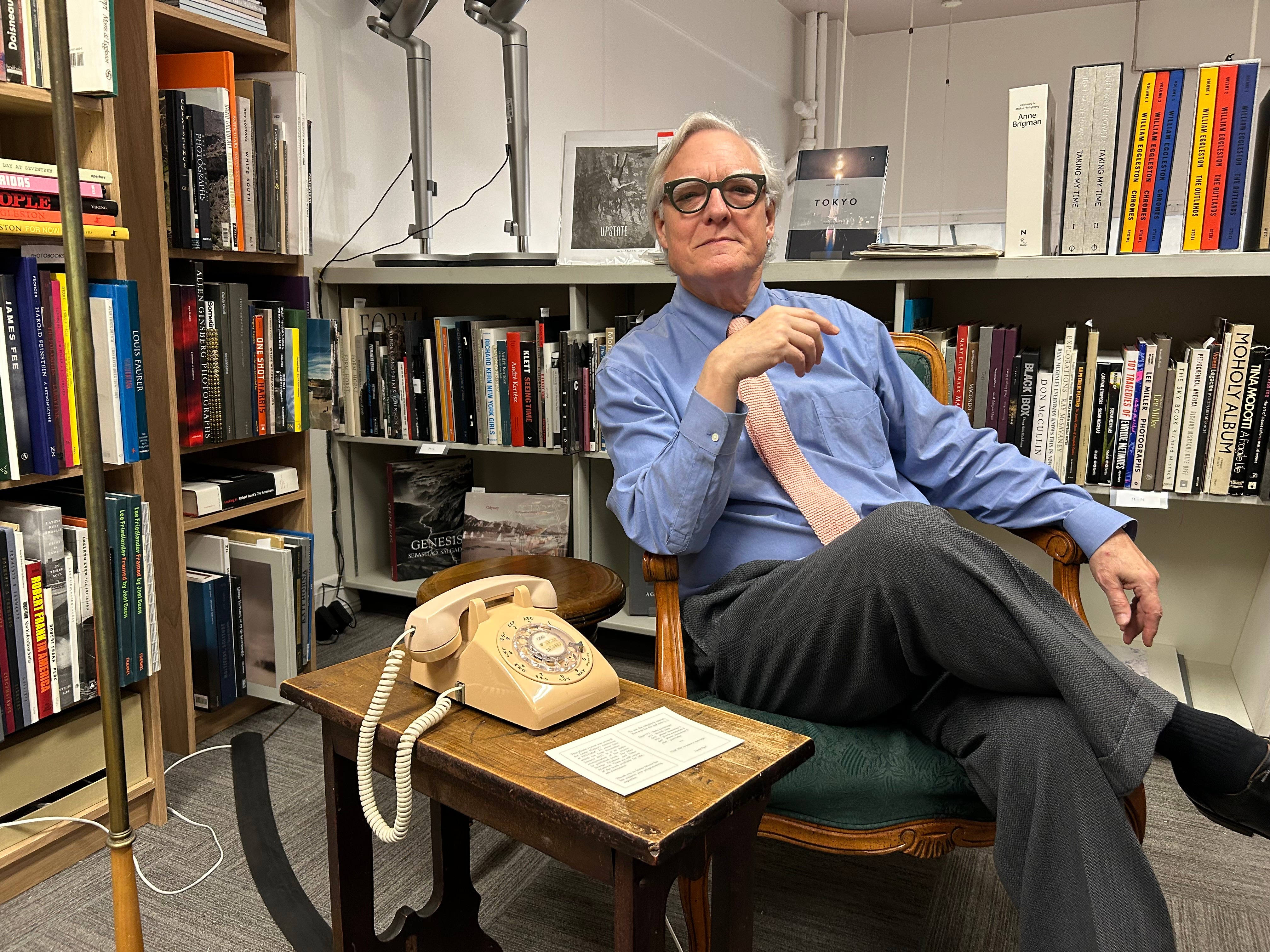
Kid Hermes the Trickster, 1030 SW Taylor St., is a bookstore where people can walk in and confront something unusual, says owner Doug Lowell, dressed in vintage tie and natty Brooks Brothers shirt on a Sunday.
“It’s not something, ideally, that they find just on any other bookshelf,” he said. Many first editions have tiny typed flags that read “signed.” Typewriters are for sale upstairs, but I’m jumping ahead.
Lowell’s two-story shop in the Medical Arts building on Southwest Taylor (across from the Multnomah County Library’s battered south side) is only seven months old. But Lowell’s grandfather had a medical practice for 30 years in this very building.
“I remember coming here and sitting on the fire escape and watching the Rose Festival Parade,” said Lowell. “I love being downtown. I really, really believe in downtown.”
A curious intern sits at a tiny desk processing books. A different desk takes up much of the remaining space of the book-lined room. It’s close and enclosed in here in the best kind of way.
Lowell attended Lincoln High School and had David Bailey for journalism. “His training was grueling the first year,” recalled Lowell. “By the second year, he really gave us a lot of leeway. He helped me become a writer.”
Later, he become an advertising executive and led the Portland web design firm Paris, France. These days, he’s running the bookstore, and writing a novel inspired by his mother, who read a book for two hours a day, during which time no one could interrupt her.
He started Kid Hermes by harvesting his and his wife’s collection of about 3,000 titles. He buys other books from online dealers, like a signed copy of Jonathan Franzen’s new book, “Purity,” that jumped out at me, and four signed copies of “Wildwood.” A rare copy from a 500-print run with drawings, prints, and enclosed notes by Carson Ellis recently sold to a Gen Z collector who had been hunting all over for it. Gen Z collectors are the type of buyer that Lowell hopes to specifically attract with his price point and inventory.
Books arrive in various ways. Scouts come to sell books scavenged from Goodwill, estate sales, library stores and thrift stores.
“They sell to me immediately at a mark up and don’t have to sell it on Ebay and schlep it to the post office,” says Lowell. “I pay about 25-35% of what I’ll sell it for. Or someone calls and says, ‘I’m ready to start de-cluttering by books, do you want to come over?’”
He is partial to signed first editions, and there are a lot of them covered in Mylar to protect the dust jacket, the most valuable part of the book.
“I could have a first edition of Kerouac’s “On The Road.” It’s got no dust jacket, and it’s not in the greatest condition, but it’s $500. If you were to find one in wonderful condition with a really nice dust jacket, it’s a $3,000 book. So we’re going to have that book for that person who says, ‘I’ll start with this and over time I can upgrade.’”
Gen Z is buying Kafka, Hemingway and Murakami, Lowell notes. “So like people 28 years old and younger, and they’re in part why there’s a revival of bricks and mortar bookstores. This is one reason why I built up such a science fiction and fantasy section, because that’s another really important category for them.”
I mentioned an article about how Trail Blazer coach Micah Nori gave everyone on his staff a copy of Hemingway’s “Old Man and the Sea,” and that I’d never read it. Lowell finds it for me and can’t resist selling it.
“That’s a lovely story! Here’s a vintage Book of the Month club book version with a nice dust jacket. It’s inexpensive, it’s $45, which is almost the cost of a new hardcover, right? But it’s got the same original dust jacket that the first edition has.”
Those Gen Z customers, he continued, are reading good stuff: Cormac McCarthy, Dostoevsky and Nabakov.
I mentioned my tennis bookclub (Gen X am I) was reading “Lolita.”
“I’ve never read it!” Lowell said. “It’s considered perhaps the best novel ever. But I read a different book Nabokov scholars think may be even better - “Pale Fire.” I was so delighted!”
Lowell is versed in a broad range of subjects, and loves meeting people who surprise him, like an erudite paint-splattered worker who wandered in recently. “There aren’t that many places where you can have a conversation about books. So I have people come in and start talking about Philip K. Dick or Neoplatonism. And it becomes this little corner of downtown where people can get a little respite from the world, and talk about things that matter to them, that maybe none of their friends want to talk about!”
Upstairs the shelves carry history, classical history and photography. Colleen’s shelf belongs to Lowell’s wife, and it has her picks: Tana French, Louise Penny, and Kate Atkinson. A complete Oxford English Dictionary is also up there, a rotary telephone, and a few typewriters for sale.
For some parts of his day Lowell teaches the book business to his four interns.
“I teach them about bibliographic descriptions, scouting, identifying first editions. The traditional language around the book trade, the anatomy of a book, you know, what’s a deckle edge, a fore edge.”
Asked if people try to sell stolen books, he said, “I cut my teeth in bookstores in the Tenderloin in San Francisco. I got pretty expert at recognizing a stolen book and very comfortable taking it back and saying I’m not giving it back to you.” Someone’s been selling stolen Ursula K. LeGuin books lately, he added.
“The thing is when you buy that book, as a book dealer, you’re gonna give it back to the book dealer it belongs to and eat the loss.”
Recently Lowell partnered up with two other Portland bookseller-friends to create a book room at the vintage mall Retropolitan on Southwest Broadway. There I landed a hardback copy of Charles Portis’ “True Grit,” a tale of vengeance about a girl who hunts down the man who shot her father.