


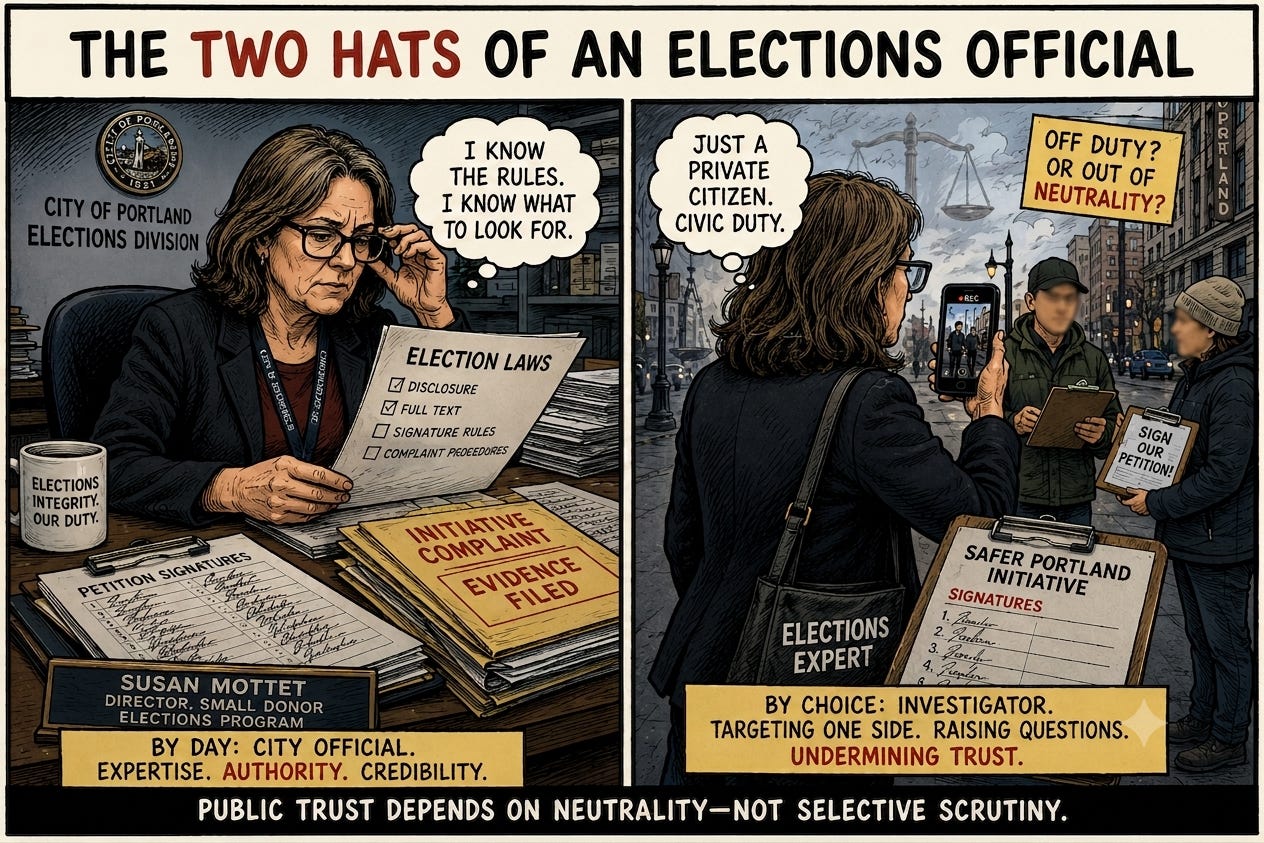
Portland’s city government wants to have it both ways when it comes to Susan Mottet, director of the city’s Small Donor Elections program.
Mottet approached a signature gatherer for the Safer Portland initiative, the ballot measure that would redirect a portion of Portland Clean Energy Fund revenues to hire additional police officers. When she asked to see the full text of the measure, while capturing the encounter on her cellphone, she did so, she says, out of “civic duty.”
She later submitted that footage as part of a formal complaint to the Oregon Secretary of State’s Office and the Portland auditor, aimed at invalidating signatures collected by ordinary Portlanders who had volunteered or been paid to gather them.
When the controversy erupted, the office of deputy city administrator Tracy Warren offered a tidy explanation: Mottet was “off work and acting as a private citizen” and operating in “a private capacity.”
That framing doesn’t survive contact with the facts.
Job and act inseparable
The issue is not whether Mottet was on the clock. It is whether her actions were inseparable from her position, expertise and public role as the city’s director of the Small Donor Elections program.
They clearly were not separable.
Mottet is not a random Portlander who happened to have a smartphone. Her own justification for the recording invokes exactly the kind of institutional authority the “private citizen” defense is supposed to disclaim. She told The Oregonian/OregonLive she was upholding “the integrity of our democracy,” language that reaches for the credibility of her office and asks the public to trust her precisely because of the position she was in that moment disclaiming.
Most private citizens do not possess specialized knowledge of election laws, understand exactly what evidence is needed to support an election complaint or enjoy the credibility that comes from serving as one of the city’s senior elections officials. Mottet’s actions carried weight precisely because of the office she holds—not despite it.
That distinction matters. Public officials do not leave behind the trust and credibility attached to their offices simply because they are no longer at their desks.
She was the city’s administrator of a public campaign finance program, using knowledge, expertise and credibility gained through that role to collect and submit evidence in a dispute involving one side of a contentious political campaign.
Reputational weight follows her title
Video from a city elections official became evidence in a complaint to a state office and a city auditor. That fact alone is why this is a story at all. Portland Elections Commission chair Amy Sample Ward defended Mottet by pointing directly to her professional standing, calling her “a trusted source that cares deeply about the integrity of our elections” because of her “deep knowledge and expertise on electoral laws and regulations.”
Even her defenders are pointing to professional standing, not her status as an anonymous citizen.
That is the central contradiction. The city cannot simultaneously argue that Mottet’s office makes her more credible while also arguing that her office is irrelevant when evaluating her conduct.
Calling this “private capacity” lets Mottet’s professional credibility do all the work of legitimizing the video while insulating the city from having to account for it as an act of a sitting elections official. It collects the benefits of her office—the trust the public extends to it— without the accountability that should come with carrying that trust.
Government officials may be subject to ethical obligations even when off duty if their conduct is closely connected to their official responsibilities. Election officials are held to an especially high standard because public confidence rests on their neutrality.
The public expects elections officials to administer the rules fairly, not to turn the machinery of their office against one side in a political campaign.
Question about even-handedness
There’s another question before anyone accepts the “civic duty” framing at face value: Has Mottet applied this same scrutiny evenhandedly across this election cycle, or has she reserved her attention for one target? Did she do any comparable fact-checking, filming or disclosure assessment regarding canvassers for other ballot measures this year, such as the participatory budgeting initiative, one of whose canvassers told me the money was for “potholes,” or the animal rights initiative whose canvassers repeatedly who repeatedly refused when asked to tell me that the measure wouldn’t ban Portland restaurants from selling Oregon seafood and shellfish. (It would have).
If not, that’s a double standard, plain and simple. It would suggest this was a targeted effort directed at one particular campaign whose policy goals are politically controversial in Portland. One standard applied to an initiative she happened to oppose, and no comparable scrutiny applied to others, would create the appearance that official expertise was selectively deployed against one group of citizens.
Government neutrality does not simply mean following the law. It means not putting your thumb on the scale for one group of citizens exercising their right to petition, and avoiding any sign of favoritism.
Labeling Mottet a “private citizen” doesn’t resolve the ethical questions — it dodges them.
Her expertise, credibility and influence exist because Portland entrusted her with administering an important part of the city’s elections system. That trust was given to her for the benefit of every Portlander who wants to bring an idea to the ballot. Those duties do not disappear when she leaves the office for the day.
Whether Mottet technically violated any city policy is a separate question.
The larger issue is public trust. Portland residents are entitled to doubt whether the city’s elections apparatus is impartial. Because public confidence in elections depends on the appearance of fairness, and that appearance has now been compromised.
Northwest Portland resident Bob Weinstein is a former special education teacher, school superintendent and U.S. Senate staffer who served for 18 years as both a council member and mayor in Ketchikan, Alaska.

The issue isn’t whether government employees have First Amendment rights. They do.
The issue is whether a senior elections official, whose job depends on maintaining public confidence in impartiality, can publicly engage in partisan political activity while claiming to act as a “private citizen.”
For decades, courts have recognized that government may place greater restrictions on the speech and political activity of public employees when necessary to preserve the integrity, neutrality, and public trust essential to their positions. That principle is especially important for those entrusted with administering our elections. Public confidence depends not only on fairness, but on the appearance of fairness.
Neutrality isn’t just an ethics footnote for elections officials ; it’s the entire job.
Brilliant summary of an egregious act!
Moffett is guilty of betraying our trust.
RES IPSA LOQUITOR
Is it any wonder we are troubled by our elected officials?