

By Kurt Misar
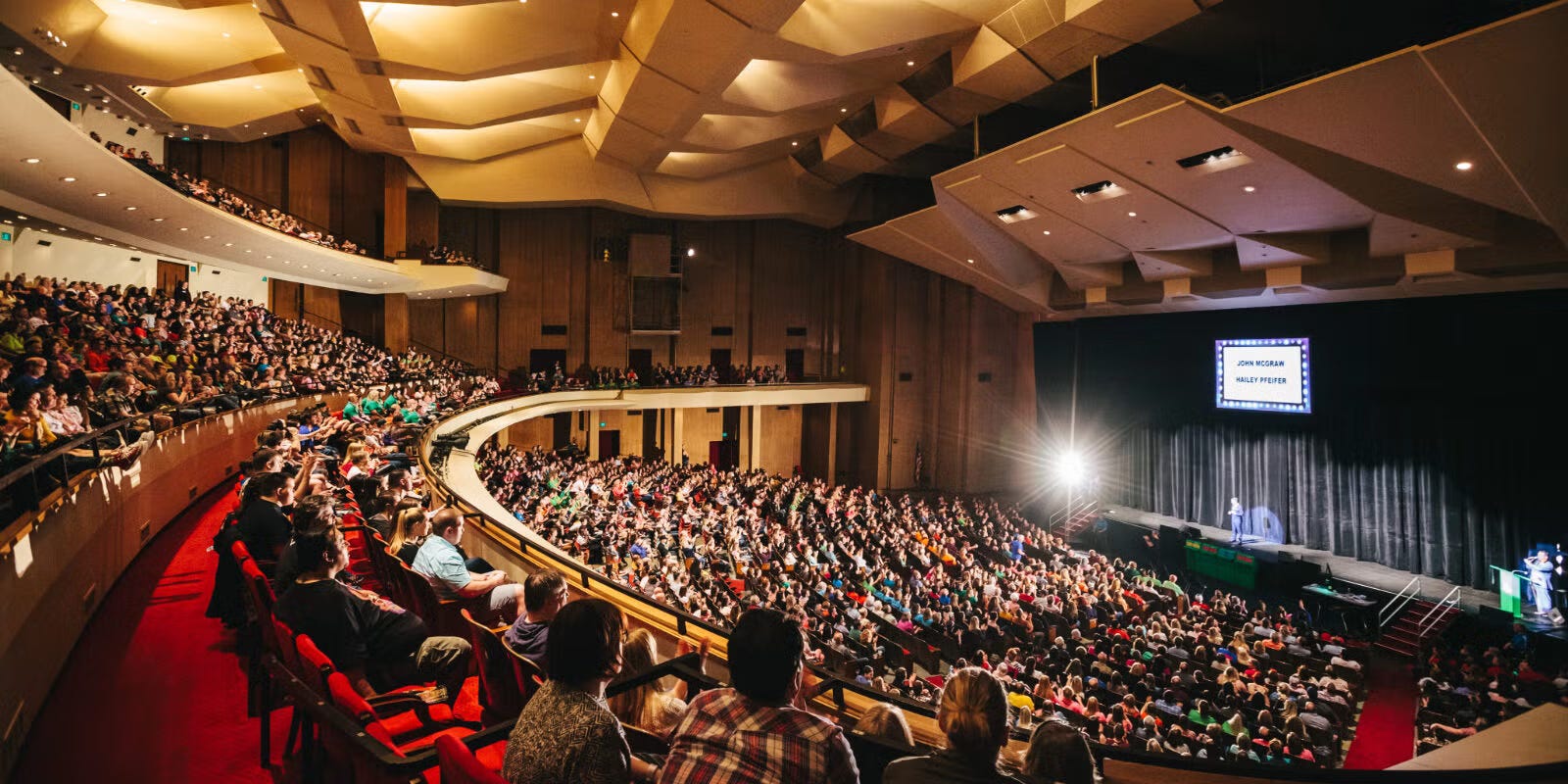
Before moving forward with the last two installments in this series, a correction is in order, based on the recent city-commissioned market feasibility study.
Our earlier sampling of Keller Auditorium usage was too optimistic. Hunden Partners reported the Keller has an average annual utilization rate of 58%. Our previous 120-day sampling suggested 80-85% utilization, allowing for move-in and move-out days. And that period didn’t include the slower summer season.
Hunden was asked to assess whether Portland could sustain both a remodeled Keller and a new Portland State University auditorium and concluded that it could not. Assuming that is true, how will the market absorb two additional privately funded 3,000-seat houses now under construction?
The study acknowledges that an additional PSU venue would further fracture the market and reduce profitability for all operators. It also concedes, but ignores, that the coming privately funded auditoriums by AEG and Live Nation will complicate the competitive landscape. Nevertheless, it recommends expansion in the form of a new 3,000-seat venue on the PSU campus.
Closing the Keller two years for renovation could interrupt Broadway Across America performances there, but city-owned Schnitzer Auditorium could accommodate BAA, at least as a temporary measure. By this summer, the 3,000-plus-seat Live Nation venue should be in operation, followed by AEG’s similarly sized facility in 2027.
The study claims local arts organizations would face hardship without a large-scale venue. Yet, if the Keller were temporarily shuttered for renovation, Portland would still have two large houses available within six months, and three within 12—long before PSU could possibly break ground. If Keller were retained post-retrofit, that number rises to four. With PSU, the total could reach five. This not only contradicts the report’s conclusion that the market cannot sustain two venues—also shown in this series—but endorses a path that could produce four or five 3,000 seat venues that defy market logic.
While the booking sample of the Schnitzer suggests that it operates in the black, that is before the Live Nation and AEG bookings disappear into their own facilities. Once they stop booking, the Schnitzer will likely fall to 50% vacancy, making it more available for BAA events during Keller renovation.
Meanwhile, the Hatfield Hall trio of stages appear to operate below 50% occupancy. The Keller is barely 60% utilized, and the rest of the city’s mid-sized inventory is significantly under-performing.
Meanwhile, Portland Opera Association has paused its next season, needing to raise $500,000 in charitable donations to resume. The POA has been retooling its seasons for at least a decade. Somehow, the public framing of the debate emphasizes protecting venue availability rather than confronting whether some resident companies can afford large houses at all.
This debate ultimately comes down to arithmetic rather than aspiration. When occupancy averages 45-58%, when mid-sized venues operate below half capacity, and when new competitors are entering the same finite marketplace, the rational question is not how to build more, but how to manage what already exists more responsibly. Before taxpayers commit hundreds of millions of dollars to another 3,000-seat hall, the city must come to grips with realities. The issue is not scarcity. It is stewardship.
The last installment examines what may be the most persistent fiction of all: the myth of scarcity.
Part II - Arlene Schnitzer Concert Hall
Part III - Newmark Theater
Part IV - Winningstad and Brunish theaters
Part V – Live Nation and AEG
Part VI – The Finite Market Problem
Part VII - The Narrative and the Myth of Scarcity

Kurt Misar is a part-time theater artist who has worked in banking, commercial real estate management and development, commercial leasing and residential sales. He is an associate broker with Capstone Real Estate Services and a resident of Goose Hollow.
Thank you for your series. Important factual information that clearly shows a new 3,000 capacity at PSU is not needed and is likely to be counterproductive.
Hopefully our elected officials are paying attention!
.
Mr. Misar’s arithmetic is sound, but the deeper problem is that the Hudson study points to a one-venue market without naming the loser. That silence has enabled the City to act as if both Keller and PSU can coexist, when the analysis itself suggests they cannot.