

In 2025, Metro returned Portland’5 management to the city, effective 2027, without stressing that theater finances will no longer be supported by Metro’s broader budget. The city must now maximize rentals, retain earnings and fund capital upgrades. Its Performing Arts Venues Workgroup’s priorities—expand usage, strengthen local arts partnerships and improve booking policies—ultimately hinge on increasing rental revenue to ensure financial stability.
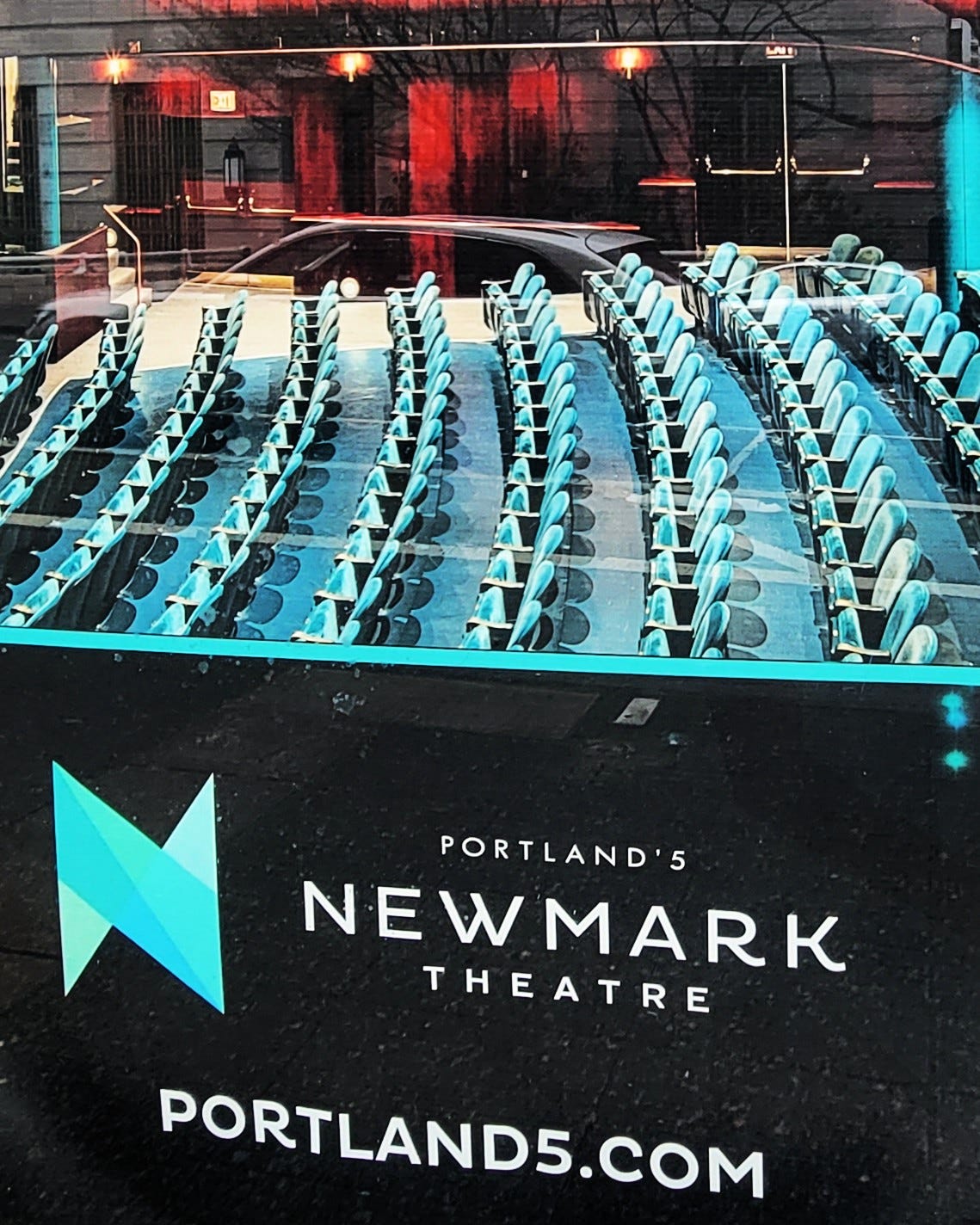
The 900-seat Newmark Theater suits mid-sized productions with moderate break-even needs, such as local dance and theater companies, stand-up comics and small musical ensembles. However, no local theater company has sufficient subscription or ticket demand to fill 900 seats over multiple performances, nor the budget to cover union-scale move-in, move-out, stagehand, actor and musician costs. Most operate in 150–250 seat venues and lack the market demand to scale up. Only about half a dozen local companies can afford to rent this space even occasionally.
In a 60-day sample, five local dance companies account for 22 of the booked days, though they do not sustain that volume year-round. The Metro Youth Symphony and Portland Opera add 10 days, and five additional events are single-night performances. Excluding possible move-in, move-out bookings, the Newmark remains dark 25 of the next 60 days. This rental sample is a close to a best-case scenario and unlikely to repeat consistently, especially in summer. The conclusion is clear: The city’s Workgroup is correct—the Newmark needs substantially more bookings and sales.
This raises a fundamental question of design and intent. Before the venue opened in 1987, what evidence demonstrated market demand for a 900-seat theater in Portland? Which well-capitalized local arts organizations with proven audiences could offer regular tenancy—and how was that need validated?
History suggests the demand was overstated. The Oregon Shakespeare Festival satellite company couldn’t make a success of a regional transplant operations there—it imploded in crushing debt. Portland Civic Theater attempted to use the space, but its finances brought about ultimate bankruptcy and destruction. Oregon Children’s Theater Co. is another that could not financially survive attempting to provide entertainment there. Local independent producers who I know likewise could not recoup investment, let alone profit. The few who remain, survive solely on charity and choose their rental dates carefully in their season of events.
Though I have not analyzed the full data, the issue appears to extend beyond one 900-seat theater, revealing a basic economic divide between local and national productions. A key factor is audience perception of quality: Many patrons assume that touring or national programs offer superior entertainment, while viewing local productions as inferior. They will pay $90–$120 for Broadway Across America, yet far fewer will spend $60 on a locally produced version of the same musical. While touring casts are equity professionals using original or replicated New York sets and costumes—and quality differences likely exist—the performance gap may be narrower than assumed. Nonetheless, audiences will not pay comparable prices for local productions, even in the same venue.
National producers can more easily absorb Newmark’s rental costs because they generate far greater gross revenue, but local companies cannot. All Portland’5 venues are union houses, requiring minimum union hires for stage crews, actors and related labor—costs equal for all producers. Most local companies do not face these union expenses in their own venues and cannot generate sufficient ticket revenue at necessary price points to cover them. This exposes a flawed city assumption: that local arts organizations could become substantial, regular lessees of this 900-seat space. They lack both the revenue scale and pricing power to sustain that level of production costs.
Of 13 productions scheduled at the Newmark in the next 60 days, six are booked by national producers—two by Live Nation and one by AEG—accounting for six of the 33 booked days in this sample. None, local or national, function as anchor tenants providing consistent volume. Roughly half of bookings come from out-of-town producers. Currently, this is the only venue of this size. If a new city-operated Portland State University theater entered the market, it would not double demand but divide it—splitting bookings between two properties and leaving both underutilized, where previously one might remain profitable.
In summary, the Newmark operates at roughly 40–45% vacancy, underperforming in both bookings and revenue. Its scale and union requirement effectively exclude most local arts companies from renting regularly or at a break-even level. Those that do rent depend on substantial charitable support, often underwriting losses, and none provide consistent, profitable lease income.
At 900 seats, the venue serves a limited market and makes profitability hard to achieve. Nearly half of recent lessees are national producers presenting single-night events—the least lucrative model—requiring higher volume to compensate for limited dates. Two of these producers, Live Nation and AEG, present additional long-term concerns for Portland’5 that remain largely unaddressed.
Taken together, current patterns suggest an increasing need for stronger management and more aggressive sales strategy at Portland’5. And there is more yet to examine.
Part I - The Keller Auditorium
Part II - Arlene Schnitzer Concert Hall
Part III - Newmark Theater
Part IV - Winningstad and Brunish Theaters
Part V – Live Nation and AEG
Part VI – The Finite Market Problem
Part VII - The Narrative and the Myth of Scarcity

Kurt Misar is a part-time theater artist who has worked in banking, commercial real estate management and development, commercial leasing and residential sales. He is an associate broker with Capstone Real Estate Services and a resident of Goose Hollow.
NW Examiner articles need to include the address of the things they are writing about.
I find this series to be very helpful, not not casting blame but for understanding the consequences of great intentions that have lead us to the place we are today in Portland and the challenges in what has been dubbed the "Cultural District". As someone who has either worked in (Big Pink) or lived in downtown Portland for the last 35 years, I have a little perspective. Given downtown's challenges today, it would be useful for our City Council to have fresh perspective. Kurt and Allan are providing it in this series for the Cultural District. I'll add a little more in the vicinity. The Eliot Tower, luxury condo, now sits on the site of the former Safeway Store, affectionately known as Psycho Safeway. It was the old "quonset hut" design and served a scattering of low income housing projects. The back side of the Belluschi designed Portland Art Museum, the anchor for the Cultural District, sat across 10th Ave from it. Safeway now sits beneath the Museum Park Apartments across Jefferson from the Eliot Tower. All of this occured in the early 2000s, spurring the expansion of the Art Museum into the Mark Building. Both low income and market rate housing has been built in immediate proximity to the Cultural District, including the St James and St Francis apartments, the Jeffrey, Sky3 and the Ladd, bolstering affordable housing throughout the southwest corner of downtown, abbutting 405 and PSU. The Street car runs through it. Max is 3 blocks away. It is a highly accessible and diverse neighborhood, demographically and economically. It has some of downtown's most important attractions and historical buildings, including some remarkable legacy churches. The problem; not enough visitors. The reasons for this are many, and include both perceptions about and the reality of public safety concerns, especially in the late evening and night in downtown. Another concerns our failure to maintain and adapt existing entertainment venues to changing times and resources and Portland's attraction to "shiny new objects" rather to maintaining and adapting those it has first. I think we see those playing out in the story here, and I can't wait to get to the ending.