


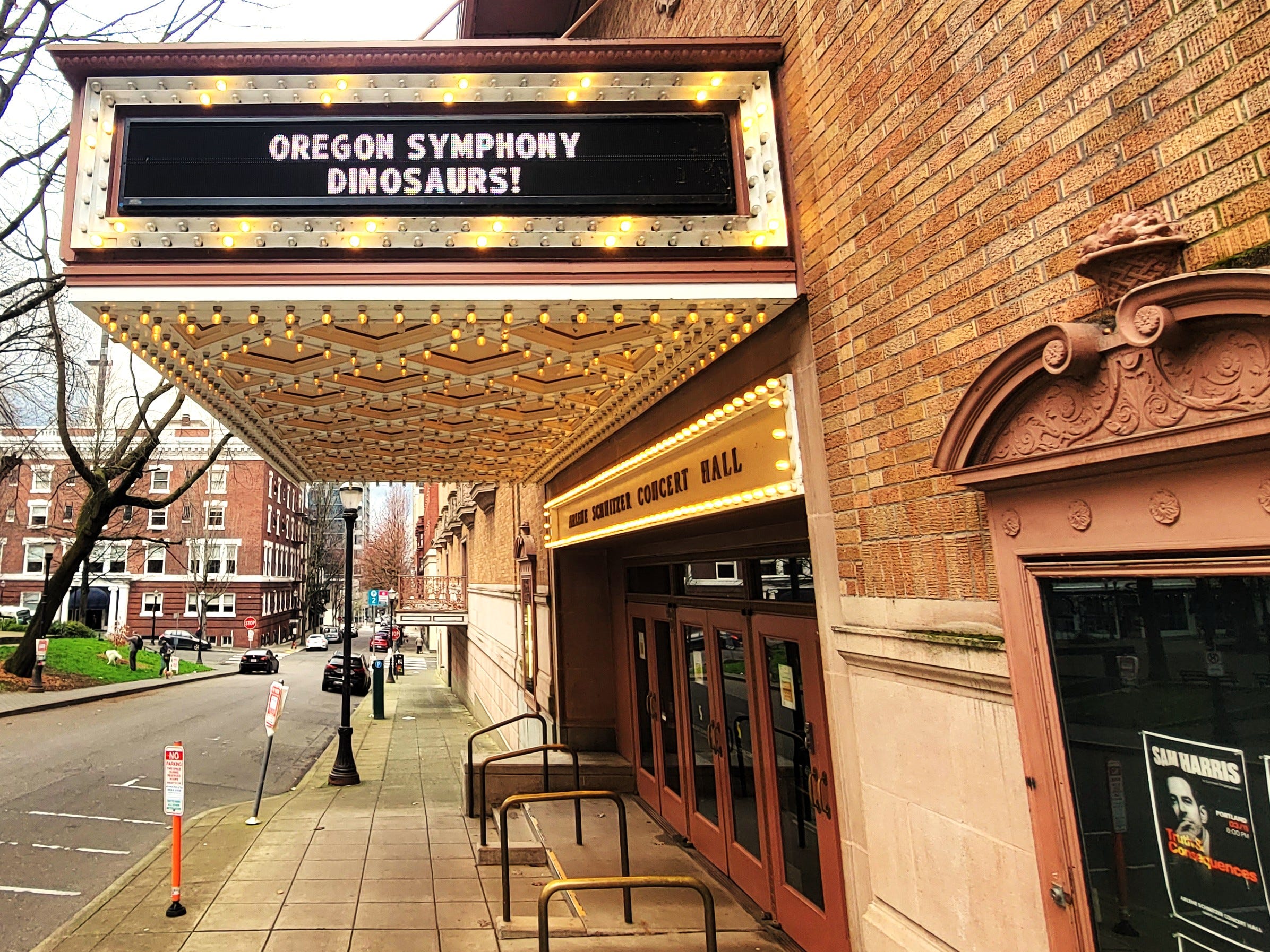
Last year, Metro chose to divest management of Portland’5, returning it to the city in 2027. That means the theaters’ profits and losses will no longer be blended into Metro’s broader finances. The city will again be responsible for aggressively maximizing rental income, retaining earnings, and preparing for aging-related capital upgrades.
Creating the Performing Arts Venues Workgroup, the city’s key short-term recommendations are: expand usage to increase revenue, strengthen engagement with local arts groups and improve booking policies to boost rentals. Increased rental sales and income will become central to Portland’5’s financial stability.
ARLENE SCHNITZER CONCERT HALL
Understanding the Keller’s severe rental customer limitations and plans to shutter, as well as potentially losing a vital anchor rental tenant, be assured that the Portland‘5 Schnitzer Concert Hall is another 3,000 seat venue. If stage size, technical specifications and load-in can accommodate them, Broadway Across America could go here. Thankfully, the Schnitzer isn’t exactly empty. Over the next 60 days, about 17 days (25% of all rental dates) are not booked. Some of the dates might be needed for move in-move out, but the events aren’t big productions needing many moving days.
They have an anchor tenant—The Oregon Symphony. They’ll be in there six times (13 performance dates). Another 25% of all the bookings there are coming from Live Nation and AEG Entertainment. This is useful diversification, offering less chance that the venue could fail economically if one tenant were to go bankrupt. Bookings will decline during the summer season.
It will be too busy, however, to accommodate Broadway Across America. So what do they do when the Keller closes for retrofit? The proposed Portland State University development would seem to have a role. But what happens to the financial sustainability of PSU’s property when that lone anchor tenant returns to the Keller after two years in reconstruction? (Assuming they want to go back. If not, then how does the Keller avoid bankruptcy?)
There is another option. Is it possible that some of the Schnitzer bookings—say all the stand-up comic, single instrumentalists or small musical ensembles—could get booked into the Newmark Theater? Naturally, that would depend on whether those artists and producers were willing to reduce gross sales opportunities from a 3,000-seat property to a roughly 900-seat venue.
This isn’t a bad idea, since the other Schnitzer anchor tenants are Live Nation and AEG Entertainment. Both book about 25% of all the acts in this venue, and acts of this size are their primary product. So, there may be reason to push more of their acts out of a 3,000 seat house into the smaller Newmark. For a lone comic with a traveling set, simple lighting and sound demands, more dates in a smaller venue can pencil out equal to a single date in a larger venue.
The Arlene Schnitzer Concert Hall might endure some lost booking sales when the Keller shutters for retrofit. It could use some bookings in the 17 open dates in the next 60 days. Drawing more single-date events into the Newmark might give the Schnitzer flexibility in accommodating lost tenants during a rebuild of the Keller.
In the meantime, more than 50% of all Schnitzer bookings rest solely on the needs of three anchor tenants, the Oregon Symphony, Live Nation and AEG. One can assume the Oregon Symphony is in better financial condition than the recently shuttered Portland Symphony Orchestra, but in future installments, we’ll discuss how Live Nation and AEG will cause some Portland’5 problems no one is yet talking about.
Part I - THE KELLER AUDITORIUM
Part II - THE ARLENE SCHNITZER CONCERT HALL
Part III - THE NEWMARK THEATER
Part IV - WINNINGSTAD AND BRUNISH THEATERS
Part V – LIVE NATION AND AEG
Part VI - AN UNHEALTHY THEATER INDUSTRY
Part VII – THE ARTIST REPERTORY THEATER DEBACLE

Kurt Misar is a part-time theater artist who has worked in banking, commercial real estate management and development, commercial leasing and residential sales. He is an associate broker with Capstone Real Estate Services and a resident of Goose Hollow.

Kurt, this is like waiting for the next drop of a Slow Horses episode on Apple. I hope there is not a week between episodes going forward, because this dialog needs to start among the public and get from them to our elected officials, because they seem to be oblivious to reality (unlikely for most) or they have their own ulterior motives for keeping the public in the dark. Thanks you for laying out the reality Portland faces so we can demand our elected officials develop strategies to live within it. We are so entranced with the next shiny object of with maintaining a pre-pandemic vision of what Portland was becoming, that we just have no impulse control. WE hsve to set clear priorities for bringing Portland back to life, starting in the Central City where the bulk of the infrastructure is focused and built around getting to and from. We need to focus on growing "export income", revenue that comes from businesses, events and visitors attracted to them and deposit revenue by buying things, eating in restaurants, seeing shows, visiting sports events and regular celebrations and leave that behind when they go home to another jurisdiction. We need to think outside the box to do that so we can do it while living within our means.
It will likely mean a sales tax is in our future, but that will mean wholesale tax restructuring in Oregon. The politicians know that, but that is another thing they are afraid to talk about.