

by Kurt Misar
With the city of Portland assuming management of Portland’5 in 2027, theater finances will no longer be supported by Metro’s broader budget. Making them self-supporting will not be easy.
Winningstad Theater
Each theater in Hatfield Hall and its three theaters, serves a distinct niche. The Newmark is a traditional proscenium with little flexibility between stage, pit, and seating. The Winningstad, by contrast, was designed for adaptable use, including thrust staging with audience on three sides, though that flexibility is seldom used. It seats about 300—close to the 150–250 range most local companies prefer for economic viability. (The Armory Mainstage seats up to 560 but does not fill it consistently and Artist Repertory Theatre’s proposed new mainstage would seat 178.)
The Winningstad, flexible or not, primarily serves local companies without permanent homes and small touring acts that don’t require large revenue to break even. Local groups need this smaller venue due to their modest ticket sales and pricing.
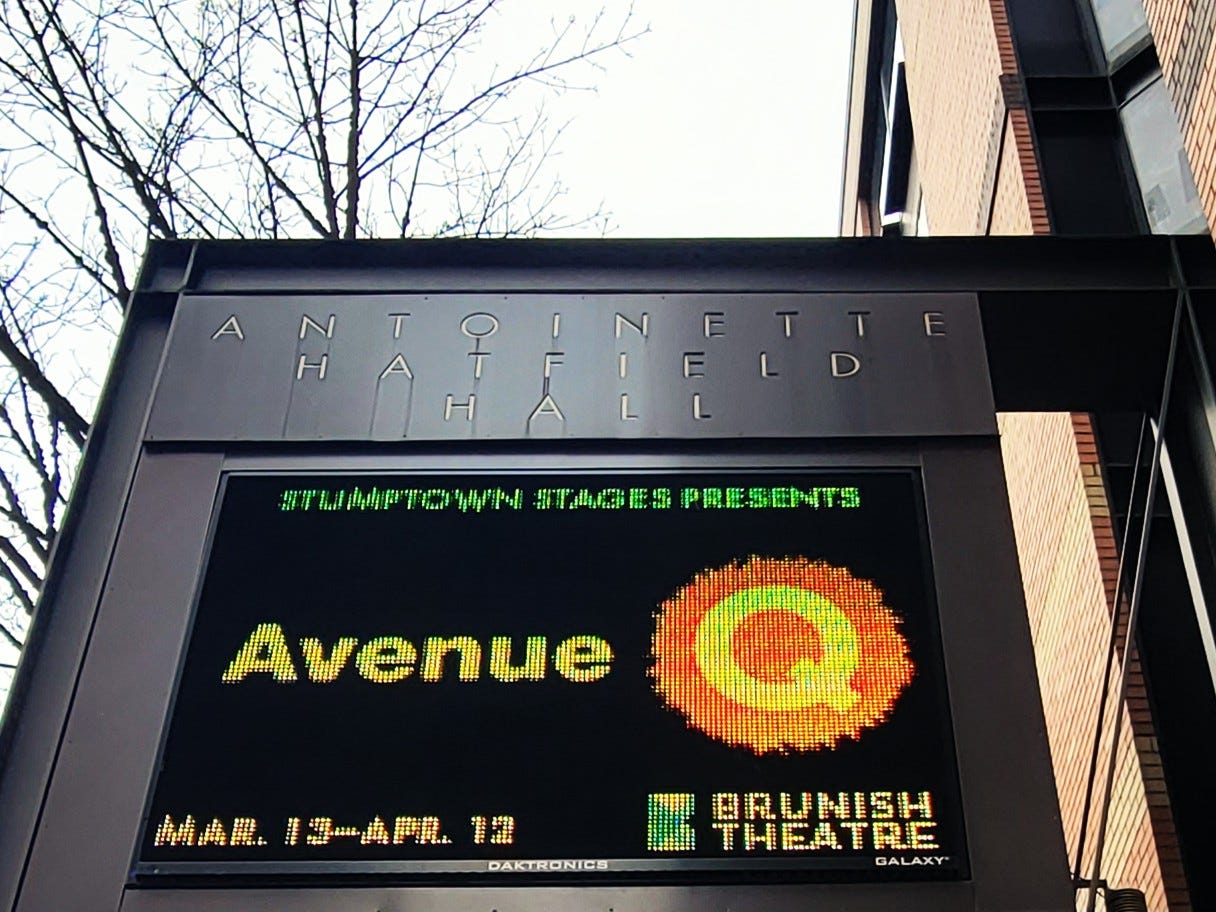
In a 60-day sample, two single-performer events booked one day each, a traveling magician duo books two days, and Stumptown Stages ran a 23-day musical—for a total of 27 booked days out of 60, leaving more than half the dates unfilled. Only four rental days at the Winningstad were booked by national producers
Stumptown does not publish prior venue data but advertises Hatfield Hall as its home, implying anchor status. Assuming five shows running 25 days each in 2025–26, it booked 125 dates across the three stages (including Winningstad and Brunish). Without Stumptown’s current 60-day Winningstad run, the theater would be dark 56 of 60 days. Without Stumptown, the stage would be effectively bankrupt.
Brunish Theater
This theater is essentially a large box with seating akin to movable bleachers for about 145 seats, suitable only for flexible but limited-production events. It is the least expensive of the five to rent and generates the lowest gross sales by seat count.
In a 60-day sample, Stumptown Stages occupies roughly 30 days, and Portland Shakespeare Project rents one day. Both present small-cast, simple-set productions to control costs. Like the Winningstad, the Brunish is operating annually at under 50% capacity and is significantly under-rented.
Stumptown’s rentals are split between two, possibly three, stages. Typically, Stumptown books 50–60 days per year in either the Newmark or Winningstad and 75–90 days in the Brunish. For the Winningstad and Brunish, their largest tenant occupies about 60 of 360 days in one theater and 90 in the other—by any measure, not enough to anchor their financial viability.
Currently, the financial stability of the aging Winningstad and Brunish theaters rests largely on local arts companies operating under substantial financial risk. At more than 50% annual vacancy rate, these stages cannot generate sufficient income for operations, maintenance, repairs and capital upgrades without city subsidy.
How long can this continue? The city’s Performing Arts Venue Workgroup clearly recognized this dilemma in its stated management goals.
And wait ‘til you hear the rest of the story.
Part I - The Keller Auditorium
Part II - Arlene Schnitzer Concert Hall
Part III - Newmark Theater
Part IV - Winningstad and Brunish theaters
Part V – Live Nation and AEG
Part VI – The Finite Market Problem
Part VII - The Narrative and the Myth of Scarcity

Kurt Misar is a part-time theater artist who has worked in banking, commercial real estate management and development, commercial leasing and residential sales. He is an associate broker with Capstone Real Estate Services and a resident of Goose Hollow.
Thank you for this interesting and informative series. I have one comment: lack of adequate advertising at actual venues! My spouse and I are in Portland once a month for a week, parttime residents, our condo is literally around the corner from P5 and it’s not apparent what’s going on there at any given week ( unless you have ten minutes to stand there watching their one slow digital monitor).There is no information outside the building and the building is closed most of the week! They make it very hard to seek passive information or inpromptu tickets walking by, IRL.
-Two cents