


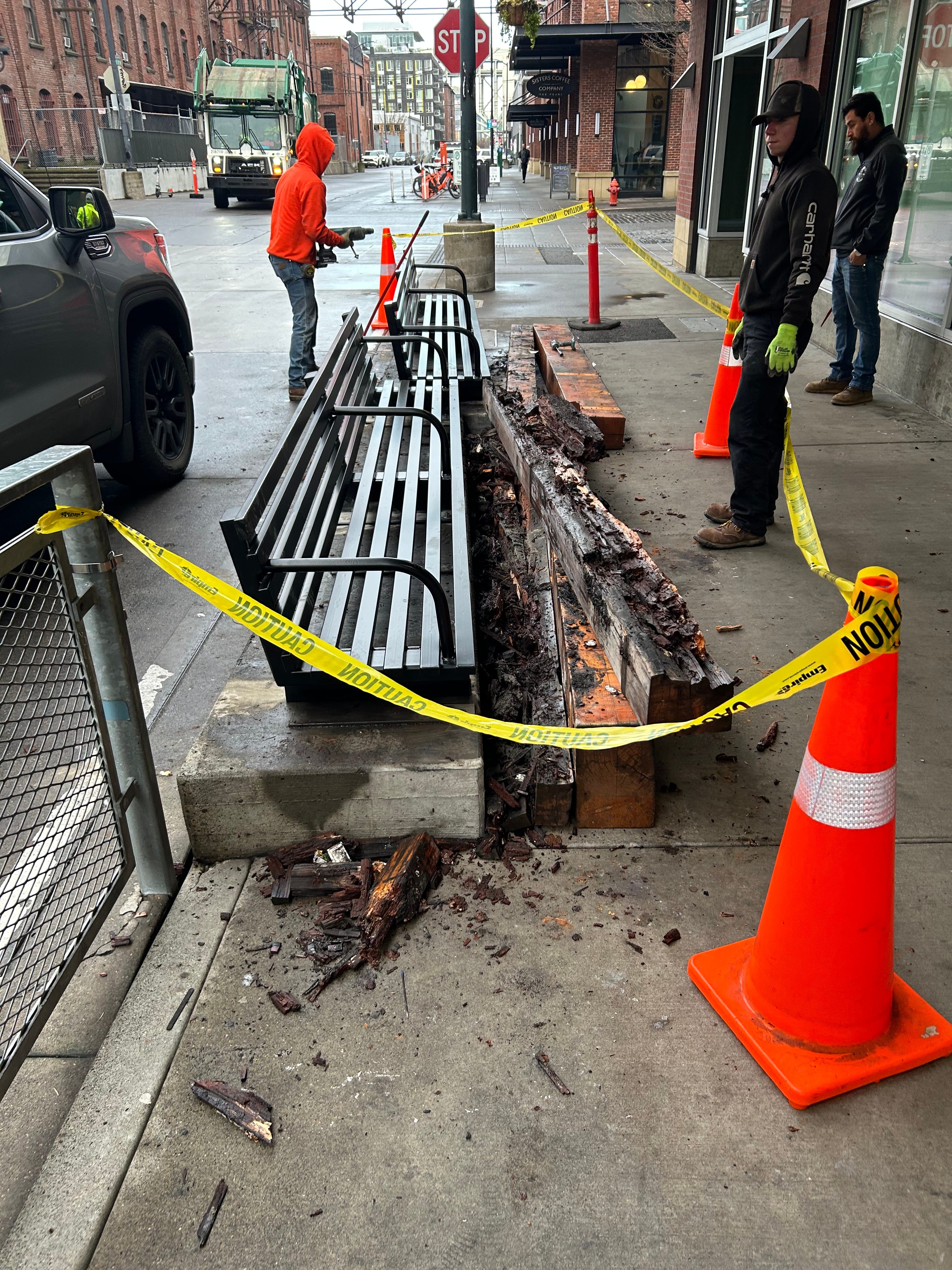
The Pearl takes a beating. Just ask the bench located on the west side of the Asa Flats, near the corner of Northwest 13th and Marshall. If this bench could talk, it would tell you stories about how it was set on fire and charred to a crisp one crazy night, then left to smolder.
Who knew livable, lovable Portland would become this hard?
Benches ought to be nice public places where a pedestrian can grab a quick rest, or tie their shoelaces. A place where old ladies and men can organize their shopping carts, or nearby Safeway workers can take a well-earned 10-minute break.
But this bench has been occupied by dealers and addicts to become a near constant gathering place for people engaging in activities that are the hard new Portland’s normal. Things some of us spend more time thinking about and looking at than is probably recommended. Don’t you wish you couldn’t see all the stuff strewn on the ground, like the to-go food containers, plastic utensils and empty ice cream and yogurt containers that make fentanyl withdrawal better. Don’t you wish you could stop memorizing all this stuff?
Lots of us have watched HBO’s “The Wire” or read “The Corner,” the book about the Baltimore drug trade that inspired the HBO series. It started as a newspaper series in the Baltimore Sun written by David Simon.
It seems like it would be so simple for the police to take a cue from that show and put a camera or bug under the bench. Or install a camera across the street at Sisters Coffee, a few feet and a world away. After all, we all have little cams so we can see what our pets are up to when we’re away at work.
After the bench was burnt to a crisp, it was replaced by an indestructible-looking metal bench and anchored to the same spot.
But now that bench is gone, too.
Presumably no kind of bench can live on this street.
The bench is a symbol, but the deeper problem lies beneath it. Cities have always faced disorder. What feels different now is the possibility that elements within the governing and nonprofit apparatus tolerate this level of degradation because it aligns with their ideological commitments.
By ideology, this means a governing mindset that treats enforcement as inherently suspect and visible disorder as morally secondary to larger structural injustices. In recent years, Portland has leaned heavily into a harm-reduction and decriminalization framework. In theory, this approach seeks to reduce incarceration, avoid criminalizing addiction, and acknowledge systemic causes of poverty. Those are legitimate concerns for some citizens.
In practice, however, that mindset can evolve into a reluctance to impose boundaries in public space. When minimizing coercion becomes the overriding value, ordinary civic norms — such as keeping sidewalks passable or a bench usable — cease to be actively defended. Disorder is reframed as an unfortunate but tolerable byproduct of compassion.
An institutional ecosystem reinforces this orientation. Many NGOs are structured around outreach, housing navigation, and harm reduction; restoring order in public space is not their mandate, and some explicitly resist enforcement as counterproductive or unjust. Bureaucracies often default to process, pilot programs, and equity language rather than decisive action. Elected officials operate within and respond to that framework.
The result is not necessarily bad faith, but a hierarchy of values in which minimizing state force ranks above maintaining visible civic order. For residents who depend on shared public spaces, that hierarchy can feel inverted.
There is also a transparency problem. Many of the policies and programmatic choices that shape this environment — de-emphasis of enforcement, contracting models for services, siting decisions, prioritization frameworks — are developed within bureaucratic and nonprofit ecosystems that most residents neither see nor meaningfully influence. The language surrounding them is often abstract and process-heavy. The practical consequences, however, are concrete and immediate for the neighborhoods that absorb them.
It is difficult to imagine that a clear majority of Portlanders would affirmatively vote for a city in which parks are unreliable, sidewalks function as encampments, basic street furniture cannot survive, and everyday public order is treated as negotiable. Yet that is the lived reality in many areas. The disconnect between policy formulation and lived experience creates the suspicion that widespread decay is not merely a failure of capacity, but the predictable outcome of decisions made without broad democratic consent.
The issue is not compassion versus cruelty. It is whether a city regards public order as a public good worth defending — and whether officials are willing to act on that belief.
Yes, it’s pathetic that the Pearl now has to be further and further “drug proofed”, meaning our common areas that we tax-paying residents fund, have the amenities stripped away so they aren’t used criminally or destroyed over and over again. This includes benches, parks, drinking fountains, bike racks, newspaper receptacles, even the electricity that lights the trees in winter.
This doesn’t even touch on the inherent safety and sanitation problems that we now deal with daily just trying to live in our own neighborhood. Does anyone else hear people screaming EVERY night now and randomly throughout the day? We’ve somehow just accepted that we must try to function within what amounts to an open air asylum at this point. And we get to pay top tax dollar to do it!
Is everyone tired enough of it yet to vote all the current enabling grifters out of their government positions?