


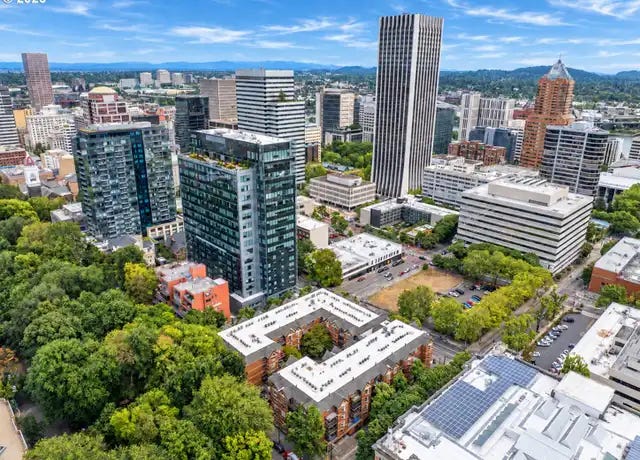
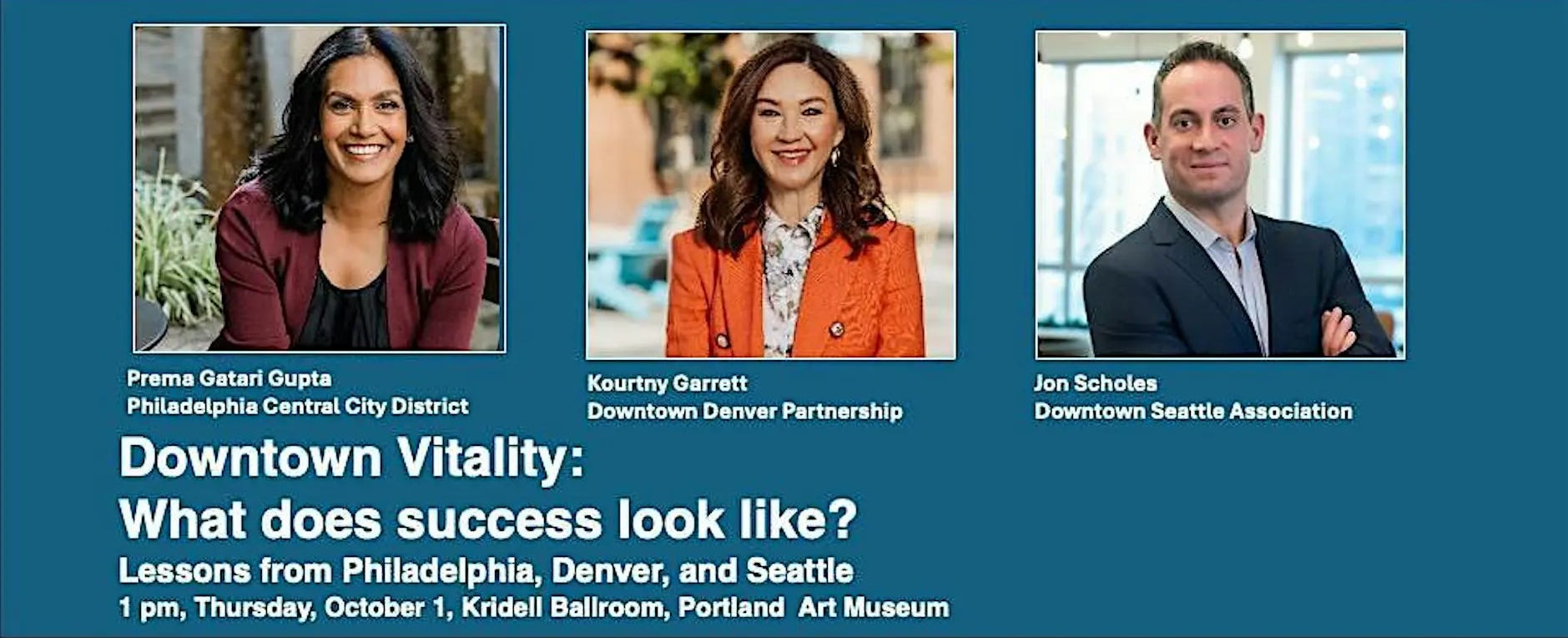
I attended an event last week sponsored by Revitalize Portland and Design Portland, among others, focused on revitalizing Downtown Portland. Mayor Keith Wilson kicked it off with a pep talk, but the presenters were the leaders of three downtown associations from other cities who share similar problems: Denver, Philadelphia and Seattle.
All are trying to revitalize their downtowns with more housing—especially affordable housing—along with activation of existing office space. All share a homeless problem exacerbated by drug addiction and psychosis and general post Pandemic livability challenges. All are liberal cities. But all three have much more financial and business support than does Portland due to more robust economies. Denver and Philadelphia have good public/private collaboration.
My initial takeaways were: Public/private alignment is needed for acceleration of improvement. Denver and Philly have this; Seattle does not but has made up for it with a very strong and established downtown business organization, the Downtown Seattle Association (DSA), established in 1958 when Interstate 5 was being built through downtown.
The audience got a good laugh from the speaker's joke about the DSA (Democratic Socialists of America) getting so much national attention these days. It sounds like Seattle shares Portland’s political dysfunction but compensates with a far stronger downtown business association, representing a bigger swath of the central city.
All three focus on public safety, cleanliness and activation in their downtowns. In all but Seattle, the alignment is good and somewhat formalized. Seattle uses referendums have been used to get big projects done. Seattle is the only one that already has a large downtown residential population (where one in eight city residents live), though much of it is concentrated in Bell Town and South Lake Union north of the Central Business District. Downtown housing growth has “fallen off a cliff” post Pandemic for many of the same reasons it has in Portland. Both Philly and Denver are actively converting office buildings to residential use. Seattle, like Portland is constrained by seismic obstacles where Denver and Philly are not.
All are worried about older office buildings without any obvious apparent reuse. These will sit vacant for years without very deliberate public/private efforts to initiate change. But the other three cities have a plan and well-developed organizations established. Portland is just starting.
All have used weekend activation to increase foot traffic overall, but all are struggling with midweek visitation and have targeted strategies to help: building or planning stadiums and cultural venues downtown, targeting office and retail tenants, coworking, creating revitalized pedestrian shopping experiences and parks built for activation with intentional activation a key element of the planning process.
Denver has turned its major shopping street, which was suffering, into a pedestrian-only promenade with public activation opportunities and is actively experimenting with other areas. They try things, such as pop-up stores and subsidized anchors, such as neighborhood markets. Both Philly and Denver are tackling behavioral health issues head on. Denver has placed over 3,000 addicts into housing after treatment to ensure they are ready for it.
All are coordinating between state and regional and local efforts. Denver is not trying to poach business from the suburbs, but rather to attract it from outside the state, including Oregon. They aggressively recruit, poaching for the kinds of business they want to see in the state. State policies are designed to help local governments and especially central cities, which are the center of expansive transport hubs, gain traction. In short, they recognize that their state and cities are in competition with every other state and city. Oregon and Portland don’t seem to get that.
All are working at streamlining the permitting process. Denver seems further along. They have eliminated design review and have set a specific 180-day target for permit approval.
Obstacles to overcome
This tells me that Oregon generally and Portland specifically,have some obstacles to overcome, none of which alone are sufficient in themselves to encourage housing production immediately, but all of which are likely necessary for the revitalization of Portland’s Central City. Some are easier to resolve than others. All require us to work on them.
The private sector is not going to build housing for a shrinking population, especially when the population that remains and/or is replacing those who depart cannot afford housing at the inflated cost it takes to build it today. And affordable housing is even more expensive to build than market rate due to unit size, durability requirements and financing costs. Construction costs have risen dramatically since the Pandemic for macro and micro reasons, with plenty of blame to go around. To turn this around will require policy changes at every level of government in our state as well as federal assistance, which is shrinking and currently counterproductive. It is notable that rents in affordable apartments today are about equal to the existing market rate apartments downtown. We cannot build our way out. We need to grow a population that can afford what can be built.
The recent rise in interest rates, driven by the bond market and the growing national deficit, is making the cost of borrowing much higher for those who want to build housing of any type. That includes governments, individuals and developers and not for profits. It also shrinks demand by limiting those who can afford the housing that is built. We may need to rethink the size of the housing we expect to live in if we want to house people.
The high prices of buildings are “sticky” and values are inconsistent with market realities. Investors and individuals bought high and financed at low rates before or during the Pandemic. It is a long process that forces those properties back onto the market through the need to refinance, foreclosure or death of an owner. Many owners are still in denial that changes are permanent.
Lack of certainty. All of us value certainty or some reasonable basis for predictability, especially developers, lenders and investors, as well as governments. We are in an unprecedented period of anomie with the roll-out of AI, the growing realization that climate change is real and its effects are significant and growing, MAGA policies changing the world order, the surprise Iran War, the demise of our democracy and an uncertain election. Add to that, the local inability of Portland government to adjust and set a direction due to a deadlocked City Council, a new form of government and a Portland city staff trying to adjust to that new form of government. We are unable or unwilling to do some of the things Denver and Philly have found success with, even if conditions were right.
Lack of a plan. The Downtown Recovery Plan is being worked on with a lot of energy and by competent people, but it is being second guessed at every step of the way. Hopefully the upcoming election will help mitigate that and “our DSA” will no longer be able to place a roadblock to any meaningful progress toward overcoming these obstacles.
Lack of political willingness to deal with the public safety and homelessness issues in a meaningful way. That means getting those addicted into treatment and sober housing they are ready for—as Denver has—and to get people ill with psychosis into treatment and ready for housing—either in suitable supportive housing or an expanded functioning State Hospital—so they, their families and society remain safe.
Lack of adequate community policing in the downtown and central city, where the most productive, diverse and integrated segments of our society live, mingle, work, recreate and participate in communal events designed to bring different communities together. It includes a safe public transit system and internal ways of getting around, such as the streetcar. This is clearly missing today and should be a relatively easy fix that Portland has control over.
We know Portland Downtown’s attractive features; nice scale (making for a walkable city) with some very attractive architecture and parks and an underutilized waterfront, cultural amenities and an exceptional art museum. Add to that a pioneering public transit hub with the investment in right-of-ways, and the fact that we sit at the confluence of the Willamette and Columbia Rivers in one of the most beautiful states in the nation. Sadly, we have not maintained or built upon these assets, and the state has not stayed competitive with policies to attract the businesses so we can have the kind of jobs we want while protecting the unique beauty of our state. We have not fully activated the assets we have to bring in more midweek visitation. And we don’t even require our publicly funded workers, our so-called “public servants,” to occupy the very nice offices we have built and maintained for them Downtown.
Conclusion
The demise of downtown is a golden opportunity to create a safe and economically and culturally diverse 24-hour city. Portland was approaching that pre-Pandemic. Now we must rethink how to get there without the over-reliance on office workers for weekday activation. We need to see this as the opportunity to create a more vibrant city where people of all economic and cultural backgrounds can live, work, play, learn, recreate, dine, seek services and be entertained in a clean and safe and livable environment with agency for each. We need to start now.
We have a mayor in Keith Wilson who is dedicated to that and has tons of optimistic energy. We have a city manager dedicated to making the administration of government more efficient by streamlining functions. We have a new 12-person City Council that can represent different issues in previously marginalized groups and ensure that all are considered in necessary compromises.
Let's set the stage for recovery. Housing growth downtown will help ensure its recovery and Portland’s recovery by helping disadvantaged individuals recover. recovery overused To do this we need the council, mayor and city administration aligned and working to stay aligned with the state and county so we are all pulling in the same direction. Let's start with this upcoming election.
Richard Perkins describes himself as a recovered heroin addict, felon and a retired and recovering commercial bank executive who finds purpose later in life as a behavioral health activist.

Thank you Richard.
For me the challenges ahead are highlighted by these observations:
Each city has a Democrat Party mayor and each state has a Democrat Party governor
The state education rankings:
CO is 9th
PA is 22 nd
WA is 32nd
OR is 44 th
Real change is required