



Portland’s public housing system is broken, and the people closest to it are well aware of its failings and the burden it places on surrounding neighborhoods.
Their conclusion: Keep building more projects and hope forces outside their control tackle the inscrutable affordable housing crisis.
That was the takeaway from an intense exchange last month between five HomeForward managers and the Pearl District Neighborhood Association board, a meeting necessitated by a subject almost beside the point: the design review requirement woven into Central City projects.
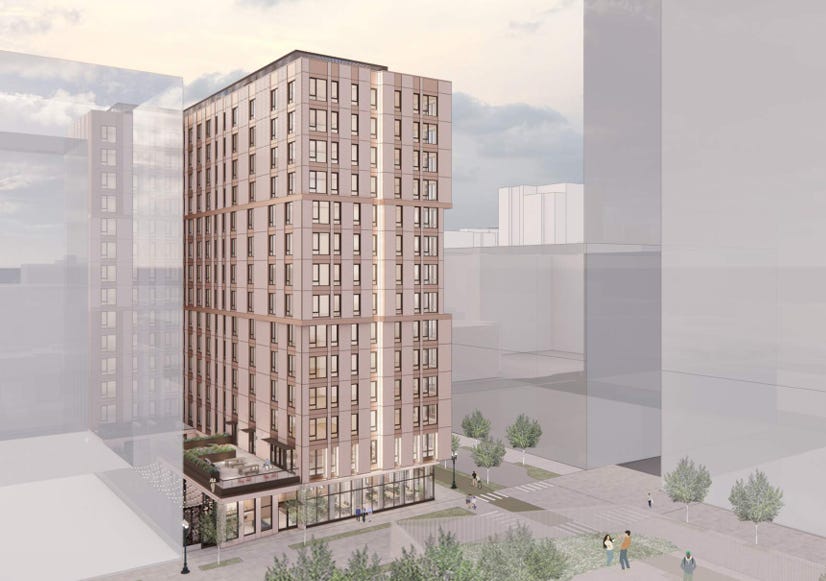
HomeForward is proposing a 14-story, 229-unit apartment building at Northwest Ninth Avenue and Johnson Street on the former U.S. Postal Service property, and the agency must engage the neighborhood association in discussion about its plans.
Portland’s housing agency brought a team to the Sept. 10 meeting, where for nearly an hour residents battered the delegation with questions and criticisms on topics having no easy answers.
It’s not the building’s size, style or configuration that bothers the locals: It’s the thought of one more HomeForward building in a district with three others that bring unmitigated social and economic problems to a neighborhood once considered a model of urban vitality.
Jonathan Trutt, director of development for HomeForward, was asked to justify spending $700,000 per unit to build low-income housing, more than twice the cost to construct market rate homes. Furthermore, why is the agency pushing ahead when it owns 900 vacant units in the city?
Trutt ticked off a list of special circumstances boosting construction costs—such as higher-quality materials meant to last for generations, higher per-unit costs for small units and the lack of staging areas around infill sites.
“There is a cost difference,” Trutt said, “but it’s important to get at the assumptions we’re bringing into it.”
“I get that,” said PDNA President Bruce Studer, “but here’s the facts in the neighborhood: You’ve got Pearl Court—Home Forward property—a shit show. You’ve got Lovejoy Station, another shit show. And then you’ve got The Yards, which is another one.”
Studer said Pearl Court “has tainted one of the jewels of the Pearl, which is Jamison Square, to a point where I don’t know if it can recover. And I guess we’d be more enthusiastic if you guys had a plan to fix that.”
Pearl homeowners are feeling the pain in their pocketbooks.
“[Your projects] drag down our property values,” Studer said, “and people are leaving. … We were down 25% in property values in the last four years, while the rest of the city was either plus or minus 5%. … Condos are selling for what they sold for in 2008, and it’s because they’re sitting next to places like yours.”
“I agree,” Trutt replied to criticisms of HomeForward’s impact on the Pearl. “I have been in the affordable housing world for 25 years. I worked for a nonprofit, and now I’m here 10 years. … I have been saddened—shocked—to see what has changed, and it really has changed in a very fast way in the last three years for affordable properties throughout the region.
“So, the challenges are real. The barriers for your average person who moves into one of our buildings of being a successful tenant are higher than they were 10 years ago.”
Evicting drug users or problem tenants is beyond difficult, he said, with little support from the police or courts.
“There are problems, and we are working to address them,” Trutt said.
“Not fast enough,” said Bill Truncali, chair of the PDNA Parks Committee. “I live next to the Pearl Court. You guys are doing a terrible job. Terrible.
“Don’t pander to us about what you’re going to do, because you’re not doing what you should be doing now.
“I am appalled that they gave you guys this contract, based on what we’re dealing with now,” Truncali added, referring to the team of HomeForward and Holst Architecture that won a competitive bid to fund the project.
Project architect David Otte, a principal at Holst, said low-income housing has become increasingly difficult to manage.
“There is a very large difference in the acuity of folks that are trying to succeed when they have 30% or less area median income. HomeForward provides a disproportionate number of those units across the city. For the hardest folks to serve, you don’t serve them very well if you’ve got a drug dealer sitting right next door.”
Vacancies abound
A new problem has arisen in recent years. Amid a shortage in affordable housing, HomeForward cannot find enough qualified people to keep its apartments filled.
“I believe you’ve got a lot of vacancies,” Truncali said. “Why aren’t you working on getting those filled first before you [build more]?”
T.J. Norton, asset manager at HomeForward, answered.
Lovejoy Station rents to households having 70-80% of area median income, and current rates are “way above what a market rent unit would even cost,” Norton said.
“So we’re offering three-month rent concessions, which would equate to what someone would pay for a 60% [AMI level]. We’re still not seeing that much [rental demand], so we may have to go more than that.”
Occupancy at Pearl Court is 62% of capacity, he said.
“The reason why Pearl [Court] is like that is because the financial structure has caused us to not be able to pay for managed return units [units so damaged they cannot be occupied]. We’ve now addressed that issue, and we should expect that to be improved. The goal is to have Pearl at 85% occupancy by Jan. 1 and then to 95% April 2027,” Norton said.
That makes no sense to Truncali. “This new building is going to have 200-250 units,” he said. “Why are we spending $700 million on a new building when we’ve got 900 units that are open? This is insanity.”
And if they were built, would they introduce more social problems than they relieve? That’s what many neighborhood representatives have seen.
Brendan Jamieson, a PDNA board member who lives at Lovejoy Station, said it used to be different.
“When I moved in in 2004, there was a waiting list,” he said. “I was so happy then. … Jamieson Square was the garden of the Pearl District. I used to take my children there. I won’t take them there now.”
It’s no mystery to him as to why HomeForward units sit empty.
“I don’t know how you’re going to get people in our properties if they look terrible,” he said.
Jamieson joins the PDNA’s Team Pearl on its almost daily patrols of the district, observing continual problems around the square.
“I believe that came directly from Pearl Court,” he said. “What happens inside the building is reflected directly outside.
“Brian [Harvey, a PDNA board member who lives in The Yards] and I had to form tenants’ unions in our properties, and then form a coalition so we could get HomeForward and the management company to sit down with us. We’re spending hours and hours and hours trying to get things [moving.]
“It’s made a huge difference,” he said, “but the resistance has been massive. It’s just massive. It’s like pushing a rock up a hill.”
As for the proposed HomeForward building, Jamieson has no quarrel with its size or design.
“I think the building looks great,” he said. “The problem is how it’s managed, who’s in there and what goes on [inside]. That’s the broken system, and that’s the system that has to be fixed, in my opinion, before something else happens.”
Have to build
Otte took in all the comments, but deflected blame from the players in the room.
“We have a systemic problem with affordable housing in our society,” he said. “This is not HomeForward’s fault. I’ve been in meetings [with the Seattle Housing Authority] where they get the same treatment and the same accusations from the neighborhoods there. … I’m sorry, but it is a broken system.
“And it is very difficult to place that blame on these individuals that are trying to do good work. We have to keep building. We’re half a million units short of housing in this state over the course of the next decade. We have to keep building. We also have to fill vacancies. We have to do all of these hard things at the same time.
“This is not because Jonathan and Julie [Garvey, director of property management for HomeForward] aren’t doing their job. They’re doing their job the best they can. They’re operating within constraints that are very difficult to overcome.”
After the HomeForward team left the room, PDNA board members continued to ruminate.
“I know we have no control over this—this is going to get built—but I personally feel that the board should take a position on this so we’re at least on record,” Truncali said.
“They’re building something because they can’t stop, for some reason,” Jamieson said, “and the compelling argument was that, ‘If we don’t do it, then all of these tax credits that belong to Oregon we won’t get back.’ It’s complicated, but to me, that’s not the argument. I would like to see a pause on this project.
“We’re having very successful town halls. Could we do a town hall regarding affordable housing at the Armory and bring in some real players to talk about what’s working, what’s not working?”


I am so impressed with the quality of the responses to this article. No rash, off-the-hip quotes. Plenty of analysis based on real-world experience. Public agencies tend hire expensive consultants to tell them what they want to hear instead of listening to people who know the community and something about how society works.
Howard Husock makes a useful distinction in America’s Trillion-Dollar Housing Mistake between people who are economically poor and people whose behavior makes them difficult tenants or neighbors. The two are not the same. Many low-income and working-poor households are responsible tenants who simply cannot afford market rents.
That distinction seems directly relevant here. Some tenants—particularly people dealing with active addiction, severe instability, or the early stages of recovery—may need more structured housing, closer supervision, treatment, or supportive services before they are ready for fully independent tenancy. Placing everyone into the same housing model does a disservice both to those who need more support and to responsible low-income tenants who deserve safe, stable homes.
Treating every low-income tenant as though they have the same needs and can function successfully in the same setting is not compassionate policy. It is poor housing management.